Showing posts with label Library Bill of Rights. Show all posts

Tuesday, January 20, 2026

Policy Shell Game Hides Parents' Rights in Kansas Libraries

Just moving these books
to the adult section
won't matter, Sunflower eLibrary
lets kids download their own copy anytime.

Public libraries in Kansas shuffle policies with Sunflower eLibrary and trample Parents' Rights to object to s*xually explicit materials freely accessed by children in online accounts. 

The Kansas State Library Handbook (2020 edition, pp. 18–19) directs public libraries to maintain a clearly defined method for handling complaints about materials. The guidance recognizes that challenges may occur and requires the library board policy to oversee a formal reconsideration process, including meeting personally with the Director, submission of a written request, review by designated staff or a committee, and appeals to the governing board, which holds final decision authority.

The 2017 version of the Handbook stated that "the library director should explain that they are complying with the law’s requirements for consideration” (p. 19). 

Reconsideration is a procedural right...

The guidance did not change, however the 2020 version states “the library should explain to the complainant its materials selection policy, stating that the library board "subscribes" to the ALA (American Library Association) Freedom Statements (ALA Bill of Rights)  (p. 19). The ALA's Library Bill of Rights has no legal force, with the judge describing the statements as an "aspirational creed" rather than a binding legal standard. (Berry v. Yosemite Community College District, Case No. 1:18-cv-00172-LJO-SAB. (E.D. Cal. Apr. 17, 2018). It is not a federal statute and the ALA has no authority in Kansas.  No identified cases show any ALA policies being upheld in court (or by libraries in litigation) specifically to deny reconsideration requests for shared digital items. Berry v. Yosemite Community College District limited the legal weight of the ALA Library Bill of Rights in court.

The Kansas State Library Handbook is weaker and less defensible by the recent changes made. Compliance with Kansas statues is required regardless of what inspired the language in the Handbook, which is produced with public funds and issued as governmental guidance to public libraries.

Children have unfiltered access to adult titles and parents can't object...

Sunflower eLibrary, a statewide consortium serving up to 150 Kansas public libraries, enforces a policy that categorically bars reconsideration of tens of thousands of shared digital materials stating, “Due to the nature of consortium or digital content, it is not possible for individual libraries to remove shared and/or content from the consortium. Individual libraries may remove content purchased under their Advantage accounts. Patrons wishing to challenge content need to submit a formal reconsideration request with each library that owns a copy of the title on the consortium, according to each library’s individual reconsideration policies and processes. Individual libraries who object to content shared by other libraries are encouraged to reconsider their participation in Sunflower eLibrary” (quoted from email dated January 9, 2026 from Hays Public Library Director).

The Hays Public Library adoption of this policy is even more restrictive, stating, “Due to the nature of consortium or digital collections, content on Sunflower eLibrary (Libby) cannot be reconsidered if it was purchased and shared by another library. Content on other online resources may also be ineligible for reconsideration depending on how the library subscribes to content on each online resource.”  As a result, patrons are denied any meaningful reconsideration process for all the materials that libraries make available through consortium access unless their local library owns the title.

There is no statutory, constitutional, or delegated authority under Kansas law that permits a library consortium to unconditionally bar reconsideration of shared digital materials, redirect reconsideration exclusively to an “owning” library, or preempt local library board authority under K.S.A. 12-1225 Powers and duties of board. This restriction contradicts the Kansas State Library Handbook (2020, pp. 18–19)) requirement that public libraries maintain a clear, accessible method for complaints about any material available via its catalog or credentials—no exceptions for shared digital items—and exceeds the consortium’s statutory authority.

Because participation in Sunflower eLibrary is conditioned on compliance with this policy, its adoption produces a uniform statewide practice among member libraries that essentially prevents patron reconsideration of shared digital content.

Enter the Consortium...

The Kansas Public Library Handbook lists no barriers to the formal reconsideration process. The process applies whenever a member of the public objects to any material available in the catalog. A library makes material "available" when it appears in the catalog, and can be borrowed, downloaded, or viewed with library credentials, or are presented as part of the collection. Kansas law attaches full reconsideration obligations at that point, with no statutory exemptions for vendors, consortium membership, awards, nor licensing terms. The Handbook makes no exceptions for digital materials, shared/consortium-purchased materials, nor ownership by another library.

The Sunflower eLibrary is not an independent legal entity but a voluntary cooperative consortium formed by member public libraries to share digital resources via OverDrive. It operates through administrative agreements coordinated by regional library systems. A consortium derives its authority solely from its member libraries and cannot acquire oversight authority nor override the legal requirements for compliance of those individual public institutions.

The consortium does not have the authority to ban reconsideration of library materials in any format, regardless of ownership, in conflict with the reconsideration policies and statutory requirements of participating library boards.

Libraries must break the law to stay in good standing as Sunflower eLibrary members...

By conditioning participation in the Sunflower eLibrary consortium on compliance with the terms that exceed its statutory authority, (eliminate meaningful reconsideration and skip over local library board governance), the consortium violates the State ultra vires doctrine. In Kansas, an act is ultra vires when a public body, board, or agency exercises power not affirmatively granted by statute and is therefore void and unenforceable.

No matter who writes the policy, Kansas law has the last word...

Kansas courts consistently hold that Kansas public institutions, including the State Library, public libraries, regional libraries, and by extension Sunflower eLibrary, possess enumerated powers only. Any guidance issued must implement or interpret only existing law and remain tied to express statutory authority.

Kansas law does not permit a public entity to require waiver of statutory protections or duties as a provision of voluntary participation in a public program. Participation and membership fees (paid with public funds) do not create new authority to restrict patron rights or bypass statutory due process. Neither vendor terms by private entities (i.e., publishers, book sellers) nor consortium policies can supersede public-law obligations. Such conditions are void and unenforceable because they are contrary to statute and public policy.

The consortium is exercising power it does not have, enforcing it through conditional participation, and requiring public institutions to act unlawfully to remain members.

Nice try, Kansas doesn't allow that...

The consortium policy that bans reconsideration of shared materials at the point of access through Sunflower eLibrary is ultra vires under Kansas law. Neither K.S.A.75-2547 et seq. (Regional LIbrary Systems), K.S.A. 12-1225, nor any other statute grants a regional library system authority to override or condition away the statutory and board-governed duties of member public libraries, rendering the policy void from the beginning.


Laundering the Accountability

This arrangement constitutes a public-private policy shell game, deliberately diffusing and obscuring accountability across multiple layers to evade statutory duties:

  • Local public library boards deflect reconsideration requests by pointing to the consortium's "rules" banning reconsideration of shared titles.
  • Sunflower eLibrary enforces the restrictive policy in up to 150 public libraries as a condition of participation and redirects local libraries to enforce intentionally difficult and burdensome procedures to discourage reconsideration directly from owning libraries as the only other option.
  • Upstream guidance from the publicly funded Handbook lends aspirational cover from a private lobby group (ALA) with no statutory authority in Kansas.
  • The result: responsibility is shuffled so no single entity bears practical liability, while patrons face prohibitive obstacles, in violation of the intent of the governmental guidance in the Handbook.

A public entity may not do indirectly what it lacks authority to do directly.

As an extension of Kansas public library systems established under K.S.A. 75-2547 et seq., and as a recipient and administrator of public funds, the Sunflower eLibrary consortium must operate within the bounds of Kansas law governing public libraries and regional systems. While the Kansas Public Library Handbook does not itself carry the force of law, it constitutes official, publicly funded government guidance intended to implement statutory duties.

Each member library remains a governmental entity subject to Kansas law, and participation in the consortium represents an extension of local library operations, not the creation of separate governing authorities. Neither the consortium nor its member libraries may rely on consent, contractual agreement, or voluntary participation to shield unlawful policies from enforcement or corrective action.

Nothing in the Public Library Handbook or Kansas statute authorizes a director to refuse a request or reroute it solely because another library bought the title. A public library does not have the lawful authority to defer responsibility or duties once their patrons are granted access to the materials.

Direct conflict with Definitions in the Kansas Harmful to Minors Law...

The Kansas Harmful to Minors law (K.S.A. 21-6402) prohibits knowingly distributing, presenting, or making available material that is harmful to minors (appeals to prurient interest of minors, patently offensive s*xual conduct descriptions, and lack of serious value). The consortium policy barring reconsideration of shared digital materials directly conflicts with the law by preventing or redirecting evaluation of material made available to minors. While K.S.A. 21-6402 applies to commercial establishments (may not cover public libraries), K.S.A. 21-6401 (Promoting Obscenity to Minors) broadly prohibits promoting obscenity to minors, using overlapping definitions in the 'harmful to minors' language to how 'obscene' is defined in K.S.A. 21-6401. This statute reinforces the legislative requirement to shield children from sexually explicit books, and does include public entities like libraries.  Any public library policy that allows children to access sexually explicit materials is in conflict with the coordinated definitions K.S.A. 21-6402 Harmful to Minors and K.S.A. 21-6401 Promotion of Obscenity to Minors and undermines the statutory librarian defense, preempts local board authority under K.S.A. 12-1225, exceeds regional system powers under K.S.A. 75-2547 et seq., and is ultra vires, void, and unenforceable. The statute requires accountability at the point of access, being at the library serving the minor. There are no exceptions in the law for shared digital materials.

Your kid gets to see it whether you like it or not...

The policy “Shared digital materials cannot be reconsidered” is a categorical elimination of review for the largest and fastest growing category of access. The practical effect is no local review of shared digital content, no local ability to restrict, reclassify, or remove content for minors, no governing board oversight where the minor lives, and effectively no reconsideration process at all for most titles offered by all of the libraries in the consortium across the entire state.  Kansas law gives no authority to the consortium to prevent reconsideration of any library materials.

The Sunflower eLibrary policy ensures no reconsideration body has authority over shared digital materials and is incompatible with the statutory design. By creating an unauthorized digital exemption and refusing statutory review at the point of access, whether that be on a library computer or on a personal device accessing the library patron account, the consortium policy flies in the face of the legislative intent. 

Sunflower says the Library Board of Directors cannot object, either...

The law holds the Board of Directors responsible, not the Library Director who is following the Board approved policy, so the consortium policy undermines the statutory librarian defense under K.S.A. 21-6401(g)(2) (Safe Harbor) by cutting out board-approved governance. The consortium policy is used by local libraries to shield digital materials offered to minors from reconsideration, but it in effect increases the risks to the Directors by removing the protection of this law.

By stripping local boards of authority to reconsider shared digital materials, the consortium rule exceeds delegated authority and conflicts with K.S.A. 12-1225’s (Library Board Powers and Duties) allocation of governance responsibility. A consortium policy cannot lawfully remove board oversight without express statutory delegation.

The policy surpasses the service-coordination limits of K.S.A. 75-2547 et seq. (Regional Library Systems Scope of Authority) which does not authorize Sunflower eLibrary to preempt locally accessed content governance, nor elimination of local complaint procedures, nor allows the library to use the policy of a consortium to override the guidance of the Handbook regarding reconsideration (which allows no exceptions for shared digital materials).

The Consortium operates outside the law...

No statute authorizes denial of reconsideration based on ownership, licensing structure, or consortium participation. A library consortium that bans reconsideration of materials without statutory authority is ultra vires (Latin for “beyond powers”). A public library board that adopts a policy that contradicts state law is ultra vires and cannot defer responsibility to the consortium who is already in violation of statute by banning reconsideration of shared library materials at the point of access.

The Sunflower eLibrary policy—as applied—is ultra vires, void, and unenforceable. It conflicts with statutory reconsideration requirements, protections for minors, and local board governance. The redirection defense creates an intentional barrier that effectively nullifies patron rights for shared digital content.

Local boards remain ultimately responsible and cannot lawfully defer to the consortium or rely on private ALA guidance. Patrons retain the right to request reconsideration directly from their local board for any accessible material.

Almost half of the public libraries in Kansas have adopted the Sunflower eLibrary policy as an active defense for refusing reconsideration requests and all patrons who use those libraries have been misled by these policies to accept that they have no right to request reconsideration of any of those shared materials, all in violation of Kansas law.

Kansas law—not consortium policies, not private lobby guidance—has the final word. Kansas statutes do not bend to voluntary agreements that strip away statutory rights and parental oversight. Communities have the right and responsibility to protect children, and no shell game of deflection and misdirection can lawfully deny that role.  


Resources include: 

Statutes (Kansas Statutes Annotated)


Official Government Guidance & Regional Library Sources

See also:

URL of this page: 


Monday, November 24, 2025

Informing Iowa Legislators About American Library Association

Critique of the American Library Association's Influence on Libraries and Legislation

The American Library Association (ALA), headquartered in Chicago, Illinois, has pursued policies for over 60 years that critics argue undermine parental rights in favor of unrestricted access to materials for children. Central to this is the ALA's "Library Bill of Rights," adopted in 1939 and amended multiple times (most recently in 2019), which prohibits denying library use based on age, among other factors. This policy effectively treats age-based restrictions as discrimination, allowing children access to any materials without barriers. For historical context, see Rita Koganzon's analysis of 1970s school book controversies, which highlights how such disputes empowered parents to challenge perceived indoctrination in educational content.

This approach has accelerated the inclusion of s[*]xually explicit or educationally unsuitable materials in public and school libraries, prompting increased parental challenges. In response, librarians—often aligned with ALA guidance—portray these complaints as burdensome, despite the ALA's role in creating the underlying policy tensions.


ALA's Push to Codify the Library Bill of Rights into Law

To preempt parental challenges, the ALA has advocated for codifying its "Library Bill of Rights" into state laws, potentially overriding the U.S. Supreme Court's ruling in Board of Education v. Pico (1982). In Pico, a plurality opinion held that school boards cannot remove books from libraries solely due to ideological disapproval but may do so if materials are pervasively vulgar or educationally unsuitable. Books like Gender Queer have been removed from schools under this standard, which ALA opposes.

One court has ruled that the "Library Bill of Rights" holds no legal weight—it's merely aspirational and "means nothing" in a binding sense, as stated in Berry v. Yosemite Community College District (2019). Despite this, ALA has influenced over a third of state legislatures to consider such codification through initiatives like the "Right to Read Act" (also known as the "Freedom to Read Act"). As of November 2025, at least nine states have passed versions since 2023: California, Colorado, Delaware, Illinois, Maryland, Minnesota, New Jersey, Vermont, and Rhode Island. Additional states like Connecticut, Massachusetts, New Mexico, Pennsylvania, and others are considering or have advanced similar bills in 2025 sessions. For a detailed parent-focused critique, see the World Library Association's page on the Right to Read Act, which outlines how it limits parental petitions and grants librarians immunity from obscenity laws.

Part of ALA's push to get laws passed includes building in exemptions or affirmative defenses to obscenity crimes for librarians. That has been a long term ALA goal. See: Reisman, Judith A. and McAlister, Mary E. (2018) "Materials Deemed Harmful to Minors Are Welcomed into Classrooms and Libraries via Educational 'Obscenity Exemptions,'" Liberty University Law Review: Vol. 12: Iss. 3, Article 3. Available at https://digitalcommons.liberty.edu/lu_law_review/vol12/iss3/3:
Similarly, the American Library Association leans upon First Amendment protections against censorship to justify the obscenity exemption for libraries, often offering derisive remarks about parents' efforts to use "harmful to minors" statutes to remove inappropriate books.
ALA's strategy positions itself as both the source of the issue (unrestricted access) and the solution (legislative protections), aiming for nationwide adoption. In Iowa, from which ALA President Sam Helmick hails, this raises questions: Will Iowa follow suit and embed this Chicago-based organization's creed into state law?


Tactics for Influencing Legislators

ALA employs sophisticated methods to advance its agenda, often through affiliates like EveryLibrary, which provides training on "long-term inoculation"—building relationships with legislators to shape policy preemptively. This includes "getting to know your legislators" and "identifying and activating" supporters to prioritize children's unrestricted access. View the training here: https://tinyurl.com/IntellectualFreedomAndBooks. EveryLibrary's ties to ALA are detailed in analyses showing how it facilitates advocacy while maintaining a "crypto" (hidden) affiliation.

Another tactic involves "sustained messaging" to reframe s[*]xually explicit materials as essential for diversity, inclusion, and self-representation, downplaying concerns about appropriateness. This was revealed in training by ALA's former top lawyer, which Utah Senator Mike Lee highlighted in a 2025 Capitol Hill hearing on "banned books." Lee described it as "saying the quiet part out loud," accusing ALA of grooming and s[*]xualizing children to provide minors with explicit content while hiding it from parents. Watch the clip: https://www.c-span.org/video/standalone/?c5085234/user-clip-sen-lee-comments.


The "book ban" narrative has been debunked by the U.S. Department of Education, which dropped actions against parents after investigations. Critics trace this hoax back to ALA influence, used to mislead the public and maintain access to controversial materials.  Official U.S. Department of Education Press Release (January 24, 2025) announces dismissal of 11 complaints, rescission of guidance, and end to the "Biden's book ban hoax." https://www.ed.gov/about/news/press-release/us-department-of-education-ends-bidens-book-ban-hoax


ALA's "Unite Against Book Bans" and Legal Setbacks

In response to successful Pico-based removals of "Gender Queer," ALA launched "Unite Against Book Bans" to lobby for laws blocking parental complaints and First Amendment redress rights. Recent setbacks include Mahmoud v. Taylor (2025), where the Supreme Court affirmed parents' rights to opt children out of certain classroom content conflicting with religious beliefs. ALA has interpreted this narrowly, claiming it doesn't apply to libraries and warning against its misuse for censorship, but critics argue it's spreading misinformation to downplay parental opt-out options.

ALA's policies have real-world impacts, including harm to children. Detransitioner Maia Poet has publicly shared how a school librarian promoted trans ideology, leading to her binding her breasts and lasting physical damage, without parental knowledge. Watch her testimony, also shown below: https://x.com/thepeacepoet99/status/1890950617998217606. Another case involves a public library director reporting a child's death linked to ALA-recommended practices: https://safelibraries.blogspot.com/2013/11/ALAKillsBoy.html.


Deceptions and Hypocrisy

ALA often misleads on legal standards, insisting the "as a whole" test from Miller v. California (obscenity) applies over Pico's "pervasively vulgar" threshold, confusing discussions on school materials. It portrays challengers as extremists, ignoring polls showing most Americans oppose explicit books in schools. Tactics include faking "banned books" lists to mobilize communities (e.g., inflating LGBT book challenges until exposed), plagiarizing maps, and funding astroturf groups to overwhelm legislators with emails and turnout. ALA even trains librarians to evade open records laws by, among other things, using private channels like Signal.

Internally, ALA faces hypocrisy accusations. Trevor Dawes, a university librarian, criticized its shift to closed-door meetings, violating its own transparency policies and undermining advocacy for open government. As Dawes notes: "The irony is particularly sharp: an organization whose members fight daily battles against censorship... is now restricting access to its own decision-making processes."

ALA critiques rating systems by parents like BookLooks or Rated Books (https://www.ratedbooks.org/) while creating its own "Book Résumés," (https://bookresumes.uniteagainstbookbans.org/) which omit excerpts and emphasize awards, always deeming books suitable for all ages.  Compare the ratings for Gender Queer on Rated Books with Gender Queer on Book Résumés.


Another significant deception is the claim of an ongoing "culture war." After 60 years of effort by ALA to accelerate the inclusion of s[*]xually explicit or educationally unsuitable materials in public and school libraries, to the point where such material is essentially in every school library today, efforts to stop this are characterized by librarians as merely for political gain.  

For example, at the 5:39 mark of ALA's new documentary called "The Librarians," someone says, "Politicians are playing a very dangerous game when they try to make school libraries battlegrounds for their political war, because the only people that that is going to hurt are kids." See https://thelibrariansfilm.com/. So 60 years of effort by ALA cannot be countered by politicians because supposedly the kids are going to get hurt in a very dangerous game, all for politics.  It is a significant deception.


Implications for Iowa

Iowa legislators should scrutinize ALA's influence, given its president's local ties. Past Iowa issues include unfiltered library Internet leading to child molestation (exposed in 2011, prompting failed filtering legislation), s[*]x offenders in libraries (addressed in 2009 law), and misleading claims by directors like LaWanda Roudebush on filters. Recent writings highlight Iowa librarians supporting ALA's Marxist-leaning president https://safelibraries.blogspot.com/2024/12/list-of-librarians-who-agree-marxism-is.html and details on stopping indoctrination: https://safelibraries.blogspot.com/2023/01/details-on-stopping-indoctrination.html.

Should Iowa adopt laws from an organization that flouts its own standards? Legislators face ALA-orchestrated pressure—expect astroturf campaigns—but prioritizing parental rights and child safety aligns with constitutional precedents.

If more details are needed, let me know.


Endnotes

1. American Library Association, “Library Bill of Rights” (adopted 1939, latest revision 2019)  

2. Rita Koganzon, “There Is No Such Thing as a Banned Book: Censorship, Authority, and the School Book Controversies of the 1970s,” American Political Thought 12, no. 1 (January 2023): 1–26  

3. States that have passed “Right to Read Act” / “Freedom to Read Act” legislation (as of November 2025)
EveryLibrary Bill Tracking (includes Freedom to Read protections for libraries/librarians): https://www.everylibrary.org/billtracking Note: This page tracks positive "right to read" bills alongside other library legislation. For recent examples, see Delaware's passage announced November 10, 2025: https://www.alsc.ala.org/blog/2025/11/go-delaware-another-state-steps-up-for-the-freedom-to-read/ (confirms Delaware as a new adopter, building on prior states like California, Illinois, and others). ALA's adverse legislation page also contextualizes supportive bills: https://www.ala.org/advocacy/adverse-legislation-states.

4. World Library Association – Detailed parent-oriented critique of the Right to Read Act  

5. Board of Education v. Pico (1982) – key Supreme Court case on school library book removal  

6. Berry v. Yosemite Community College District (2019) – court rules ALA’s Library Bill of Rights “means nothing” legally  

7. EveryLibrary / ALA training on “long-term inoculation” and building relationships with legislators  

8. Documentation of EveryLibrary as a “crypto” ALA affiliate and its “long-term inoculation” tactics  

9. Senator Mike Lee (Utah) – “saying the quiet part out loud” clip from 2025 Capitol Hill hearing on banned books  


10. Mahmoud v. Taylor (2025) – Supreme Court affirms parental opt-out rights; ALA’s response  

11. Maia Poet (detransitioner) testimony on harm caused by school librarian promoting trans ideology  

12. Public library director reports child death linked to ALA-recommended practices  

13. Trevor A. Dawes, “ALA’s Closed-Door Dilemma: When Governance Reform Conflicts with Organizational Values” (July 19, 2025)  

14. Guide for parents/legislators on obscenity law, Pico vs. Miller standards, and stopping indoctrination  

15. Harris Poll and other surveys showing majority opposition to s[*]xually explicit books in schools  

16. Exposure of ALA faking “banned books” lists to inflate LGBT challenges (2011)  

17. ALA caught plagiarizing a student’s “Censorship Map”  

18. ALA astroturfing: creating and funding local “grassroots” groups to pressure legislators  
    Bribes/incentives detail: https://safelibraries.blogspot.com/2024/03/ala-details-bribes.html Recently in Alabama, four separate ALA-created groups failed to stop the library board from voting against ALA:
Meanwhile, the board finalized a restriction on transgender books for children and teens. Once approved by legislative services, the code states that “any library material regarding transgender procedures, gender ideology or the concept of more than two genders” must be weeded out of library circulation or moved to the adult section. See: https://www.al.com/news/2025/11/alabama-library-board-finalizes-transgender-book-restrictions-delays-fairhope-funding.html

19. ALA’s deleted article on “sneakily” pushing Drag Queen Story Hour into conservative towns (archived)  

20. Librarians trained to evade open-records/FOIA laws using private channels (Signal, Slack, etc.)  

21. Iowa-specific posts referenced and other Iowa posts covered by SafeLibraries
    - Iowa librarians supporting Marxist ALA president: https://safelibraries.blogspot.com/2024/12/list-of-librarians-who-agree-marxism-is.html  
    - Child molestation in Iowa library linked to unfiltered porn (2011): https://safelibraries.blogspot.com/2011/07/porn-and-sex-abuse-in-our-public.html  "Consider the case of a child molested in a public library bathroom and no one knew that it was the result of p[*]rn viewing!  I was the person who exposed the truth.  As a result of my work, the Iowa state legislature attempted to pass state library computer filtering legislation.  It would not have happened but for my involvement in that community."
    - Davenport Public Library director misleads on filters (2010): https://safelibraries.blogspot.com/2010/04/revive-iowa-internet-filtering-law-for.html
    - Unimpeded child p[*]rn viewing in the Council Bluffs Public Library" (2009): https://safelibraries.blogspot.com/2009/07/terminal-cancer-in-council-bluffs.html
    - Iowa nixes s[*]x offenders from libraries (2009): https://safelibraries.blogspot.com/2009/05/iowa-nixes-sex-offenders-from-libraries.html
    - ALA ruse keeping p[*]rn in Council Bluffs (2008): https://safelibraries.blogspot.com/2008/08/ala-ruse-keeping-porn-widely-available.html
    - Burlington library director misleads on Internet filters (2008): https://safelibraries.blogspot.com/2008/04/burlington-ia-library-director-misleads.html
    - Media needs to wake up to library crime (2008): https://safelibraries.blogspot.com/2008/04/media-wake-up-to-library-crime-source.html
   

Friday, May 17, 2024

Sham Litigation by American Library Association: An Astroturfing Escalation

American Library Association based in Chicago, IL, has been starting, funding and supporting dozens perhaps hundreds of organizations across America so they appear local to pressure local governments with what ALA wants.  I have written about this for so long that they finally came out and admitted as much: "ALA Details Bribes to Convince Governments to Sell Out Childrenhttps://safelibraries.blogspot.com/2024/03/ala-details-bribes.html Now a new level in astroturfing has been reached—an astroturfing escalation: sham litigation to files suits in local jurisdictions where ALA otherwise would have no standing to sue.  Case in point?  Read Freely Alabama v. Autauga-Prattville Public Library Board of Trustees, Case 2:24-cv-00276, filed 05/09/24, in the United States District Court for the Middle District of Alabama, Northern Division.

Read Freely Alabama, the named plaintiff, claims in paragraph eight of the complaint that it is "grassroots."  In paragraph four it is "a local grassroots organization."  Both are false.  It was created and remains funded and guided by ALA.  It is lying to the Court to obtain a jurisdictional basis for ALA to sue the library.  Were the plaintiffs truthful, ALA itself would have been the first named plaintiff as opposed to not being a party as all.

The library board changed policies to keep inappropriate material from children, and that cannot be allowed to stand by ALA because ALA's "Library Bill of Rights" makes it "age" discrimination to keep such material from children.  This is a Chicago goal, not a Prattville goal.  And ALA has been working for over half a century to ensure children nationwide get and retain access to inappropriate material.  See: Koganzon, Rita. “There Is No Such Thing as a Banned Book: Censorship, Authority, and the School Book Controversies of the 1970s.” American Political Thought 12, no. 1 (January 2023): 1–26. https://drive.google.com/file/d/1PZ2pDhKhRAtlNgR7gek_1kcdGFoskHpa/view?usp=sharing

So not only did ALA create Read Freely Alabama, but it also created multiple other local groups, namely, STOP Book Bans at Autauga-Prattville Public Library!, Stand with the Autauga-Prattville Public Library, Prattville First Amendment Defense Group, and Protect Prattville Library Staff and Patrons.  Read Freely Alabama was chosen to be the plaintiff standing in for ALA that doesn't have standing.

Details of the ALA astroturfed groups in Prattville were previously reported by me here:
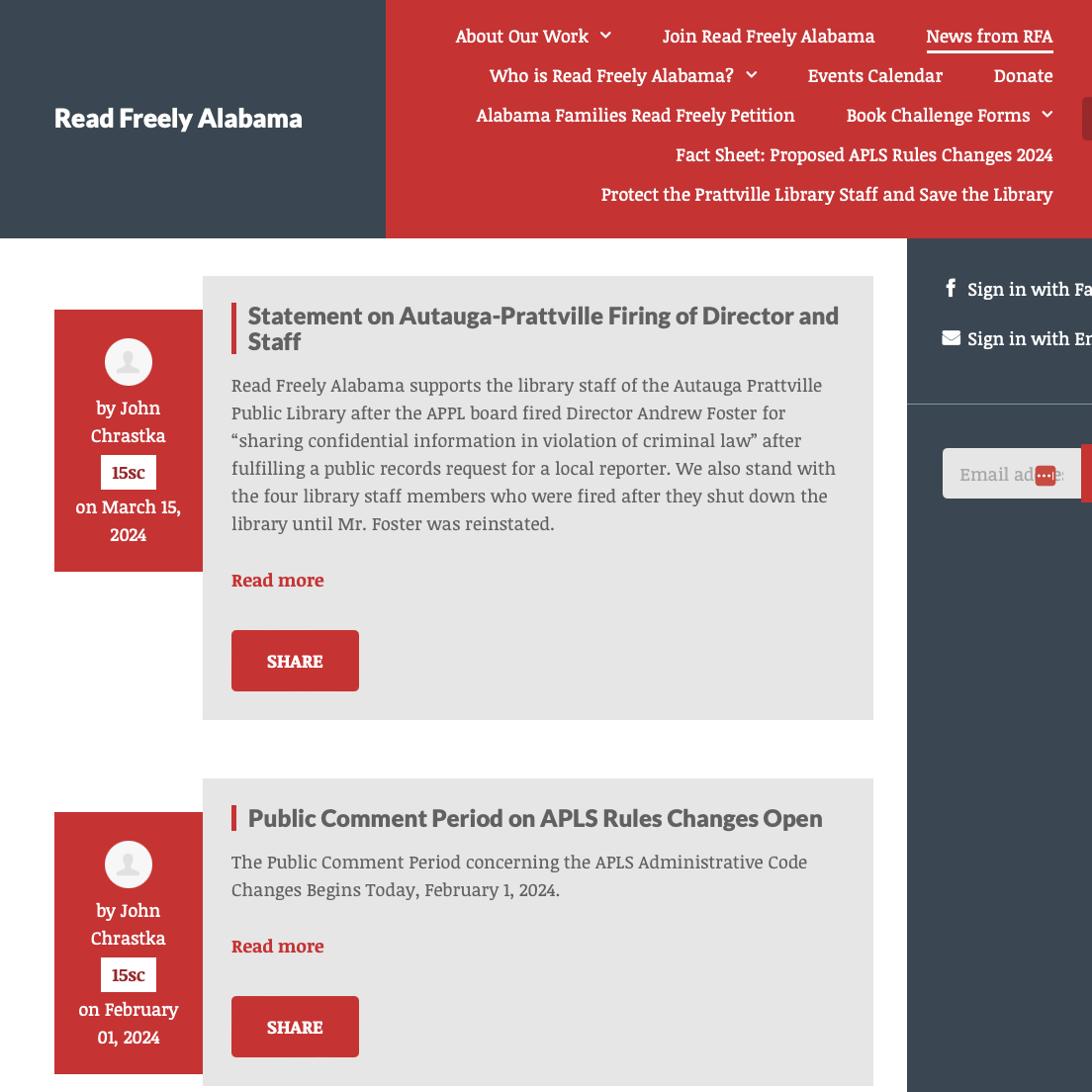
Since that reporting there is more evidence of ALA's control of Read Freely Alabama that goes to supporting this is sham litigation.  Here is the web page for news from Read Freely Alabama (RFA) and notice seven out of eight news stories are written by John Chrastka.  He's from ALA (via ALA's group called EveryLibrary, as I reported here: "Library Boards Trained to Lie by ALA; Banned Books Wedge Issue Adopted by White House" https://safelibraries.blogspot.com/2023/06/library-boards-trained-to-lie-by-ala.html


ALA is writing the news for Read Freely Alabama and the website has seven out of eight articles written by ALA's Chrastka:
Other web pages directly reference EveryLibrary, like "About Our Work":
The "Donate" page links to yet another ALA/EveryLibrary web site:
By the way, also in paragraph eight of the complaint the plaintiff asserts it is "volunteer-run."  Oh no.  It gets money from ALA via EveryLibrary, according to what ALA itself revealed, and it gets a ton of services for free.  We can call them "volunteer" but they are really getting what's needed to community organize and fundraise while local citizens who support the defendants and community children are left in the dust.  And ALA does this in community after community across America.  Governments get hundreds of emails already prewritten by ALA.  People show up by the dozens after having been astroturfed by ALA.  It's sort of like library policy by bullying.  So "volunteer-run" is intentionally misleading.  The people providing the community organizing platforms aren't volunteers, they are paid.

In summary, this is an ALA effort, wrapped in an Alabama veneer, filed with a federal court, hiding that Chicago's American Library Association, the real plaintiff here, has no standing itself to bring such litigation before the Court.  It's sham litigation by ALA, and an astroturfing escalation in ALA's war on children in America.

Liberati legunt sine restrictione in the graphic logo upper right means "free to read without restriction."  That's Chicago ALA's goal, not the goal of the Autauga-Prattville Public Library Board of Trustees who acted within the law to carry out the goals of the local citizenry to whom they answer, not the Chicago Way.  Let's hope justice is done and this sham litigation is closed.  

Besides, even ALA's Read Freely Alabama says, "We trust librarians to partner with parents to ensure developmental and age-appropriate access to information and books."  So even Read Freely Alabama really stands for Liberati legunt cum restrictione, free to read with restrictions, like "developmental and age-appropriate access to books."  That's nearly exactly what the Autauga-Prattville Public Library Board of Trustees wants and set as policy.

There's literally no case here, sham litigation or not.