Public awareness of crime, sexual harassment in libraries, and inappropriate books and web sites in schools due to American Library Association policy. ⚖️
The biggest mistake is codifying the American Library Association's so-called "Library Bill of Rights."
As previously reported, the Library Bill of Rights incorporated Marxist ideology that it's "age" discrimination to keep children from educationally unsuitable and pervasively vulgar material in schools. Now such materials have spread to schools nationwide via school librarians and only school librarians. See:
Even so, in the final analysis, I agree with Dan that challenges should not be completely forestalled and I find the legislating of a professional code like the Library Bill of Rights to be curious and unnecessary. The permanent ban on challenges to library materials silences the voice of dissent in the library’s community. It is a bully move by the ALA, it seems to me, and seeks to unbalance the scales in favor of a professional class deemed to know better what children need than parents do.
Finally Getting Media Attention
Well I'm happy to see this issue is finally getting some media attention. Church Militant has just published a scathing report on ALA's efforts to codify the "Library Bill of Rights," picture top right, and I highly recommend reading the whole report:
SPRINGFIELD, Ill. (ChurchMilitant.com) - Illinois is set to enshrine the corruption of children into law, thanks to its collusion with the Marxist-led American Library Association.
The proposed legislation, House Bill 2789, has passed both the House and the Senate and is now awaiting the signature of Illinois Gov. J.B. Pritzker. Among an array of legal amendments and declarations, the bill requires that all public libraries must adopt the so-called Library Bill of Rights or be denied state funds.
Pritzker and the radical Democrats running the state frame the bill in glowing terms, spinning it as an anti-censorship measure to advance the so-called ideals of diversity, equity and inclusion.
"I look forward to signing HB2789 to fight back against book bans," the governor recently said. "Illinois children shouldn't be kept from learning about the realities of the world."
Illinois Secretary of State Alexi Giannoulias, who also serves as state librarian, drafted the bill. The card-carrying member of the ALA referred to the passage of the bill as a "triumph for our democracy" as well as a "great victory for future generations to come."
Giannoulias, who has been assisted up the state's political ladder by Barack Obama, added, "Unfortunately, a scourge of censorship is polarizing and disrupting communities throughout our country; it has also threatened the safety of our amazingly dedicated librarians, the likes of which they have never seen before."
The Library Bill of Rights is a sort of ALA manifesto, declaring that seven basic policies should guide the services of public libraries and librarians. Adopted in 1939, the document is now being used to fundamentally transform the public library system, which is now under the leadership of Marxists.
Deborah DeGroff, a homeschooling mother and an authority on children's literature, has been puzzled by the increasing influence of the ALA's bill of rights.
The author of Between the Covers: What's Inside a Children's Book? told Church Militant, "I have questioned this for years. Who penned this list of rights? Which power gives them legitimacy?"
Critics of the Illinois bill and the ALA's bill of rights point to its dangers and deception.
Library watchdog Dan Kleinman has been scrutinizing the ALA's decades-long maneuvers to corrupt children.
In an article posted on his blog, SafeLibraries, Kleinman exposes article VII of the bill of rights as radical finagling of the ALA to establish age as a morally irrelevant issue.
Article VII states, "People, regardless of origin, age, background, or views, possess a right to privacy and confidentiality in their library use."
Kleinman comments:
A small group of librarians just decided to add the word "age" to their "Library Bill of Rights" that they had previously made up. They were enamored with the anything-goes-at-any-age views of a 1960s radical sociologist named Edgar Friedenberg who wanted equality of rights between adult and child library uses. So they added the word "age." You see, before then, everyone knew you don't allow children school library access to inappropriate material. We all know it now too, we just let the librarians bully us into thinking it's a First Amendment right when it isn't.
Kleinman, whose blog is dedicated to raising "public awareness of crime, sexual harassment in libraries, and inappropriate books and websites in schools due to American Library Association policy," sounded the alarm about the dangers of Illinois House Bill 2789. He told Church Militant:
Codifying the Library Bill of Rights into law is like embedding the Marxist viewpoint that children and adults should have the same sexual rights in order to pervert the children. [It] will be the biggest mistake ever when it comes to parents, and their children being sexualized in public schools. The Library Bill of Rights is a "camel's nose under the tent" situation for sexualizing children. It's because it basically says anything goes. ... If that becomes a law, it's going to be awful.
The firebrand also had a lot to say about ALA's leadership pushing sexually inappropriate material for children under the guise of promoting diversity, equity and inclusion:
They know this material is sexually inappropriate for children, but they are trained by the director of the [ALA's] Office for Intellectual Freedom [Deborah Caldwell-Stone] to "reframe" (that's her word) this material as diversity, equity and inclusion. So they know the material is inappropriate. ... And the law says that you cannot remove material because it contains diversity, equity and inclusion. That means you cannot remove any sexually inappropriate material whatsoever—that's the goal of the law. These people have been sexualizing kids for over 50 years.
One piece of so-called children's literature taking center stage in discussions in Illinois and elsewhere is Gender Queer. The book was given an Alex Award from the ALA in 2020 for its appeal to teens aged 12-18.
The sexually graphic, comic-book-style memoir includes depictions of sex acts and vulgar language, befitting Pritzker's plea for books "about the realities of the world." It is just one of the thousands of such books that Illinois libraries will have to keep on their shelves to receive state funds.
DeGroff points out that it's not just sexually inappropriate pieces that the Marxists are promulgating to corrupt children. The author points to Brave Girl: Clara and the Shirtwaist Makers' Strike of 1909, a book suggested for 4–9 year olds that teaches young children to be social justice warriors.
Another example DeGroff points to is I Look Up to Ruth Bader Ginsberg, which is intended for children ages 1 and up. A blurb for the board book on Amazon reads, "It's never too early to introduce your child to the people you admire! This board book distills Ruth Bader Ginsburg's excellent qualities into deliciously illustrated little baby-sized bites, with text designed to share and read aloud."
DeGroff asks, "Whether someone is a fan or not of the former Associate Justice of the U.S. Supreme Court is not the issue. But why are we reading this to the youngest children?"
Once Gov. Pritzker signs the bill, HB2789 will take effect on Jan. 1, 2024. It will provide a template for other states to follow or resist.
Have you noticed school children have been inundated with educationally unsuitable or pervasively vulgar school books nationwide? Librarians are working to pass legislation to ensure schools retain such materials despite United States Supreme Court rulings and common sense, precisely to use the power of the state to stop parents from complaining to school boards about such materials.
It is a very dangerous development in the war to s3xualize children, it must be stopped, and this post will detail how a small group of people made up and promoted the claimed "right to read," precisely to cut off parents and impose their own worldview on America. Once that is realized, no parent or legislator will want legislation that would codify this radical foothold on the American education system.
Indeed, the ultimate way to stop this is to get on school and library boards, remove all references to the "Library Bill of Rights," stop any librarian interaction whatsoever with any current library association, then legally remove all educationally unsuitable material from schools, the way it used to be before librarians imposed their made-up rules on everyone. It's the librarians who are the true minority, not the parents.
Here's the story I just read that spills the beans on American Library Association's attempt to legislate their 1960s radical view of age discrimination:
Eadopt the American Library Association's Library Bill of
25
Rights that indicates materials should not be proscribed or
10300HB2789ham001
- 3 -
LRB103 29629 AWJ 58578 a
1
removed because of partisan or doctrinal disapproval or, in
2
the alternative, develop a written statement declaring the
3
inherent authority of the library or library system toprovide
4
an adequatecollectionstockof books and other materials
5
sufficient in size and varied in kind and subject matter to
6
satisfy the library needs of the people of this stateand
7
prohibit the practice of banning specific books or resources.
This legislation will codify the "Library Bill of Rights" in Illinois and become the model legislation for nationwide codification.
So let me explain a general overview of whence comes the "Library Bill of Rights" and how the word "age" got added that American Library Association hopes becomes law. Then you'll know why this legislation must be defeated by any means, or the s3xualization and indoctrination of school children will become set in stone and there won't be any means whatsoever to stop the onslaught. The First Amendment right to seek redress of governments will be overturned by this legislation, as will US Supreme Court precedent. Redress will be gone. Parents children will be s3xualized. Game over. Marxists win.
The @ALALibrary is the problem. “Age” is now equated with other aspects such as background or views with no mention of what may be inappropriate. This is why they call all challenges a “ban” or “censorship”. pic.twitter.com/4bkixBmWpK
However, the Code of Ethics of the Library Bill of Rights is not a federal statute, but is promulgated by the American Library Association. The Library Bill of Rights is an unambiguous statement of principles that should govern the service of all libraries. While the documents represent the policies of the American Library Association, there is nothing to indicate that there would be a private cause of action based upon a violation.
Third, the "Library Bill of Rights" is just an aspirational creed for librarians—so it should not be applied generally via law:
Wiegand, Shirley A. “Reality Bites: The Collision of Rhetoric, Rights, and Reality and the Library Bill of Rights.” Library Trends, Library Trends: The Library Bill of Rights, 45, no. 1 (Spring 1996): 75–86. https://hdl.handle.net/2142/8065.
This creed, albeit lacking in legal support, might provide inspiration to library professionals and would provide them with a standard which goes beyond First Amendment mandate. It might be incorporated into the employment contract for library professionals, but it would not represent the current state of legal principles.
Fourth, at least one library has already removed from its policies all references to the "Library Bill of Rights" precisely because its inclusion of the word "age" is so harmful to the children of the community:
Schaper, Arthur. “Big Victory: Wyoming Library Board Cuts Ties With American Library Association Over Graphic Children’s Books; Board Didn’t Back Down to Mob of Pro-LGBT Leftists at Meeting; Also Modified Library’s Mission Statement; And More to Come!; A Culmination of Hard Work by Wyoming MassResistance Parents.” MassResistance, November 6, 2022. https://www.massresistance.org/docs/gen4/22d/WY-Library-exits-ALA/index.html.
The Campbell County Public Library (CCPL) will no longer have any association with, nor be associated with The American Library Association (ALA) its affiliate organizations, subdivisions or subsidiaries thereof. No CCPL public funding will be used for any membership, training, informational services, or events sponsored by the aforementioned groups or any groups associated with them. CCPL policies will be adjusted to reflect the same.
Fifth and lastly, it is important to know that American Library Association has admitted it knows certain materials in schools are "s3xually inappropriate for minors," but it trains librarians to "reframe" such material as diversity and inclusion, before such matters even get to legislators. Yes, ALA is specifically targeting legislators for misinformation, and here we are, ALA is trying to get legislation passed to codify its "Library Bill of Rights." Read/watch:
But ultimately, we found that the thing that needs to happen most, and it needs to happen before these bills are introduced, is sustained uh messaging that reframes this issue um that uh that takes it away from the idea that these are inappropriate for minors, or s3xually inappropriate for minors, and promotes them as diverse materials and programming that are about inclusion, fairness, and protection of everybody's right to see themselves, and their families reflected in the books in the public library.
So librarians know such material is inappropriate for children, but they are still going to spread it just by "reframing" it, just by fooling people. Now these very same people want our legislators to pass laws codifying the reframing of inappropriate material that violates Board of Education v. Pico as "diversity" and "inclusion." Truly diabolical to fool legislators into allowing librarians to continue to harm children by making this "reframing" the law of the land.
Now back to the "Library Bills of Rights" and how "age" got inserted.
A small group of librarians just decided to add the word "age" to their "Library Bill of Rights" that they had previously made up. They were enamored with the anything-goes-at-any-age views of a 1960s radical sociologist named Edgar Friedenberg who wanted equality of rights between adult and child library uses. So they added the word "age." You see, before then, everyone knew you don't allow children school library access to inappropriate material. We all know it now too, we just let the librarians bully us into thinking it's a First Amendment right when it isn't.
Marxists in govt schools now have a powerful ally, the American Library Asso. (ALA). It has elected a new Pres., Emily Drabinski who describes herself as a “Marxist lesbian”. The ALA will now turn our libraries woke. As a librarian myself, I will be in the trenches fighting ALA!
To Xi Van Fleet @XVanFleet who experienced Marxist indoctrination first hand, Friedenberg looks like a Marxist because he believed parents have no authority over their children. That comes directly from the Marxist goal of abolition of family. It also comes from the Marxist goal of abolition of religion. When there is an absence of morality, there is no longer a difference between right and wrong. Therefore, anything goes in terms of books for children. See:
Why are school boards and the propagandists in the media defending rapists and attacking parents? The sobering answer to that question is that the abolition of family is essential to the successful infiltration of their ideology. If Marxists can abolish parental authority, the state can control the educational system—and ultimately society.
So this Marxist Edgar Friedenberg is the genesis of the word "age" in the "Library Bill of Rights." And now the American Library Association, itself Marxist, wants to get the "Library Bill of Rights" codified nationally. Should we allow that? Should legislators agree to that? If they do, what does that say about them?
But thanks to the out and open s3xual indoctrination of school children by school librarians using the "Library Bill of Rights" as both sword and shield, parents have finally began to wake up and have been successfully using US Supreme Court cases to get books like "Gender Queer: A Memoir" by Maia Kobabe and "All Boys Aren’t Blue: A Memoir-Manifesto" by George M. Johnson pulled from public schools.
American Library Association reacted by giving those books awards and creating "Unite Against Book Bans" to lie about the legal removal of educationally unsuitable material from public schools and to cast the parents as a small minority of religious nuts driven by dark money to take away the alleged right to read of students.
Part of Unite Against Book Bans involves legislative efforts, like asking your legislator loaded and deceptive questions, like, "Would you introduce or sponsor legislation that would prohibit government entities from banning books from local libraries and schools because of the content, ideas, or viewpoints expressed in the book?" and "Would you introduce or sponsor legislation that would protect librarians and educators for doing their job of providing a variety of age-appropriate reading materials to students?" Source: Unite Against Book Bans; Candidate Questionnairehttps://uniteagainstbookbans.org/wp-content/uploads/2022/06/UABB_CandidateQuestionnaire_02-ac.pdf
Those push questions exactly mirror the very law ALA seeks to get passed in Illinois. What a coincidence.
This legislation is so precious to ALA that it is funding school librarian Amanda Jones to sue parents for defamation, and in return Amanda Jones has asked her Louisiana legislature to pass laws to ban parents from challenging books. Another coincidence.
Moving forward, legislation is needed to protect your constituents against these types of unfounded, vicious attacks. I hope that you will not only speak up against their actions, but take action as a political leader to prevent this from continuing.
I myself have been named in the defamation lawsuit of another school librarian suing other parents, but I digress:
So let's get to the meat of the matter. Heard of the right to read for school children in schools? It's a "phantom right" perpetrated by American Library Association and other politically motivated groups, according to:
Koganzon, Rita. “There Is No Such Thing as a Banned Book: Censorship, Authority, and the School Book Controversies of the 1970s.” American Political Thought 12, no. 1 (January 2023): 1–26. https://doi.org/10.1086/723442.
Abstract:
What accounts for the persistence of school book banning controversies in the United States? In Island Trees School District v. Pico (1982), the Supreme Court ruled that book removal violates children's right to read, but school book challenges have only increased since then. I argue that Americans have been unable to put this controversy to rest because a misleading narrative of censorship framed the Pico case and has continued to frame the question since. That narrative depicted what is fundamentally a contest between competing adult authorities—educational professionals and parents—as instead a contest between children and adults. By reconstructing the development of this narrative by young adult authors and professional educators in the 1970s, I show that the invention of children's "right to read" in this period sought to discredit the legitimate democratic authority of school boards over curricular decisions in a way that left the conflict simmering and unresolvable.
This article is outstanding in a number of ways. It's well written, well researched, and it sheds light rarely seen elsewhere about the scam ALA plays on the American public. I may not republish it, but I do have permission to share it, so ask me if you would like a copy.
Here's what I learned from this article:
1
There's no such thing as a banned book. Children's "right to read" was invented to "discredit the legitimate democratic authority of school boards over curricular decisions."
2
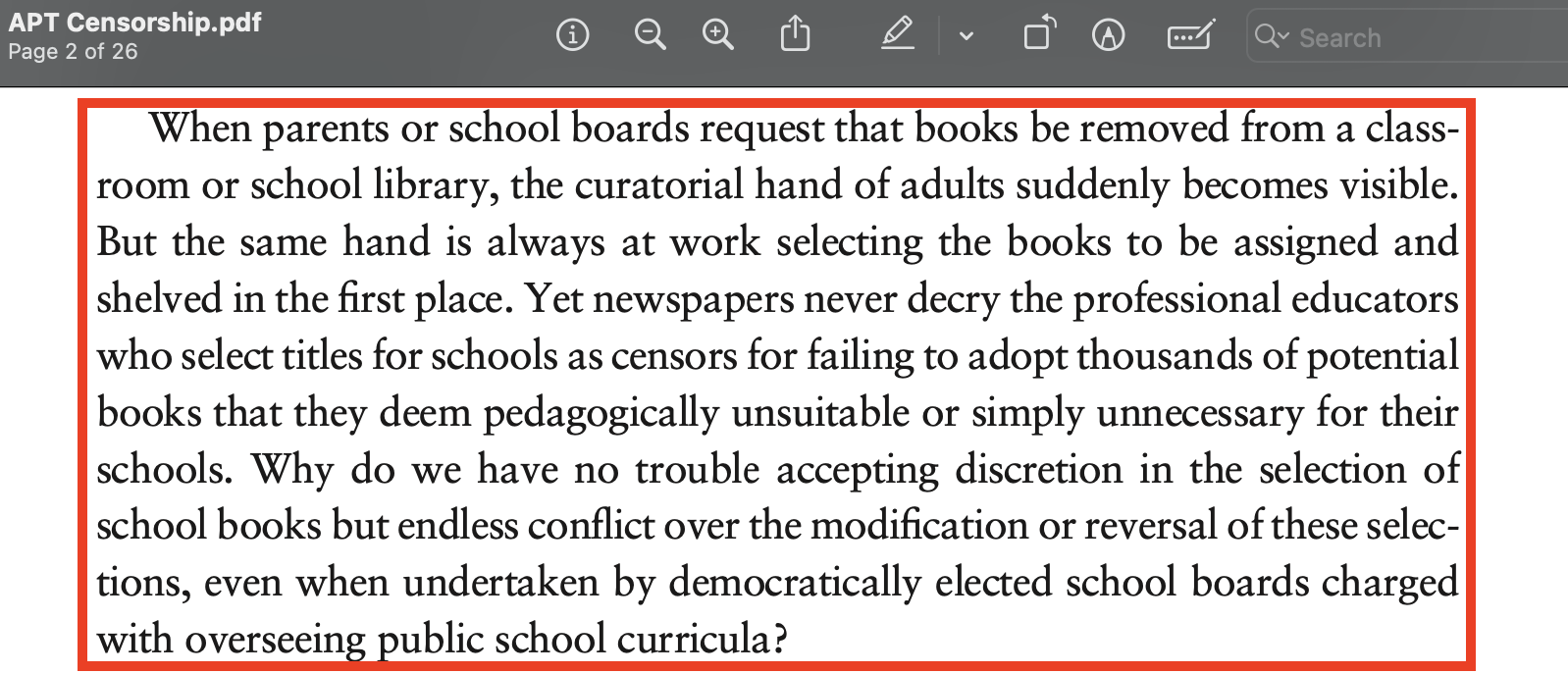
Newspapers always target parents in book challenge cases yet they never raise the issue of how the inappropriate books got into the library in the first place. Censorship is always the issue, never the initial selection of the material. Why is that?
3
The right in book challenges is always the "student's right to read," rather than how such a book was selected in the first place.
4
Everyone's always critical of the parents challenging the books. No one looks at the "motives of the educators who select the works that end up being challenged." So parents and school boards suffer high scrutiny, while everyone overlooks "the motives and authority of the writers and educators in generating and assigning the controversial work." And University of Houston Professor Rita Koganzon is going to correct that shortfall now.
5
Basically, "young adult" or YA literature "became a vehicle for professional educators to counter the reticent child-rearing practices of families and communities by treating them as obstacles to their children's healthy development." Sound familiar with all the gender transitions going on without parental involvement? So YA authors hopped on ALA's censorship train and "position[ed] themselves as alternative sources of education against families." Then when their books got challenged, "they transformed their case for promoting YA books through library and curricular selection into a case for students' rights to read them, thereby obscuring their own pedagogical purposes behind rights claims."
6
"[A]uthors of YA books understood their work as an intervention into child-rearing and a subversion of reticent parents unwilling to expose their children to controversial s3xual and social issues." "[L]ike YA writers, educators saw their efforts in competition with those of parents and communities, if not in outright opposition to them. Both writers and educators viewed families as failing to equip their children with updated views about s[3]xuality and hot-button social issues and saw YA books in school libraries and curricula as a means to counteract them." "Having forged a strategic alliance, YA writers and professional educators transformed their battle for educational authority against parents into a claim about the rights of children against censorship, not only obscuring the nature of the conflict but also undermining their own pedagogical authority in the process."
7
In the 1970s, there never was any "book banning." It was just a contest between educators/writers and parents/communities. The tussle between the "book banners" and the "book selectors" is the heart of the problem. The made-up "right to read" just obscured this tussle. It was "conceived as a means of discrediting parental dissent and shielding educators from community opposition." This "rights talk" is all made up to for the writers/educators/librarians to fool people.
8
A "series of questionable assumptions about family life and children's experiences" was used to justify the entire YA genre, such as the assumption "parents were unjustifiably concealing [information] from [their children]." Author Judy Blume was part of the problem. "YA books did not so much reveal the facts of life to adolescents as transform the facts of life from peripheral eventualities into the defining cultural dramas of adolescence."
9
"Only once YA books had popularized this cultural script as the healthy way to grow up and made the case for the necessity of openness and publicity around these issues could parental reticence around them be questioned and overruled on the grounds that it impeded healthy development."
10
YA book authors were averse to "moralizing." Parents who didn't want to "reveal 'adult secrets'" were now "downright negligent." "Refusing to moralize allowed YA writers to overcome their distance from readers and claim to relate to them better than their parents." "Indeed, it was not unusual for journalists to describe YA writers as children."
11
"But writers could not triumph over parental objections to their work on the authority of their kinship with children alone. They required the affirmation and assistance of another set of authoritative adults—the experts in education and development. Because the primary buyers of YA books were schools and libraries, 'youth novelists and librarians therefore have a common cause. We want the attention of the newest generation,' Peck proclaimed (1973, 205)."
12
x NOTE: BECAUSE I AM PREPARING THIS FOR A ZOOM MEETING TONIGHT, I DON'T HAVE TIME TO FINISH THE TEXT AND WILL GET TO IT IN THE FUTURE. I WAS BASICALLY SUMMARIZING THE GRAPHICS, AND THEY ARE ALL PRESENT. SO I WILL PUBLISH THIS NOW IN THIS INCOMPLETE STATE. FORGIVE ME!
[NOTE ADDED 7 MAY 2023: Here is a link to the YouTube video of the Zoom meeting referenced in the above paragraph wherein I discuss the contents of this post—and more:
BEEN WARNING PEOPLE LIBRARIANS WANT LEGISLATION TO S3XUALIZE SCHOOL KIDS + STOP PARENTS FROM RAISING THE ALARM. THIS STORY SHOWS @ALALibrary STARTING IN ITS HOME STATE TO PASS JUST SUCH LEGISLATION. #UniteAgainstBookBans
— Dan Kleinman of SafeLibraries® 🟧 (@SexHarassed) April 10, 2023
NOTE ADDED 11 APRIL 2023:
Another problem with the "Library Bill of Rights" is that librarians themselves intentionally mock it and ignore it when authors try to stop the s3xualizing of children, so why should it be codified if librarians themselves will toss it aside to meet their Marxist purposes? It's already provably arbitrarily applied. We can't have arbitrary legislation.