Showing posts with label PornInPublicLibrariesNotRequired. Show all posts

Monday, May 13, 2013

Ethics Complaint Against Library Attorney Ann Grossi for Misleading Roxbury and Montville, NJ

This is the substantive portion of an attorney ethics complaint being filed against Ann Grossi, Esq., Parsippany, NJ, via an Attorney Ethics Grievance Form; this is in response to "E. NATURE OF GRIEVANCE."  I am retired attorney Dan Kleinman, Esq., Chatham, NJ.  Under the New Jersey Rules of Professional Conduct (RPC), I am required by RPC 8.3(a) to report professional misconduct.  I confirmed with the Ethics Help Desk that I still have this duty despite being retired.  I am filing this ethics complaint in fulfillment of this duty.

This complaint is being filed soon after I learned that Ann Grossi is misleading a second community to allow pornography in its public library, among other things, and for that reason only.  It is mere coincidence that Ann Grossi is currently a Morris County Freeholder and that she is running in the 2013 Republican primary for Morris County Clerk.  As "SafeLibraries," I have been opposing those who mislead communities about Internet pornography in libraries for over a decade.  That activity should not be used as a defense by Ann Grossi to have my complaint dismissed.

Ann Grossi is or was the attorney for the Roxbury Public Library, Roxbury, NJ, and the Montville Public Library, Montville, NJ, at all times relevant to this complaint.  Over a long period of time, she has substantially mislead those communities by intentionally providing false legal advice, among other things.  The intention to provide false legal advice is revealed by her continuing to provide the same false advice to different clients even after being advised of the falsity of her legal argument, the maintenance of the same false library policy after she admitted the policy would be reviewed, and her repeated refusals to respond substantively to requests from the media or others regarding her false advice.  From at least 2011 to present, she advises that public libraries may not block Internet pornography as that would violate the First Amendment.  That is legally false, and it is a US Supreme Court case that says the exact opposite, as discussed below.  She is advising communities the exact opposite of what the US Supreme Court says.  As a direct result of her misleading various communities in the course of her legal representation, library employees and patrons including children remain exposed to pornography and its harms and the effects upon people directly or indirectly via criminal activity of porn viewers in a manner that might not have occurred but for the false advice.  Also, municipalities are not properly advised of potential liability for failure to block pornography from libraries.

These communities want to exclude Internet pornography from their public libraries but, on advice of counsel, they do not.  I have been informed of this by people in both communities.  In one case a recording of a public meeting in which I appeared makes this evident.  Only Ann Grossi stands in the way of legally ridding these libraries of Internet pornography.  Ann Grossi accomplishes this by providing false legal opinions and by not providing accurate information that would support the libraries ability to block porn and keep it blocked even after a request to unblock and the municipalities ability to prepare for liability that sometimes results from Internet pornography in public libraries.  Libraries and municipalities have been successfully sued for sexual harassment arising out of the failure to filter out pornography, but Ann Grossi fails to advise of this.

Libraries and municipalities are mislead by Ann Grossi in the course of her work as library attorney into believing patrons have a First Amendment right to view pornography in public libraries.  Librarians who mislead their communities in this fashion suffer few if any consequences, but attorneys have ethical duties that must be followed.  As will be explained below, it is possible Ann Grossi has violated the various rules by clear and convincing evidence, including:  RPC 1.2(d): she knew she was advising the libraries to act in a fashion that exceeded the bounds of law, unless such law provides for Internet pornography, which it does not; RPC 4.1(a): she made a false statement of law to a third person, and RPC 8.4(c): she engaged in conduct involving dishonesty, fraud, deceit or misrepresentation.  Ann Grossi's violations of these rules raise a substantial question as to her honesty, trustworthiness, or fitness as a lawyer in other respects.  Worse, the communities are still suffering from her actions and omissions as she remains active in both communities, to my knowledge and belief.

Turning now to the specifics, in 2000, the Children's Internet Protection Act [CIPA] [FN 1] was enacted by the United States Congress and signed into law by President Clinton.  CIPA required Internet filtering in public and school libraries under certain circumstances.  CIPA's constitutionality was challenged by the American Library Association [ALA] and the American Civil Liberties Union [ACLU], among others.  The United States Supreme Court [SCOTUS] ruled in US v. ALA, 539 US 194 (2003) [FN 2] that filtering out pornography from public libraries is constitutionally sound since libraries are quasi public fora, not open public fora.  The Court determined that "public libraries' use of Internet filtering software does not violate their patrons' First Amendment rights...."  Since that time, the ALA has worked actively to thwart the effect of CIPA, according to CIPA's author, Ernest Istook, who wrote in 2012, "Although many libraries now apply CIPA, others - encouraged by lawyers for the American Library Association - deliberately reject federal funds to avoid the requirement of filtering patrons' access to the Internet.  Unconfirmed reports claim a third of our public libraries are using this tactic. [FN 3]"  It is "a strategy promoted by the American Library Association, which regards pornography as just a routine aspect of protecting the First Amendment." [FN 3]  By the way, neither the Roxbury nor the Montville library obtain any CIPA funding [FN 4].

On 25 June 2011, News 12 NJ published "Access to Pornography at Libraries Raises Concerns" [FN 5] regarding children exposed to pornography on computers in the Roxbury Public Library, Roxbury, NJ.  The article states, in the context of viewing pornography, "Officials at the library say they ... cannot censor what people watch because it would be a violation of First Amendment rights."  That is false given US v. ALA.  I took action to advise the community that the library officials were wrong, including writing a letter advising about US v. ALA and appearing before the Roxbury Township Committee Meeting, 28 June 2011 [FN 6].  "We are waiting for our attorney on what can and what cannot be done," said one of the Committeemen.  Another said, "what I can tell you is that our attorney has looked at [the letter I wrote], we do have a separate library attorney.  She told us we are in compliance with the rules as they are written in New Jersey and we are, we should be fine with those rules at this point.  I'm not in favor of pornography in the library.  I reached out to our attorney and asked her what forum are we considered, whether it's quasi or open public, so I'll wait for her answer, and to let me know."  The Roxbury Public Library's attorney was Ann Grossi.

On 6 August 2011, News 12 NJ wrote a story entitled, "Morris Co. Man Wants to Make Library Computers Safe for Kids" [FN 7] wherein Ann Grossi is reported to have said she is reviewing Roxbury library policy.

Later, New 12 NJ attempted to set up a debate between myself and Ann Grossi but she refused to appear.  So only I was interviewed in a broadcast aired 5-6 November 2011 [FN 8].  Ann Grossi, the issue of public library pornography, and her legal advice for Roxbury is discussed.  She is quoted as saying in June 2011, well after US v. ALA from 2003, "if the library attempts to restrict access, regardless of how offensive, it would be a violation of the First Amendment of the Constitution of the United States."  In August 2011, she is quoted as saying "the library is in the process of reviewing its policy and practices surrounding the use of the Internet."  News 12 NJ tried to get Ann Grossi to explain what she meant by that but was unsuccessful in that effort.

The Roxbury Public Library last amended its Internet Use Policy on 29 August 2012 [FN 9].  It contains statements such as the library "cannot protect individuals from information and images which they might find offensive or disturbing," which is false as even the ALA now admits library filters work [FN 10].  In italics, it says, "Libraries and librarians should not deny or limit access to information available via electronic resources because of its controversial content or because of personal beliefs or fear of confrontation."  True, but pornography is not "information," neither is a library empowered to provide it, as shown below.  Again in italics, it says, "Information retrieved or utilized electronically should be considered constitutionally protected unless determined otherwise by a court with appropriate jurisdiction."  This is false and misleading.  It is false because pornography, though constitutionally protected in certain forms and fora, may be legally excluded from public libraries, as US v. ALA explained.  It is misleading because, thanks to cases like US v. ALA and Bradburn v. NCRL [FN 11], the library knows full it may block pornography without having to get judicial review of each of the millions of porn sites available.  And getting such a review is an impossibility anyway.

These statements and accompanying ones indicate that the library policy has not changed significantly regarding the issue of public library pornography despite Ann Grossi's presumably having reviewed the policy as she stated.  Instead, the policy continues to ignore US v. ALA, and the Roxbury community continues to be exposed to the harm it is legal to curtail.  So the community that praised my assistance and said, "I'm not in favor of pornography in the library," has ended up with substantially the same legally false policy as when the matter first arose, and Ann Grossi's misdirection is likely the main reason.

On 19 April 2013, the Montville Patch published a story about the Montville Public Library, Montville, NJ [FN 12], stating, "Mayor Tim Braden noted that ... the library cannot entirely restrict patrons from looking at pornography ... as it would be considered restricting their rights."  Seeking to learn who might have misled the Mayor, I learned that Ann Grossi, the Roxbury Public Library's attorney, was also the Montville Public Library's attorney.  I have asked Montville and the library what Ann Grossi advised [FN 13] [FN 14] but have gotten no substantive responses based on those requests.  I even asked Ann Grossi directly via email.  Her response was that I should "cease and desist" from emailing her Morris County Freeholder email address.

I have learned that Ann Grossi did indeed advise someone involved in the Montville matter that the First Amendment protects pornography in public libraries, but I am awaiting permission to make that conversation public.  As in Roxbury, I have been asked to help the community exclude Internet pornography from its public library.

In Roxbury, Ann Grossi waited for the media storm to blow over then left the library policy the way she wanted it.  In Montville, this being her second bite at the apple, I am reporting her actions for the determination of possible ethical violations.  If such violations are found, that may go a long way toward Roxbury and Montville restoring law, common sense, and community standards to their public libraries.

The law as presented in US v. ALA and Bradburn v. NCRL is one thing, but is there relevant New Jersey library law?  Yes.  Libraries are almost always created by some legal instrument.  They are granted powers and may act autonomously from local governments in accordance with those powers.  This is done to prevent political control.  If they exceed those powers, local governments are free to stop such ultra vires activity without fear of piercing the library's shield of autonomy.  For example, if a library set up a massage parlor, that business could be shut down by the municipality without piercing the veil of autonomy a library enjoys for carrying out the activities of the library.  In other words, simply because a library has a shield of autonomy to perform any action consistent with the legal instrument that created it, it does not enjoy that shield if it were to act outside the law.

Turning now to the actual law of libraries in New Jersey [FN 15], they are created under NJS 40:54-1 which states, "Any municipality may, in the manner hereinafter provided, establish a free public library within its corporate limits."  Also, such libraries "shall be governed by the provisions of this chapter."  When it comes to the powers of the library board of trustees, NJS 40:54-12 says they may do anything a library is expected to do, "and generally do all things necessary and proper for the establishment and maintenance of the free public library in the municipality."  A massage parlor is neither necessary nor proper for a library, so a library board may not provide for a massage parlor, and if it does, it is acting outside the law.  In such a case, the municipality has the right and duty to stop such ultra vires activity.  Indeed, if harm results from such activities and the municipality failed to take action to stop it, the municipality may become partially liable for the harm.

NJS 2A:53A-7.1 grants immunity from liability for library trustees who are acting within the law circumscribing their duties, it is specifically does not grant immunity to those acting outside the law.  "Nothing in this subsection shall be deemed to grant immunity to any person causing damage by his willful, wanton or grossly negligent act of commission or omission."  Running a massage parlor, for example, would likely not protect trustees from liability resulting therefrom.

So libraries might act outside the law, and doing so may lead to legal liability for libraries and municipalities, let alone grave consequences for those harmed by any resulting damage.

Pornography is neither necessary nor proper for a public library, according to US v. ALA, common sense, community standards, etc.  The SCOTUS case reveals pornography has been consistently excluded from public libraries and for good reason.  This is an example of how US v. ALA applies to all libraries, not just those receiving federal funding.  Something that is consistently excluded from public libraries for centuries is neither necessary nor proper for public libraries, neither is it an essential public service.  Under NJS 40:54-12, a library is not empowered to provide pornography as it is neither necessary nor proper for a public library.  Library trustees who allow the library to act outside the law may be held liable for damages under NJS 2A:53A-7.1.  A municipality that does not stop a library from acting outside the law may also be liable, and if it forces a library to act within the law, it is not piercing the library's veil of autonomy to act within the law.

Indeed, despite library policy claiming the library must be held harmless for any damage, several libraries have been paying very large settlements as a result of sexual harassment cases filed by librarians harassed as a result of library policy allowing pornography for claimed First Amendment reasons despite the law [FN 16].  For example, one harassed librarian was told, "if you don't like it leave."  She received a $150,000 settlement a week before the beginning of her trial against Birmingham, AL.  Ann Grossi does not reveal this.  If library boards knew *not* filtering pornography was resulting in major litigation and big settlements for sexually harassed librarians, that might convince them to filter out porn.  Ann Grossi has a duty to reveal this.

By advising that libraries are open public fora that may be sued under the First Amendment for filtering out porn, something which has not happened (although a few libraries have been sued for filtering out other material such as information about Wicca) and *not* advising that libraries are sued successfully for sexual harassment as a result of *not* filtering out porn, Ann Grossi substantially misleads those communities into allowing the very thing they are seeking to curtail but are afraid to do so without attorney approval.  Librarians may do this with impunity but attorneys have ethical and professional obligations that must be met.

Her actions not only reveal conduct involving dishonesty, fraud, deceit or misrepresentation, but also leave communities exposed to the very harm it is legal to prevent,  She does this in a substantially similar fashion to what the CIPA author said is happening in a third of American libraries.  As evidenced by the above, Roxbury and Montville will continue to be forced to allow pornography in their public libraries so long as Ann Grossi continues to act as library attorney.  In other words, Ann Grossi's misconduct not only occurred in the past, but it is a continuing and present danger to the Roxbury and Montville communities, particularly library employees, patrons, and their children, let alone the exposure to liability of the library and the municipalities themselves.

Librarians may be promoting "a strategy promoted by the American Library Association, which regards pornography as just a routine aspect of protecting the First Amendment," as the CIPA author said [FN 3], but that does not mean library attorneys who are held to a professional and ethical standard can follow that same strategy with impunity.  As the library attorney, Ann Grossi has the power to force her will on Roxbury and Montville, and, given her continuing actions and the essentially unchanged library policy in Roxbury that perpetuates her misinformation, it appears only her own Office of Attorney Ethics can act to stop her.


FOOTNOTES IN SUPPORT OF ETHICS COMPLAINT RE ANN GROSSI, ESQ.

FN 1  http://www.fcc.gov/guides/childrens-internet-protection-act
FN 2  http://laws.findlaw.com/us/539/194.html
FN 3  http://safelibraries.blogspot.com/2012/02/cipa-author-exposes-ala-deception.html
FN 4  http://www.usac.org/sl/tools/commitments-search/default.aspx
FN 5  http://prod.news12.com/NJ/topstories/article?id=285187

An Internet cache of the site is available here:
http://webcache.googleusercontent.com/search?q=cache:e1zbldFK8sUJ:prod.news12.com/NJ/topstories/article%3Fid%3D285187+&cd=1&hl=en&ct=clnk&gl=us

Under US Copyright Fair Use provisions, I provide the text but not the video:

(06/25/11) ROXBURY - Lori Bradley was at the Roxbury Library with her son when he pointed out someone viewing pornography on one of the public computers.
Bradley says she was shocked that someone could do that especially in such close proximity to children and have access to it through taxpayer dollars.
Officials at the library say they have a policy to ask people to stop if they are becoming disruptive, but cannot censor what people watch because it would be a violation of First Amendment rights.
Bradley hopes that this and other incidents will force the library to move computers away from the busier parts of the library to keep the inappropriate images away from children's eyes.

FN 6  http://dl.dropbox.com/u/32156878/RoxburyNjTwpCouncil28June2011.mp3
FN 7  http://www.news12.com/articleDetail.jsp?articleId=288797&position=1&news_type=news

Under US Copyright Fair Use provisions, I provide the text but not the video:

(08/06/11) ROXBURY - After a woman complained about pornography being accessible through the computers at the Roxbury Public Library, a Morris County man has made it his mission to make libraries safe for children.
Dan Kleinman, the founder of the website safelibraries.org, says his goal is to protect children from pornography on library computers in New Jersey.
The U.S. Supreme Court ruled in 2003 that a library using filtering software does not violate a patron's First Amendment rights.
Library officials say that they are reviewing their policies regarding patrons' use of the Internet.

FN 8  http://dl.dropbox.com/u/32156878/DanKleinman-KaneInYourCorner-News12NJ-5Nov2011.wmv
FN 9  http://www.roxburylibrary.org/pdf/PolicyManual/Internet%20Use%20Policy%20-%2008292012.pdf obtained from http://www.roxburylibrary.org/policies.html
FN 10  http://safelibraries.blogspot.com/2012/02/ala-admits-library-filters-work-barbara.html
FN 11  http://safelibraries.blogspot.com/2013/04/HowToFilterLibraryComputers.html
FN 12  http://montville.patch.com/articles/porn-watching-at-library-may-prompt-policy-changes
FN 13  http://safelibraries.blogspot.com/2013/04/AnnGrossiOPRA.html
FN 14  http://safelibraries.blogspot.com/2013/05/AnnGrossiOPRA.html
FN 15  http://lss.njstatelib.org/library_law
FN 16  http://safelibraries.blogspot.com/2012/08/SexuallyHarrassedLibrarianGets150K.html and see Adamson v. Minneapolis Public Library as examples


NOTE ADDED 14 MAY 2013:

I mailed out the ethics complaint today.

The Star-Ledger has reported on this matter.  See how Ann Grossi makes false personal attacks, false legal statements (such as libraries must unblock anything), and even mocks the ethics procedure itself by claiming I'm attacking her ethics and that an ethics complaint "means you've done something wrong.  I haven't done anything wrong":

NOTE ADDED 15 MAY 2103:

And did you notice, "Grossi said there is no 'bright-line rule' in the law when it comes to pornography at libraries."  Grossi is quoted saying, "I find people using the library to view pornography as abhorrent as any other person.  ....  But there is no bright-line rule on this, despite what Mr. Kleinman says."  Has she read US v. ALA?

US v. ALA is chock full with the long standing exclusion of porn from public libraries.  For example, it says, "Most libraries already exclude pornography from their print collections because they deem it inappropriate for inclusion. We do not subject these decisions to heightened scrutiny; it would make little sense to treat libraries' judgments to block online pornography any differently, when these judgments are made for just the same reason."  And when it discusses if privacy screens or moving the furniture around will solve the porn problem, it says no, and further, they would make the porn problem worse.  Yes, worse.  If it's that much of a problem, do you really need a "bright-line rule"?  It is obvious you can block pornography from libraries, you don't need a "bright-line rule."  It's like saying there is no bright-line rule for keeping pornography books out of public libraries.  Ann Grossi, even in the face of this ethics complaint, is still clinging to her misleading ways.

By the way, I attending the Montville Public Library meeting Monday night.  So did Ann Grossi.  Board member Mr. King is in favor of removing the porn.  Yet at one point he suggested moving the furniture might solve the problem of children viewing porn.  Ann Grossi sat there silently.  It was I who stood up, when allowed, and advised about what US v. ALA said about moving the furniture and how it makes things worse, not Ann Grossi.  Various board members then discussed how moving furniture or having separate adult viewing areas would make the problem worse, and because of me, not because of Ann Grossi.  It's a microcosm of the problem.

This insistance on a "bright-line rule" is an example of how Ann Grossi misleads communities who, because they rely on the attorney say so, will not act to block porn.  Ann Grossi does not reveal the true nature of what US v. ALA says about porn, and on the other hand, as exemplified here, she says there is no "bright-line rule."  This might be ineffective assistance of counsel if it did not appear so intentional and so in your face, especially given her personal attacks on me ... and the media.

I have learned she has threatened litigation against some media for reporting on the existence of the ethics complaint!  So, to her, public libraries are required by the First Amendment to allow porn so as to protect free speech, but the media should not have the free speech to report on the filing of an ethics complaint that evidences how she is misleading people on free speech.

All this is my opinion, of course, but that's why I filed the ethics complaint, for an official decision to be made, so hopefully the communities will finally feel free to ignore her advice and to effectively block porn from their libraries and, importantly, keep it blocked even if someone requests an unblock for porn.  Sure Montville has filters, for example, but they do no good if you ask to have them disabled then you watch porn.  No one else or no other group is in a position to stop Ann Grossi from misleading and harming communities or to convince the communities to stop following her faulty advice.  I'm hoping the Office of Attorney Ethics will help to resolve this issue in some manner.


NOTE ADDED 16 MAY 2013:

Further regarding Ann Grossi's claim that there is no "bright-line rule," she has one.  She gives legal advice with this rule and it is 100% false and it is the reason the Roxbury and Montville communities are afraid to act.  Her bright-line rule is, "if the library attempts to restrict access, regardless of how offensive, it would be a violation of the First Amendment of the Constitution of the United States."  The US v. ALA case, on the other hand, says, "public libraries' use of Internet filtering software does not violate their patrons' First Amendment rights...."

So when media reports, "Grossi said there is no 'bright-line rule' in the law when it comes to pornography at libraries," that is showing Grossi maintaining the same false front that misleads the communities and that led to the filing of the ethics complaint in the first place.  And she displays this after she is aware of the filing of the ethics complaint, making it even more egregious.

And when Grossi threatens litigation against the media to suppress its message about the filing of an ethics complaint, that may result in even further ethics violations that I have not reported due to their arising out of the filing of my complaint.  To my knowledge, that media source has not yet published anything about the ethics complaint.


SECOND NOTE ADDED 16 MAY 2013:

The Montville Patch now features a second story on the issue:


Regarding the article, yes, Montville has filters, but they need not be turned off to view porn, and Grossi does not advise of that.  Neither must they be left off after a person is found to be viewing porn, even if he bypassed the filter.  Actually, Grossi advises it is a First Amendment violation to block porn, and that is the exact opposite of what the US Supreme Court said.

As to the risk of litigation for blocking pornography, it has never happened since the 2003 US v. ALA case issued.  Not once, never.  Other cases such as blocking Wicca, yes, but not pornography.  But library after library is sued for the failure to filter out porn, sometimes repeatedly.  The ALA's claim that libraries might be sued for blocking porn has never been borne out.  On the other hand, the ALA fails to disclose that not filtering computers rings up big sums for sexually harassed librarians.  It's the exact same false tactic Ann Grossi uses.  The ALA has no duty to Montville.  Ann Grossi does, and she may have failed in that duty.  We'll see what the Office of Attorney Ethics says.

If anyone is willing to watch me and Ann Grossi debate and can arrange to set it up in an appropriate public forum for possible rebroadcast, I'm game.


NOTE ADDED 18 MAY 2003:

A third article features this case.  Let's be clear my filing of this ethics complaint has absolutely nothing to do with Ann Grossi's political activity despite her protestations.  Ann Grossi's own actions and omissions have led to the filing of this complaint.  Had Ann Grossi acted in the past to stop misrepresenting the law, and she was given numerous opportunities including those outlined and referenced in the body of the ethics complaint, the complaint would never have materialized:
"Grossi advises that the filter be turned off if requested…," reports the Parsippany Patch article.  She advises more than that.  She advises the First Amendment protects porn viewing in public libraries, as illustrated in the News 12 NJ stories I included in the ethics complaint.  That goes 100% counter to the US Supreme Court.  That she is crafting her words carefully now when speaking with the media does not make her possible failure to meet her ethical obligations go away.  Besides, Bradburn v. NCRL shows filters need not be turned off until after compliance with library policy is reviewed.

"'There is no fundamental difference between us on pornography,' Grossi told Patch.  'It is just issues of law that are different, and I am following the letter of the law.'"  No, Ann Grossi, there's a big difference, and no, Ann Grossi, advising 100% opposite of the US Supreme Court and failing to advise of Bradburn v. NCRL, New Jersey library law, etc., is not following the letter of the law.


NOTE ADDED 22 MAY 2013:

Yesterday I learned from the recipient of my ethics complaint that it indeed had been received.

For those interested, the following may be of interest:

NOTE ADDED 5 JUNE 2013:

The porn pusher prevails in the primary.  In Morris County, that likely means she will be the next County Clerk, and this despite the current County Clerk endorsing another candidate:


Saturday, March 24, 2012

Salt Lake Library Votes to Filter All Computers For Adults; Computers For Children Had Already Been Filtered; Public and Librarians Pleased; Pornography Put Librarians In an Uncomfortable Position

The title says it all, and notice the harried librarians love this as well.  Bravo, Salt Lake City Public Library, for installing Internet filters on all computers to block pornography and for exposing how to overcome the false fear of "accusations of censorship"!

Clearly this is not one of the one third of American libraries Children's Internet Protection Act [CIPA] author Ernest Istook says is controlled by the American Library Association [ALA].  And, as we know, it is perfectly legal to use Internet filters to block legal pornography from public libraries, and even the ALA now says filters work:


Wary of accusations of censorship inside institutions founded on principles of intellectual freedom, many library administrators for years relied on staff and patrons to ferret out unsavory elements who might abuse public Internet access for unsavory aims and images.

The Salt Lake City Main Library and its five branches have long filtered Internet access to computers in their children's sections. During a Thursday evening meeting of the library system's board, members voted unanimously to extend those same filtering capabilities to the entire network of computers available for adult use.

Advance notice of the impending decision generated no public comment, in person or otherwise, during the public meeting held on the Main Library's fifth floor.

"Frankly, I was a little surprised," said Kevin Werner, board president. "I was expecting to hear something."

In fact, the procedure was greeted as little less than a speed bump on the way to items the board greeted with far more interest, including next year's budget and plans to build two new branches in the Glendale and Marmalade neighborhoods.

The decision to filter Internet access harbored far more than the urge to protect children and other patrons.  In exchange for its compliance under the federal Children's Internet Protection Act (CIPA), the government will reimburse the Salt Lake City library system 80 percent of its costs for telephone and Internet services.  The library also becomes eligible for state funds in grant form, specific to technology projects, administered by the Utah State Library.

At a time when circulation numbers for physical materials — books, DVDs and periodicals — are flat, but demand for Internet access, e-books and other downloadable content has soared, that savings is nothing to sniff at.  It is money the library system can use to reinvest in the future, said library spokeswoman Julianne Hancock.

"This year, our federal discounts on telecommunications services will result in about $80,000 in savings for telecommunications services," Hancock said.  "In future years, we will apply to be considered for additional discounts, but this gets us well on our way."

The downtown library has had intermittent reports of people using library computers to access pornography and other material harmful to minors.  The problem has never become chronic or unmanageable, but the responsibility of often monitoring patrons diverted staff time from other work. "It always put everyone in an uncomfortable position," Hancock said.

Deadline for installment is June next year, but it's estimated the filter will be installed by the end of this summer, she said.

For public libraries everywhere, Werner said, the struggle to keep current in the new digital world is a more significant concern than the occasional nuisance of patrons surfing the Web for obscene and offensive material.

"The filtering issue, while important," he said, "is really an issue outside the greater trend of how libraries are being transformed."

[NOTE BY SAFELIBRARIES, THE FOLLOWING COMMENT AT THE ARTICLE APPEARS TO COME FROM THE LIBRARY SPOKESWOMAN, AND IT IS SPOT ON:]

Hi!  It's Julianne from the Library.  The updated policy allows us to install a filter to block access to "visual depictions that are child pornography or obscene as defined by state and federal statues."  Additionally, adult patrons may request unfiltered internet sessions, as long as their internet use does not violate Library policies or federal or state statues.  We will be posting the policy the Library Board passed tonight soon on the City Library's website.


Monday, February 27, 2012

CIPA Author Exposes ALA Deception; Ernest Istook Who Authored Children's Internet Protection Act Calls Out American Library Association for Using Legal Tactics to Claim First Amendment Protection for Public Library Pornography Viewing, Causing Librarians to Be Indifferent and Leave Children Unprotected

CIPA Author Ernest Istook
Children's Internet Protection Act [CIPA] author Ernest Istook describes how the American Library Association [ALA] hides important information from communities in a manner that harms children all these years after US v. ALA, 539 US 194 (2003).  Previously, Library Director Dean Marney described how the American Library Association [ALA] uses "dogma" to mislead communities.  Now its the CIPA author himself.  When will people wake up?
Sadly, Seattle is following a strategy promoted by the American Library Association, which regards pornography as just a routine aspect of protecting the First Amendment.  But they generally omit an important qualifier:  When taxpayers are paying for the computers they have a right to insist that children are protected.
You think?
Although many libraries now apply CIPA, others - encouraged by lawyers for the American Library Association - deliberately reject federal funds to avoid the requirement of filtering patrons' access to the Internet.  Unconfirmed reports claim a third of our public libraries are using this tactic.  They should not be criticized for not tapping into the federal Treasury, but their motivation is worrisome.
Legal tactics?  A third of public libraries using these tactics?  Anyone want to continue to claim the ALA has little to no control over local public libraries?
Nobody should have the Seattle experience of shocking their children, nor of having librarians who are indifferent to the problem.
Now isn't that a shame?  "Indifferent" librarians?  Indifferent to children?

Not all are indifferent, and I am quietly building an organization of those who are not, but more on that much later.  Librarians willing to stand against harmful ALA policy, tactics, and indifference that endangers children may wish to contact me.  All will be kept confidential.

Now read this, by Ernest Istook, the CIPA author, and the source of the above quotes:


Libraries Need Not Expose Kids to Porn
The Heritage Foundation


PUBLISHED MONDAY, FEB. 27, 2012

Librarians can be strict.  In Seattle, for example, you can't eat, sleep, go barefoot or be noisy in a public library.  You can, however, "watch graphic porn on a public computer in front of kids," the Seattle Post-Intelligencer recently reported.

You don't need to be a literary expert to figure out that making computer porn available is not the highest and best use of limited public resources.  And certainly patrons, whose tax payments keep the doors open, deserve better than to have their children exposed to hard-core pornography.

As a former chairman of a metropolitan library system, the story from Seattle appalled me.  But it didn't surprise me at all.

Sadly, Seattle is following a strategy promoted by the American Library Association, which regards pornography as just a routine aspect of protecting the First Amendment.  But they generally omit an important qualifier:  When taxpayers are paying for the computers they have a right to insist that children are protected.

I know because I authored the federal law on this, and it has passed muster with the Supreme Court.  In 2003, the high court upheld The Children's Internet Protection Act (CIPA) in United States v. American Library Association.  Earlier federal attempts to address the problem had all been rejected by the court.

The 6-3 ruling affirmed the constitutionality of CIPA, which requires public schools and libraries that receive Internet-related federal funds to use blocking filters to restrict access to pornography.

The Supreme Court agreed that the Internet is "no more than a technological extension of the book stack."  The justices wrote that each public library has "its traditional role in identifying suitable and worthwhile material; it is no less entitled to play that role when it collects material from the Internet.  ...  Most libraries already exclude pornography from their print collections because they deem it inappropriate for inclusion.  ...  It would make little sense to treat libraries' judgments to block online pornography any differently."

Because "libraries cannot possibly segregate, item by item, all the Internet material that is appropriate for inclusion from all that is not," the Supreme Court agreed that using filters to exclude categories of websites is appropriate and constitutional.

Adults who so request may have the filter temporarily turned off, but this intervention gives librarians the opportunity to make sure no one is using an unfiltered computer in an area open to children and other patrons.

Although Congress' other approaches had been overturned, connecting this filtering requirement to receipt of federal funds was key to gaining Supreme Court approval, because use of government funds is commonly allowed to include restrictions.

Although many libraries now apply CIPA, others - encouraged by lawyers for the American Library Association - deliberately reject federal funds to avoid the requirement of filtering patrons' access to the Internet.  Unconfirmed reports claim a third of our public libraries are using this tactic.  They should not be criticized for not tapping into the federal Treasury, but their motivation is worrisome.

These libraries still rely upon public funds from the state or local level.  Lawmakers who provide that funding have an opportunity to protect children.  States and local governments can do so if they use CIPA as their model.  They can require that schools and libraries funded by local and state governments must protect children from Internet porn by installing these software filters.  No such filter is perfect, but they protect children and they help parents who want libraries to be safe places for their entire family.

Nobody should have the Seattle experience of shocking their children, nor of having librarians who are indifferent to the problem.

ABOUT THE WRITER

Ernest Istook, a fellow at The Heritage Foundation, served 14 years as a Republican congressman from Oklahoma.  Readers may write to him at:  The Heritage Foundation, 214 Massachusetts Avenue NE, Washington, D.C. 20002; Web site: www.heritage.org.  Information about Heritage's funding may be found at http://www.heritage.org/about/reports.cfm.

This essay is available to McClatchy-Tribune News Service subscribers.  McClatchy-Tribune did not subsidize the writing of this column; the opinions are those of the writer and do not necessarily represent the views of McClatchy-Tribune or its editors.

2012, The Heritage Foundation

Reprinted by SafeLibraries under US Copyright Fair Use §107.  Clearly, on SafeLibraries, this article is reprinted for educational use and community discussion, etc.


NOTE ADDED 3 MARCH 2012:

That OpEd was written by Ernest Istook, the author of the Children's Internet Protection Act.  It appeared in numerous outlets across the country.  Basically, he said the ALA is misleading many communities nationwide resulting in continued harm to children.  Exactly what I've been saying, by the way.

One would think the CIPA author saying the ALA is thwarting CIPA, particularly given the ALA's big loss in US v. ALA, would be a major story in honest media.

Predictably, not a single main stream library media source has covered that story.  The author of CIPA says the ALA is misleading communities on CIPA, and CIPA is central to the ALA and its so-called "Office for Intellectual Freedom," the heart of the ALA where it spends most of its money for lawsuits, and the library world is silent.  No articles in the ALA's own American Libraries?  Nothing in Library Journal?  School Library Journal, hello?

Nothing.

When you ignore a story so it WON’T have legs, that's a part of the propaganda game.  And Library Journal is independent from the ALA.  When an independent journal won't cover the story, as major a story to the library world as it is, that's evidence of intimidation, in my opinion.

By the way, above I called for people to contact me if they wished to band together to oppose harmful ALA policy, tactics, and indifference that endangers children.  Several have already done so.  Really, there will be only so much longer the ALA can help bury major stories about the ALA's own malfeasance.


NOTE ADDED 5 SEPTEMBER 2013:

As an apparent follow up to his written opinion, Ernest Istook went into further detail in an interview with Dawn Hawkins of Morality in Media.  He provides never before heard details on the legislative history of CIPA, the extent of ALA's propagandization, what can be done to wrest control of libraries from ALA and restore it to local communities, even recommending me as a "trusted source" on ALA control, and so much more.  Definitely a fascinating read:


Sunday, August 7, 2011

Turning the Tide on Library Porn; Predicted Excuses for Not Filtering All Library Computers

US v. ALA: library filters okay
It appears, at least in Roxbury, NJ, the tide is about to turn on a public library misleading its community by claiming the First Amendment requires public libraries to allow Internet pornography.  You see, a mother whose child saw the porn an adult was viewing on the library computer complained to the library, but it refused to help since it was following American Library Association guidance.  So she went to the media.  That was when the tide started turning.  Thank you, Lori Bradley.


News 12 New Jersey's Matt Murphy Gets the Ball Rolling

Ann Grossi's misleading statement
News 12 New Jersey produced an excellent report that caught my attention and I got directly and immediately involved in the Roxbury matter since I am in the same NJ county.  I provide details here: "Public Library Law Allows Porn Exclusion and Allows Governments to Ensure Same," including a link to Matt Murphy's original story on this issue.

Basically, I pointed out to the media and the local government exactly how the community was being misled, such as with the library attorney's claim of First Amendment protection for anything at all in a public library, whereas the US Supreme Court says, "public libraries' use of Internet filtering software does not violate their patrons' First Amendment rights."  Compare that to the graphic at right which is Ann Grossi, Esq.'s, misleading statement that basically says the exact opposite.  Personally, I find the US Supreme Court is more credible than Ann Grossi and more reflects common sense and community standards, and I'm in the same county as that community.


Tables Turning Against Public Library Porn

Now I learn my intervention may have turned the tide on library porn in Roxbury.  Be sure I'll be taking this message nationwide, that accurate information can enable communities to use legal means to protect citizens from harm, and that library misinformation will no longer be enough to lull people into obeisance.  And it is misinformation to advise a community the exact opposite of what the US Supreme Court says.


Library Attorney Singing Different Tune Thanks to SafeLibraries 

Ann Grossi sings a different tune
You see, the library's attorney is now singing a different tune.  See the video for yourself in yesterday's News 12 New Jersey report on the issue, namely:

Matt Murphy reports:
The 2003 US Supreme Court decision in the case of United States versus the American Library Association states, "public libraries' use of Internet filtering software does not violate their patrons' First Amendment rights."  In June, Roxbury Public Library board attorney Ann Grossi insisted restricting access would be in violation of the First Amendment.  But since my June story aired, she now says the library is in the process of reviewing its policy and practices surrounding the use of the Internet.

And what was the difference between June and now?  I appeared in a Roxbury Township Committee and told them that they were being misled on that very point and that they have the legal authority needed to require compliance with the law.  And one of the Committeemen is also on the library's board of trustees, and he clearly heard the other Committeemen favorably receiving what I was saying.


SafeLibraries Quotes From the Story

FYI, here is the totality of my quotes from yesterday's story:
  • "When the public's being told that libraries are open public forums where anything goes, including pornography, they are being misled."
  • "That's correct, you can't censor what people watch.  However, it's not censorship to keep pornography out of a public library."
  • "The Supreme Court says you can apply the book selection policy which keeps out pornography from the books over the Internet with the use of filters."
  • Dan Kleinman adds that many public libraries choose not to restrict adult content fearing a lawsuit by the American Civil Liberties Union.


Major Success for SafeLibraries

I view this turnabout as a major success for SafeLibraries, with the potential that the ideas I present may grow nationwide.  The emperor has no clothes.

Here again are those ideas written up as talking points:  "Public Library Law Allows Porn Exclusion and Allows Governments to Ensure Same."


List of Predicted Excuses for Not Filtering All Library Computers

There will be major obstacles in the way of a library such as Roxbury deciding to filter all computers.  But those major obstacles will simply consist of more propaganda and misdirection from the very people so successful at it previously.

Here is my list of predicted excuses and suggested responses:
  • There are so many other concerns that face libraries, such as funding, that something that occurs so few times is really not our focus now.  That's the "Oh look, there's a squirrel over there" defense, anything to take focus away from the issue.
  • US v. ALA only applies to libraries that accept federal funding.  That's the "We know better than you" defense.  In reality, the Court discussed the library issues first, then applied them to the federal funding issue.  Just because a library does not accept federal funding does not mean the case is otherwise of little value.  For example, is this of no value if a library accepts no federal funding for Internet access:
    "The interest in protecting young library users from material inappropriate for minors is legitimate, and even compelling, as all Members of the Court appear to agree."
  • Who's to decide what is and what isn't pornography?  That's the "Let's make believe US v. ALA doesn't exist" defense.  You see, 1) the Court addressed that issue and 2) if no one can decide what is pornography, then the entire case of US v. ALA is entirely without value, but that cannot be since US Supreme Court decisions are never to be interpreted in a way that makes them useless.
  • Filters don't work well, and privacy screens and acceptable use policies are much better.  That's the "Let's hope the people don't read US v. ALA" defense.  The Court said it is filters that work, not shoulder tap policies, not privacy screens, not recessed computers, and not moving computers. Further, extensive evidence shows nothings works as well as filters.  Media reports are even catching on and showing, for example, just how useless are "privacy screens."  And acceptable use policies?  Their self-policing, voluntary nature makes them essentially worthless.
  • Filters block "breast cancer" web sites and that's censorship.  That's the "Go for the emotional message so we can keep pushing our agenda" approach.  While overblocking breast cancer sites used to be true, it is no longer the case.  Quality filters properly maintained no longer filter out health-related information.
  • So few children are raped or molested in libraries, why don't you direct your legitimate interest to a place where more children are being hurt in that fashion and work there.  That's the "Compliment the person then misdirect them anywhere else" defense.  Lovely idea, but no dice, especially where the harm being done might be a result of the library's own failure to comply with library law by allowing an anything-goes attitude.
  • Libraries are protected by a shield of autonomy from governmental control.  That's the "Let's avoid the real issue" defense.  The real issue is not that the government seeks to invade the shield of autonomy.  It doesn't.  Rather, where the library has acted outside that shield, the government may require it to comply with the law.  And US v. ALA is right there with support for that.
  • Requiring filtering might cause people embarrassment and that would violate the First Amendment.  That's the "Don't look behind the curtain" defense.  US v. ALA addressed that issue and it is simply of no consequence.  Any library expert supporting any issue already asked and answered in the negative by US v. ALA as if it were never previously addressed is misleading you.
  • The library is in the process of reviewing its policy and practices surrounding the use of the Internet.  That's the "Go away" defense, depending on the circumstances.  They want you to allow time to pass and forget about the issue.  Of course libraries legitimately review policies all the time.  But sometimes it is just a means to delay things and only cosmetic changes will occur, if any, or useless alternatives will be proposed, like improved acceptable use policies, moving computers, or using privacy screens.  I suspect the Roxbury situation will be the latter and the government will need to intervene if filters are not proposed for every computer.  No way will Ann Grossi advise that it is perfectly legal to filter all computers and that all computers should be filtered, I predict.
  • SafeLibraries cannot be trusted because Dan Kleinman opposes pornography and is otherwise unfit or untrustworthy.  That's the "Saul Alinsky was here" defense.  Setting aside that not being true, the argument over the issue should not become ad hominem.  And I am not imposing my will on anyone.  Rather, I am suggesting people become educated, I am guiding people to that education, and US v. ALA is the bright line to follow, not SafeLibraries.  Leave me out of the story.  Local libraries laws may also come into play.  They trump American Library Association policy embedded in local policy any day of the week.
  • Censorship is a slippery slope.  That the "Let's make up a legitimate-sounding non-issue/strawman defense."  Simply put, no censorship is involved where, as the US Supreme Court said, "public libraries' use of Internet filtering software does not violate their patrons' First Amendment rights...."  Further, to the extent some librarian might take too long to unblock a site, US v. ALA has already made provision for that.  It is called an "as applied" challenge.  In all the years since the case was decided in 2003, there has never yet been an "as applied" challenge, to the best of my knowledge.
  • Handling ACLU lawsuits will be too costly for the government.  That's the "Deer Hunter" defense where they hold a gun to your head.  You'll never, ever hear them worry about lawsuits brought by victims of library harms and how such suits have a greater potential for monetary damages, like the near half million dollar Adamson v. Minneapolis Public Library case where library management allowed porn and the librarians suffered as a result.  If you follow the law, the ACLU will have no basis for bringing suit.  Like in Burlington County, NJ, the ACLU threatened suit over a book showing two boys watching two men having anal sex.  But the library merely applied the selection policy to the book, found it wanting, and removed it.  No ACLU suit occurred because the library followed the law and the ACLU did not bluff, in this case.  Consider also the possibility for treble damages against the ACLU for vexatious litigation where it bluffs.  Where the ACLU threatens suit based on legal theories it itself lost in US v. ALA, that is dirty pool.  But if such a suit gets filed with the court, that might be grounds for vexatious litigation.  Example.  Nampa, ID.  The library, after three years effort, put four books inappropriate for children in a location that required only adults to ask for them.  The ACLU sent a threatening letter and the ACLU attorney said the issue was embarrassment.  Embarrassment to ask for one of the books would violate the First Amendment, supposedly.  Within one week the city caved to the ACLU.  Three years effort down the drain.  For what?  For embarrassment.  For an issue the ACLU itself raised in US v. ALA and lost on years previously.  Sounds like dirty pool to me.  So do not be frozen by fear of the ACLU.  If you get such a letter, let me identify all the propaganda in it for you so you won't cave.
  • State law requires one terminal be left unfiltered.  This is a legitimate reason for not filtering all computers.  So long as you are not claiming certain federal funding, you should be okay.  Take a gander at this: "Michigan Libraries at Risk of Massive E-Rate Fraud; Michigan Library Privacy Act May Need Amending."


SafeLibraries Is Offering Assistance and Seeking Donations

Edison Public Library
Should anyone face these issues and suspect they are being misled, please contact me for guidance.  Basically, you have the legal right to choose to filter 100% of library computers, and government can require libraries to do so if they only realize their own power.  Leave one computer unfiltered and that will not solve the problem.

Should anyone wish to help fund my efforts, like paying for the gas to travel to the interview in Edison, NJ, yesterday morning or to investigate the Nyack Public Library, Nyack, NY, yesterday afternoon, please use the donate button on the bottom right of this blog post, and thank you so much.  It'll give me gas to go elsewhere.  And I hope to have my report on the Nyack library available soon.

Finally, here's that story I'm in again:

NOTE ADDED 7 November 2011:

I was on television:

Note: I am requesting permission to republish the broadcast as it shows an example of major library leaders intentionally misleading the public about Internet filters on public library computers then blaming whistleblowers for why they need not explain themselves.

While I am adding this note let me add the following:

Saturday, August 6, 2011

Public Library Law Allows Porn Exclusion and Allows Governments to Ensure Same

To prepare for a media interview, I put together a few talking points on why porn may be legally excluded from public libraries (see US v. American Library Association).  It gives a really quick overview of why governments may ensure public libraries are filtering out pornography even where the library refuses to do so.  Such information is completely absent from communities being misled to believe that porn in public libraries is a First Amendment right.  It isn't.

Here's the URL for my media interview talking points:


And now, presenting for your enlightenment:


Sunday, July 24, 2011

Porn and Sex Abuse In Our Public Libraries: Public Library Porn Harms Children, Patrons, Librarians, and Porn Industry Actors

Ladies and gentleman, welcome to this evening's webinar entitled, "Porn and Sex Abuse In Our Public Libraries: Public Library Porn Harms Children, Patrons, Librarians, and Porn Industry Actors."  It is being presented by Morality In Media as part of its series on Pornography Harms and its new Safe Library Project.

Your tour guide this evening is me, Dan Kleinman, from an independent organization called SafeLibraries, and it is easy to follow me on Twitter @SafeLibraries or email SafeLibraries@gmail.com.

Here is the actual nationwide broadcast; after introductory meandering, the speech begins at the 7:15 mark:


Watch live streaming video from pornographyharms at livestream.com. Speech starts @ 7:15 mark.


Down To The Wire

I have been involved with public library and public school library issues for about a decade.  I am grateful to have been asked to be your guide on this webinar.  After all these years, it is down to the wire for me to organize what I have learned and present it to you so you can learn about the issues and act within your own communities, if you wish.

Hopefully you will learn that porn and sex abuse in our public libraries exists in the first place, what are the issues involved, then what can be done to restore community standards to your own public libraries.  I can't be in 500 places at once.  I need you to act in your own communities to protect your own fellow citizens and thereby your own families.


Burned

I got started learning about these issues when my own family got burned by the effects of the policies of the American Library Association, hereafter called the ALA.  You see, I had heard Dr. Laura say the ALA was pushing inappropriate material on children.  Ridiculous.  No way.  Then one day my child brought home a book to read from her fourth day in kindergarten.  I said this is it.  I have reached the top.  A house in the country.  A beautiful wife and child.  And now I have to read to my child like my mommy and daddy read to me.

Cover of Mangaboom
As I began to read I found I had to change the wording because it was entirely inappropriate.  Skinny dipping on a blind date with three guys.  Ohh la la, she said in a lusty voice.  And so on.  For the curious, the book is called Mangaboom.

I brought it to the principal's attention.  After a four day review, she informed me the book was twice as bad as what I reported and that it would be removed from the library.  I asked why the book was given to my child.  Because it was on an ALA list of books approved for kindergartners and the librarian was an ALA member.

Dr. Laura was right!

So I investigated my local public library and found it had a page called "Fun Sites for Kids and Teens."  On that page was an ALA-recommended web site about bestiality and how to have a better orgasm by strangling yourself, and so on.  The library director agreed the link was inappropriate and agreed to remove it, but it was never removed.

I went to the library board meeting and was told citizens are not sophisticated enough to make decisions—that why libraries have boards.  So I started a web site to get people in the town organized.  I suppose I'm a community organizer.  Anyway, that led to my being noticed nationally.


Mr. Soul—Heart of Gold

Mark Decker
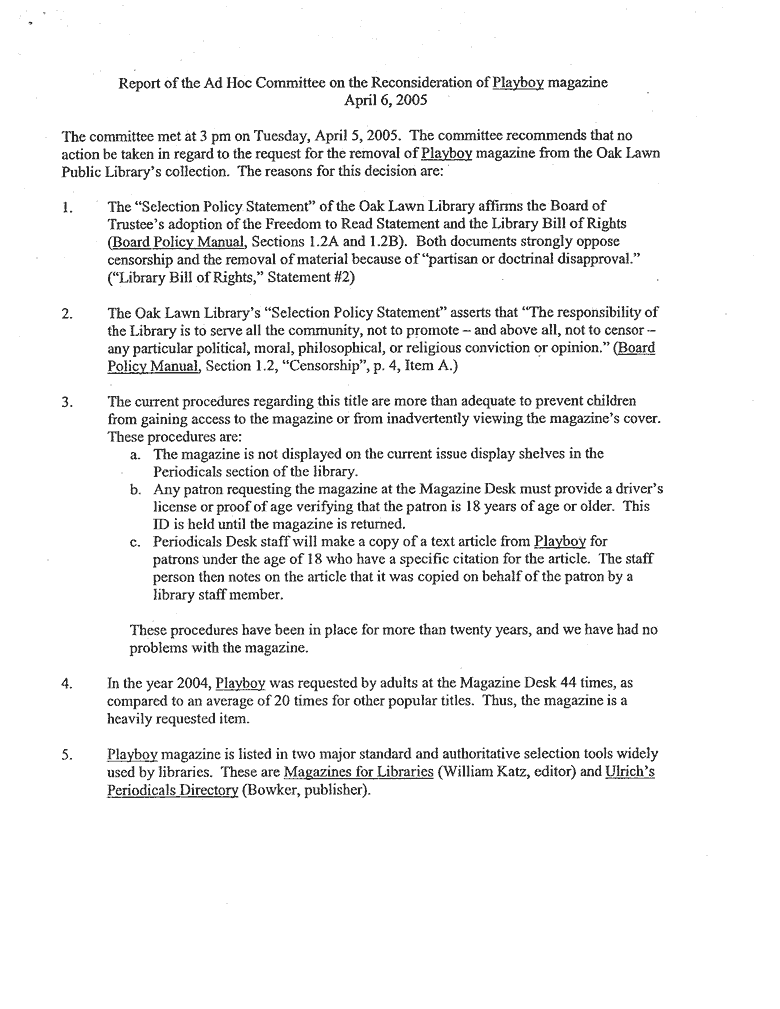
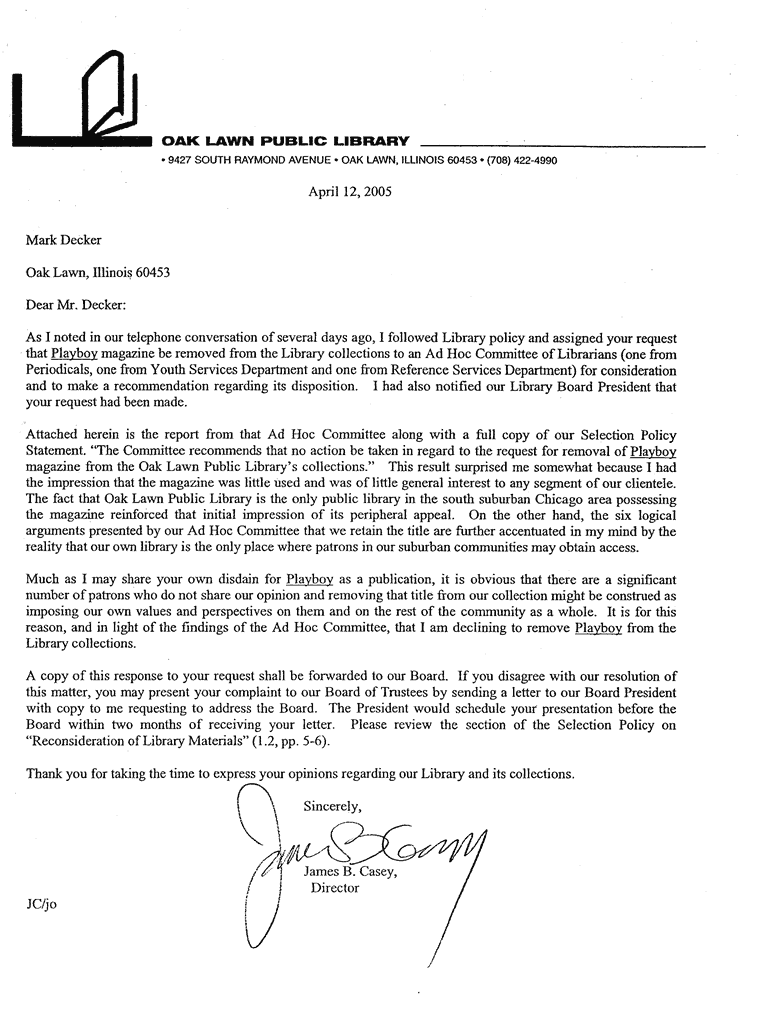
Mark Decker of Oak Lawn, IL, contacted me about his public library making Playboy magazine available to children.  Children simply have to ask for a page range and it will be photocopied for them.  "Periodicals Desk staff will make a copy of a text article from Playboy for patrons under the age of 18 who have a specific citation for the article."

He was like Mr. Soul.  He had a heart of gold and thought it was wrong for children to have access to Playboy.  Imagine that.  The nerve of him.

Together, Mark and I created SafeLibraries.  He thought up the name.  Unfortunately, Mark died in a terrible car accident.  More here: "Man Who Fought Pornography in Oak Lawn Dies," by William Lee, Daily Southtown, 14 June 2007.  I continue working SafeLibraries in Mark's honor so that his zeal for protecting children will continue on.


Broken Arrow

Playboy cover
Mark Decker asked his local library to stop purchasing Playboy or otherwise stop making it available to children.

He was shot down by the library.  No, it would make no changes.  From the magazine pictured at right, read: "Check Us Out," by The Playboy Forum, Playboy Magazine, Nov 2005.

But he picked up that broken arrow and kept pushing.


Expecting to Fly

He put out notice in the local paper about the library's policy and asked for signed petitions.  He got hundreds.  Expecting to fly, he presented them to the library.

Again, the library would make no changes.


Sugar Mountain

Now he had a hill to climb.  Did that stop him?  No.  At a town summer fair, an independent pollster determined the townsfolk agreed that the Playboy subscription should be stopped and children should not access Playboy.  That was sweet, like being atop a sugar mountain.  Surely the library would do as its patrons wanted.

No.  The library refused to budge.

Exactly who was in charge of this library that it refused to comply with the wishes of its own patrons?  Are you seeing the case I am slowly building here?  I am in the middle of showing you the total control the ALA has over a public library.  You will hear the ALA say again and again that it has no such control.  So I'm taking you step by step through this so you can see through such misinformation.  Let's keep going.


I Am A Child

Mark Decker never lost sight of the goal.  Children are innocent, like in the Neil Young song, "I Am a Child" (hear excerpt).  Mark sought to protect that innocence, and he saw now that the library was apparently defying the will of the community.  So he kept pushing.


The Loner

It appeared to be a tactic of the library to make Mark appear like a loner, ridiculing him for wanted to force his will on the library, all the while the library was forcing its will on the community.  Mark was no loner.

His next move was to ask the government of the Village of Oak Lawn to take a stand.  It did.  It stood with Mark.  It stood with its citizens.  It unanimously requested the library drop its subscription to Playboy.

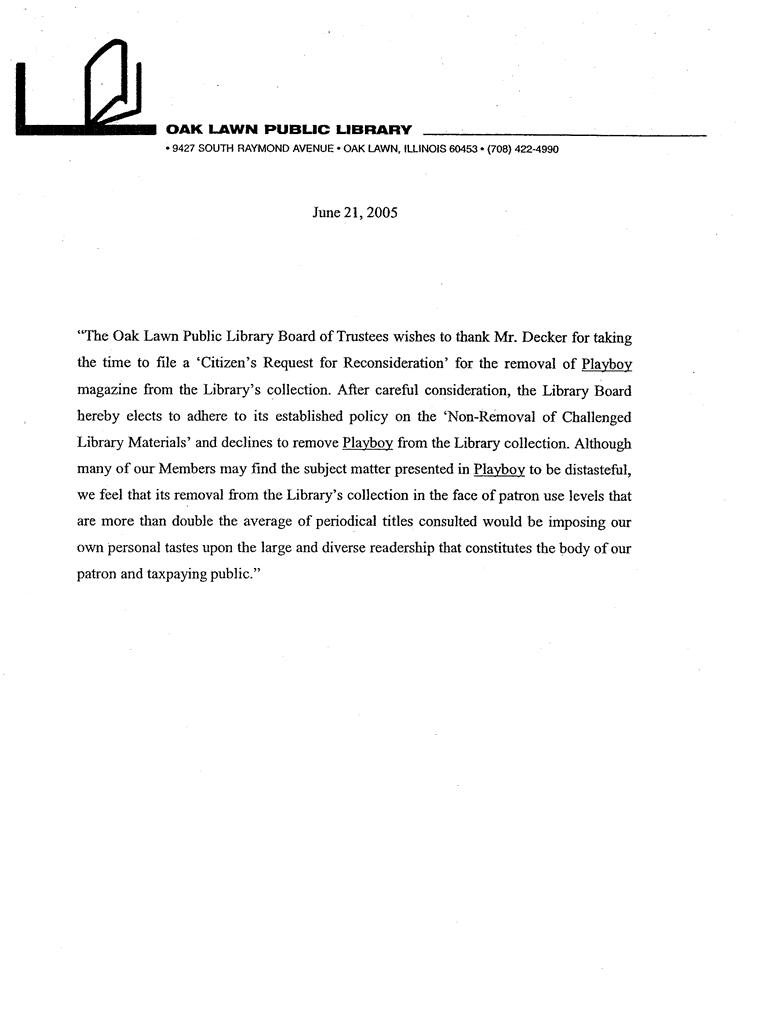
Can you believe?  The library refused.  See for yourself:


Did you see that?  The library will continue to allow children access to Playboy.  Children!

Heck, the library even advertised its Playboy subscription, but lied as to an age restriction, which is really unlimited.  See: "Check It Out; Newsletter of the Oak Lawn Public Library," Oak Lawn Public Library, 19:5, September/October 2005, bottom of page 2.


The Old Laughing Lady

The library director, James B. Casey, was himself a member of the ALA Council, a significant group within the ALA.  He got ALA top brass involved in the matter, including the old laughing lady, Judith Krug.  (Sorry, that's not an accurate description of her, but it is in keeping with the musical theme of consecutive song titles from a Neil Young album.)   Judith Krug was the Illinois state ACLU leader who joined the ALA, created the so-called "Office for Intellectual Freedom" and the "Freedom to Read Foundation," then single handedly changed how librarians would approach children.  No longer would librarians keep children from inappropriate material.  Now it is anything goes for children in public libraries and school libraries, and it is a direct result of the ACLU leader's changes within the ALA.  Now you know.

Anyway, the old laughing lady was laughing at Mark Decker and the entire Village of Oak Lawn.  Could you believe some unsophisticated local yokels would try to stop a Playboy subscription in their own public library?  As she put it:

"I get very concerned when we start hearing people who want to convert this country into a safe place for children," she said.  "I am adult.  I want available what I need to see."

But David Smith, senior policy analyst with the Illinois Family Institute, a conservative advocacy group based in Glen Ellyn, said Playboy is degrading to both men and women and that it has no place in a publicly funded library.

"It is not productive," he said.  "Why shouldn't taxpayers like Mark Decker have a say in what goes on the shelves?"

Source:  "Oak Lawn Library Vows to Keep Playboy on Shelf," by Jo Napolitano, Chicago Tribune, 23 June 2005 (alternate URL).

And with that, the ALA forced its will on the Village of Oak Lawn.  To this day Playboy remains available to children, to the best of my knowledge.  To this day, when the ALA feigns it has no influence over local communities, I'll know otherwise, and so will you.

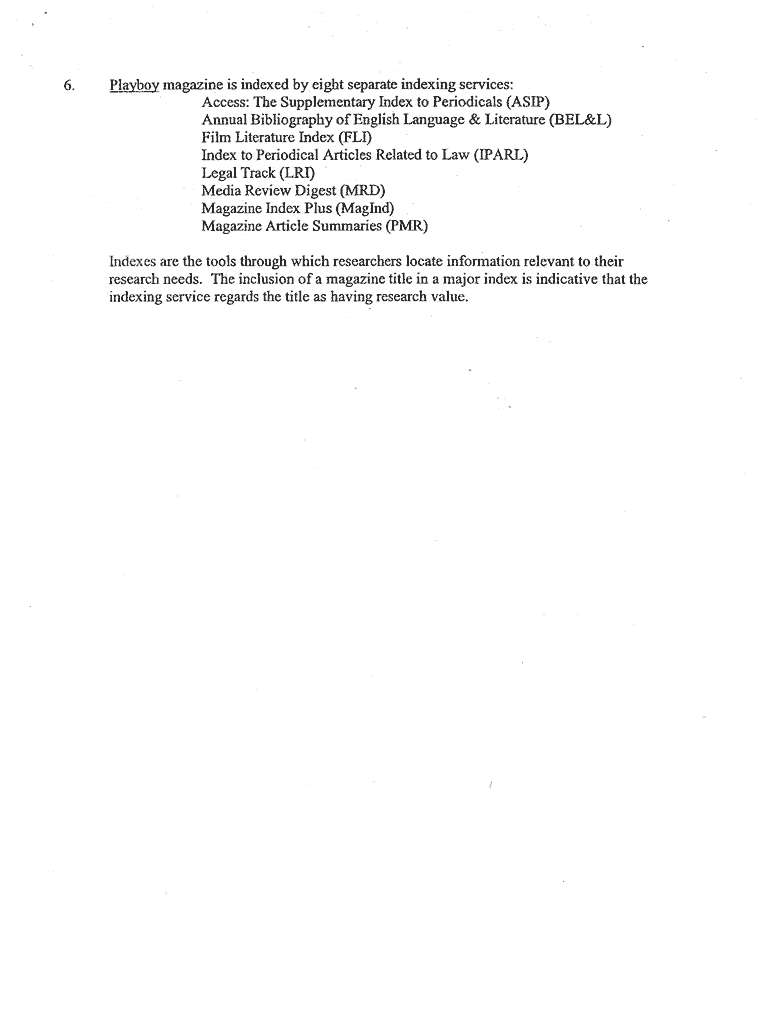
To sum up, the library refused to act even after 1) a citizen complained, 2) a citizen presented hundreds of signatures, 3) a town survey showed most people wanted to stop the Playboy subscription, and 4) the village government unanimously requested the subscription be stopped.  No, the library was forced to do as the ALA demanded, with the ALA's top leader getting directly involved to sink the deal.

And it is amazing the library argued it cannot "be imposing our own personal tastes upon ... the taxpaying public" while imposing the ALA's personal tastes over the entire taxpaying public in the Village of Oak Lawn.  It is a breathtaking example of the double standards that basically define how the ALA operates on many issues too numerous to raise here.


Like a Hurricane

The Oak Lawn Public Library was so successful in defeating its own community that it provided guidance to another community on how to defeat the local population there.  Like a hurricane, the disaster moved from Oak Lawn to St. Louis.  Oak Lawn library director Jim Casey mocked the local community and SafeLibraries as "censors," for not wanting children to access Playboy magazine!  See: "Who's Controlling County Libraries: Taxpayers or the ALA? New Teen Sections at County Libraries Stocked with Sexually Explicit Materials," by Dan Kleinman, St. Louis MetroVoice, 21 August 2008.  The ALA itself calls anyone who complains about anything a censor.  You'll be called a censor.  Don't let it bother you—it's not true.

You have to know when the ALA or its acolytes are controlling your own community so you can stop it.

Why didn't the Mayor sue the library to remove Playboy after it refused the government's request, you might ask?  He was afraid of the ACLU drain on village resources.  Yes, the very same ACLU that used Judith Krug to create the very policy that forces inappropriate material on communities nationwide.  See how it works?  This might help:


Helpless

But people like us are not helpless.  Hence SafeLibraries was born.  Hence you have come here to listen today about how public library porn harms children, patrons, librarians, and porn industry actors.  With this new knowledge, all backed up with reliable sources, you too can be aware of how ACLU engendered ALA policy is entrenched in your communities and what you can do about it.

Let's get started.


Decade

Before we get started, I hope you enjoyed my musical introduction with titles from Neil Young's Decade to warm things up.  "Ain't it funny how you feel when you're findin' out it's real."  It's real alright.

Yes, I still buy Neil Young albums.  I'm listening to Decade while writing this speech.  Anyone here like Neil Young too?


Public Library Porn Harms

Public library pornography harms a lot of people.  Some harm is direct.  Some is indirect.  Some harm isn't even to anyone in the library.  Some harm is nearly harmless.  Some remains forever.  Some harm is done after the fact, like when libraries coverup the harm.  Some harm occurs and libraries don't even know.  Some harm occurs only after you get home.

To help open your eyes to the possibilities of how pornography harms, I will categorize and list numerous instances.  Later I will specify why it happens and who or what is at fault.  That way you can be best informed so that you are not victimized in the first place or so you know how to react afterwards.


First Off, Most Library Visits Will Be Perfectly Safe

Let me say here and now that the vast majority of your library visits will be the positive ones we all expect them to be.  The chances of something untoward happening are slim.  But over time, something might happen, and you want to be prepared and head it off at the pass or minimize the effect.  So far as I know, no other such advice exists, so please pay attention.  And this speech will be available on the SafeLibraries blog so you can look at it again and again as the need arises.

Here we go.


Porn-Viewing Hooligans Beat Up Old Lady

Teenagers who viewed pornography on the Internet computers in a public library went on to viciously attack an old lady—it even made the cover—there she is on the ground:


"An elderly woman suffered a broken arm and jaw after she was thrown to the ground in a daytime mugging by three teen thugs yesterday.  ....  'They're just animals,' said one outraged cop.  'Put a big zoo around the city.'  ....  'People go to church for a funeral and there's gunshots, they go to the library and they're mugged,' Nunziata said.  'Where can you be safe?'  'It's disgusting,' she said.  'It just makes me sick.'  ....   
Police said the elderly victim had just left the Mount Dennis library branch at about the same time the three teens had also left after surfing porn sites on the library computers.  Police said staff had been keeping on eye on them because of what they were looking at, and the trio left.  ....  She described the trio as being around 14 and 15 years old." 
Source: 'Animal' Teens Attack Woman, 84; Victim Suffers Broken Jaw, Arm in Purse-Snatching Outside West-End Library, by Rob Lamberti and Rob Granatstein, Toronto Sun, 8 December 2005.


Public Library Porn Harms Children

Public library porn harms children.  Sometimes people do not even realize it.  Consider the case of a child molested in a public library bathroom and no one knew that it was the result of porn viewing!  I was the person who exposed the truth.  As a result of my work, the Iowa state legislature attempted to pass state library computer filtering legislation.  It would not have happened but for my involvement in that community.

Turns out the Des Moines Public Library refused to filter the Internet because it chose to follow the ALA instead of local interests.  As a result, a homeless sex offender molested a toddler in the restroom.  He was a regular viewer of porn on the computer closest to the bathroom where the toddler's life was changed forever, courtesy of the ALA indirectly enabling the sex offender.  And porn doesn't harm?  And the ALA is not partly responsible?

I'm not bragging.  The point is to show you there are things you can do to make a big difference.  You can do this.  For example, you can pick up a telephone and tell a reporter where you think he may have missed something.  You just have to be aware, and I'm helping you to become aware right now.  To learn more about my involvement in that matter, see "Media-Wake Up to Library Crime Source."

For other examples of children harmed by porn in public libraries, allow me to list some of my past writings on the topic, than come back to this page and view the information whenever you like:


Phew!  That was a long list, wasn't it!  Did I say something previously about library crime not being too frequent?


Think This Can't Happen to You?

Think this can't happen to you and your family in your own community library?  Think again.  This is from that case I uncovered in Des Moines, IA:

Justin Newman [has ...] seen news accounts of grown men arrested on charges that they preyed on children in municipal libraries.  ....  "You don't want to be too fearful," said Des Moines Police Sgt. Barry Arnold.  "But, doggone it, it's pretty bad when it happens in your own backyard."  ....   
Last week, Des Moines police charged registered sex offender [JE] Jr. with sexually assaulting a 20-month-old girl in a restroom at the downtown public library.  ....   
Then Monday, on the same day Des Moines city leaders voted to expand a 2,000-foot boundary law and eliminate the few remaining places where child molesters can live legally, another man was arrested for allegedly assaulting a pre-teen girl at an Ames library [- the man], a library regular, inappropriately touched the girl after he asked whether she would like to see a picture in a book.  ....   

"People think, 'It's Iowa.  It doesn't happen here,'" Lien said as he watched his 2-year-old grandson play on a slide.  "I don't think that makes any difference." 
Source:  "Child Predator Reports Scare Parents; Take a Deep Breath, Keep a Watchful Eye, Officials Say," by [unknown to me], The Des Moines Register, 11 October 2005.


Public Library Porn Harms Students

Library porn harms students too.  Students at Utah Valley University [formerly UVSC] appear to be awash in pornography in their school library.  And notice how illegality and acceptable use policies seem to make no difference, whereas Internet filters would have prevented the problem in the first place:

On average, the UVSC library staff catches at least one person a week viewing pornographic materials on the library computers, and the number of instances of people being caught rises as finals approach.  Twenty-five percent of total search engine requests are porn-related.  The top three searches being: sex, mp3 and hotmail, according to Healthmind.com.

All UVSC computer labs follow state law, which says: "Public Displays: Utah law (76-10-1228) prohibits public display (at any establishment frequented by minors, or where the minors are invited as a part of the general public, i.e. UVSC), any motion picture, or any still picture that consists of nude or partially denuded figures posed or presented in a manner to provoke or arouse lust or passion."  It is illegal to view pornography on UVSC campus.

All UVSC public computers are marked with a warning stating: "This computer may be monitored for inappropriate use," and computer lab employees have access to monitor what is being viewed on each computer in the facility.

But how often do staff members check it?  One Library employee said they don't check what the students are doing very often.  Usually they wait for someone to approach them with a complaint about another person using the computer to look at porn before they will actually check student computer activity.

The UVSC Library policy also states that persons caught looking at pornography for the first time will receive a warning.  If a repeat offender is caught, library staff is instructed to contact the UVSC Police Department immediately.

Source:  "Can't Look Away; Therapist Speaks on the Damage a Pornography Addiction Can Cause," by Ashley Robertson, NetXNews (Utah Valley State College), 12 March 2006.

Not all students are silent on the issue.  Get a gander at this:


And here's a graphic of students mocking a guy masturbating in a school library:


Public Library Porn Harms Patrons

Oh please.  There must be example after example of patrons harmed by porn in public libraries.  But this story is downright silly—porn viewing caused a fist fight in the Brooklyn Public Library, a library that allows unfettered porn viewing:  "Porn Fist Fight in Library; The Brooklyn Public Library May Be At Fault, Perhaps the ALA As Well."

But I have a scarier story, one that I know but have not yet published.  You see, people contact me when they have trouble in the library and no one will help them.  So what I am about to tell you is literally breaking news, breaking right here and right now.

In the Lincoln, NE, public library, a woman and her boy were in the children's section of the library when the mom saw a man viewing child porn on one of the computers in the children's section.  When she complained to him, he assaulted her, yelling at her an inch from her face and threatening her, frightening her and her child.  When she sought assistance from the library, it refused to act.  The police also refused to act, saying they already had experience with that library intentionally destroying computer records so they already knew there was nothing they could do.  Both the library's refusal to act and the library's destroying records are the result of ALA policy.  

So the mom and her son got the double whammy from the ALA that simple filters would have prevented.  To this day her son will duck down in the car each time they drive past the library.  Sad, isn't it?


Public Library Porn Harms Librarians

Would you believe porn harms librarians and library employees as well?  Worse, to my best recollection, I have never, ever seen the ALA come to the aid of a single one of these librarians.  Not one.  Not once.  Never.

Sometimes not even that very library's management will help.  Don't like getting sexually harassed?  Then leave!  Think I'm making that up?  I am not.  Look what library management told one harassed library employee:


The public library in Birmingham, AL, is a perfect example, and it occurred just last week—and two years ago!  The above picture is from that case.  Two separate library employees have been harassed so badly by patrons fueled up on unfiltered pornography that the employees had to bring suit and file EEOC complaints for sexual harassment on the job.  After the first incident two years ago, the library did absolutely nothing to stop it from happening again.  "If you don't like it leave."  See "Library Employee Harassment Continues As Second Suit for Unabated Porn is Filed in Birmingham Alabama."

Examples of harassment include that "patrons regularly engage in offensive sexual conduct such as masturbation in the presence of children" and that "management has failed to address the matter."

How about this—is this harassment?  Is this sex abuse?  "[S]ome patrons [were] openly viewing pornography on computers, groping her and performing lewd acts in front of staff or other patrons, including children."  Speak out please, how many of you have been groped on the job as a result of porn, then had your manager tell you to get out if you don't like it?


And again, the ALA never assists such people.  Contrast that with how the ALA awards other librarians who allow children to read books having explicit sexual activity.  Those are the kinds of librarians the ALA supports.  Right, Dee Venuto of Rancocas Valley Regional High School, Mt. Laurel, NJ?  See "School Media Specialist Passes Sexual Content Review to Students; Dee Venuto Says It Is Discrimination to Keep Children From Material Including Lengthy, Vivid Descriptions of a Ménage a Trois."

Here are more stories of librarians harmed by library policy allowing porn:


Public Library Porn Harms Porn Industry Actors

Some libraries are so concerned about the rights of patrons to view porn that they will even cover up instances of child pornography viewing.  See, for example:


Now while libraries bend over backwards to defend the claimed right to view porn in a public library, even though there is no such right according to US v. ALA, while libraries are so sensitive about peoples rights, they could care less about the rights of the porn actors.

That's right, porn actors have rights too.  Like the right not to be killed or abused or forced to be drugged and have sex with animals.  See the Pink Cross Foundation.

Do the librarians who push porn in their own libraries by ignoring the law and their communities care?  How about those who cover up for child pornography?  Do these rights-sensitive people care one iota about these porn actors?  Obviously not.

You need to see this sad video to get the picture of porn victims, men and women, who the rights-sensitive librarians could care less about when they allow porn viewing in the public library despite its being legal to exclude:


What You Can Do About Your Library Allowing Porn

There are a number of things you can do about your library allowing porn.  I have helped you through the first step, and that is becoming aware there may be a problem in the first place.  Once you become aware, once you learn to recognize the signs that your library is no longer under your community's local control, once you realize the harm done to so many by those defying the law to promote a political agenda, then you'll be in a position to start doing something to bring the library into compliance with local standards and local control.


Stay Informed

If you enjoyed this webinar by SafeLibraries, if you would like to see another on exactly what can be done to restore local control to your public library, then please thank Safe Library Project for having me speak today and ask them to invite me back for another webinar on steps needed to clean up local libraries.

What a pleasure it has been speaking with you today.  To keep up with the latest information, please subscribe to our blogs (SafeLibraries, Safe Library Project) and follow our Twitter feeds (@SafeLibraries, @Porn_Harms).  Information is power.

This webinar is available for replay online and embedded above.  The URL for this SafeLibraries blog post page is http://safelibraries.blogspot.com/2011/07/porn-and-sex-abuse-in-our-public.html.


Questions?

Does anyone have any questions?

....

Goodnight, everyone, thank you all for attending, and thank you, Safe Library Project.