Showing posts with label AlaCensorsOpponents. Show all posts

Wednesday, January 11, 2023

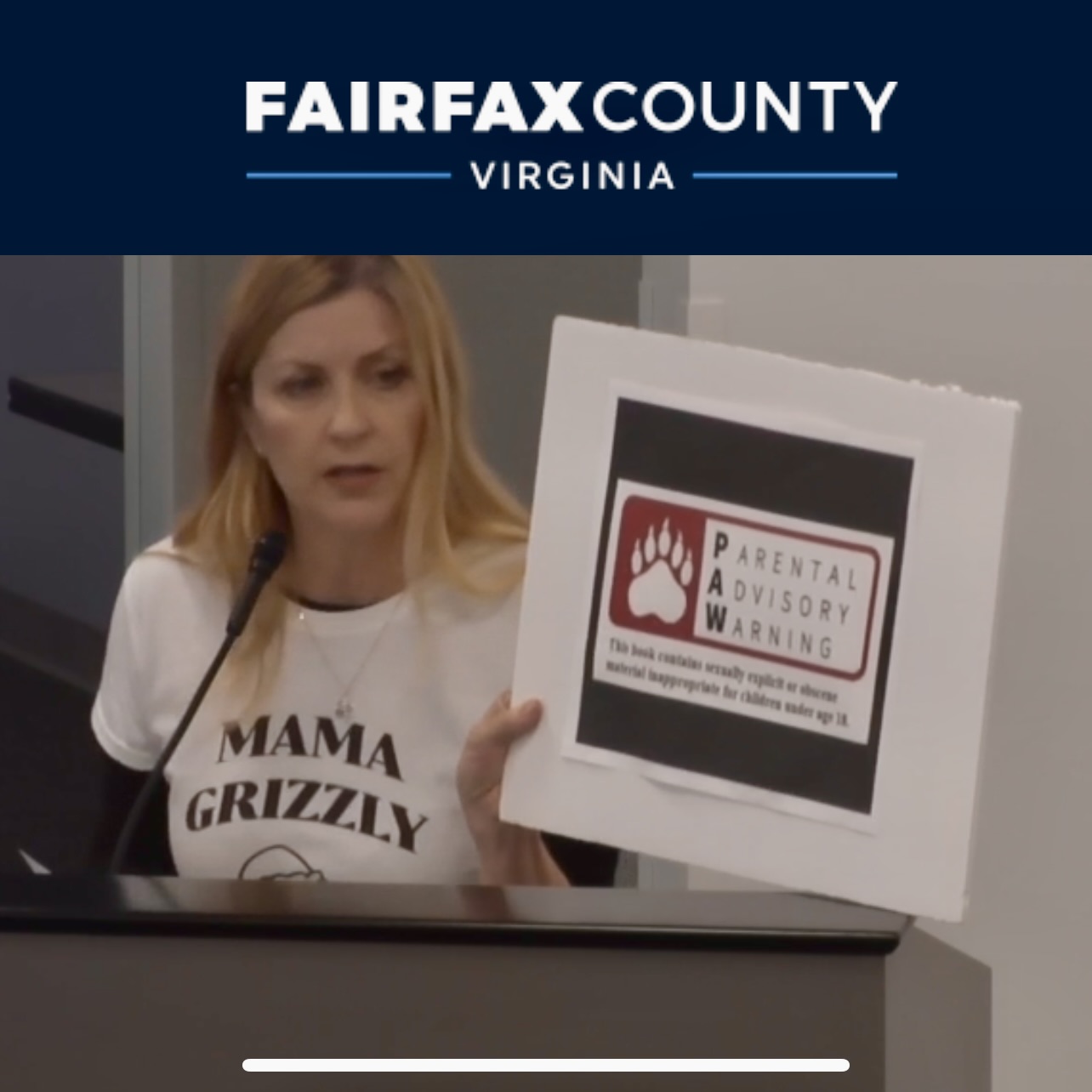
PAW Prints: Parental Advisory Warning for Books

My name is Stacy Langton and I’m a mother of six children, two at Fairfax High School. I went before the school board in Fairfax County in September of 2021 to alert parents and the public that there are graphic, s3xually explicit books that contain p0rnographic images and written descriptions of s3x—s3x between two children, and even between an adult and child, otherwise known as pedophilia.

My speech started a national conversation on the s3xualization and indoctrination of our children in public schools, and raised the anger of parents which helped to elect Glenn Youngkin.  I have since appeared before the school board meeting at least a half dozen times and have exposed four more p0rnographic books. 

It is with gratitude that I acknowledge the passage of SB 656 last session, a bill which was brought forward by Senator Dunnavant, which requires parental notification and the ability for students to opt out of any s3xually explicit classroom assignments. I thank the members who crossed the aisle to pass this bill. While it is a good start, it unfortunately does not address s3xually explicit books that are still on the shelves of school libraries.

School libraries are not a place where students have any parental supervision to guide their choices. There are books in our school libraries that are not appropriate for minors under the age of eighteen.

Therefore, I have created a label that I seek to have placed on all such books in our school libraries. I call the label PAW Prints. The acronym stands for Parental Advisory Warning. The purpose is to provide a visual warning to parents that there are things inside the pages that are not suitable for minor children. I’ve asked Senator Amanda Chase to introduce the PAW Prints bill during the new session. 

I modeled PAW Prints after the Parental Advisory Warning label made by Tipper Gore in the late 80’s. They were put on music albums that had p0rnographic cover illustrations and s3xually explicit lyrics to warn parents about what their children were listening to. They are still in use to this day. We now have warning labels on the products of all things in the entertainment industry such as video games, films, and television programs. Books are entertainment and should be no different. 

P0rnographic and explicit descriptions of s3x are offensive to common decency in all societies. It makes people uncomfortable and they look away rightly when confronted with it. No one enjoys having their child exposed to such things. In fact, exposure without their knowledge is actually a crime under the law. 

Not all school districts have removed these types of books. Some have inexplicably chosen to keep them in the libraries. We need to do something to give parents a bare minimum of notification. Parents have the right to be notified and to have a say in what their child is exposed to. 

Sometimes, it is impossible to judge a book by its cover. I don’t think anyone would have guessed at the x-rated pictures inside the book Gender Queer just by looking at its cover. The PAW Prints label would give parents that notification. 

Thank you for your support of the PAW Prints bill.

# # # 30 # # #

Watch Stacy Langton speak the above speech here:


Here's more about PAW Prints:


Here's expected opposition from the librarians themselves, given this past opposition to book labels:

ALA Office for Intellectual Freedom. “Labeling and Rating Systems Q&A.” Text. American Library Association, May 29, 2007. https://www.ala.org/advocacy/intfreedom/labelingratingqa.

Bertin, Joan E. (NCAC), Christopher M. Finan (ABFFE), Barbara M. Jones (ALA), Richard M. Long (IRA), Judith Platt (AAP), Larry Siems (PEN American), Kent Williamson (NCTE), Lin Oliver (SCBWI), and Paul Aiken (Authors Guild). “Parental Warning: Books Are Dangerous. Here’s How to Protect Your Kids from Subversive Ideas.” National Coalition Against Censorship (blog), June 22, 2010. https://ncac.org/incident/parental-warning-books-are-dangerous-heres-how-to-protect-your-kids-from-subversive-ideas.

American Library Association. “YALSA Board of Directors Meeting via Conference Call August 29 2013.” American Library Association, August 29, 2013. https://www.dropbox.com/s/8sytqvlo3asbint/YALSA-IFreportAug2013.pdf?dl=0.

That latter reference from YALSA (Young Adult Library Services Association, part of ALA) reveals American Library Association actively censors and blacklists Common Sense Media for daring to provide ratings for parents that include the amount and type of s3xual activity in books.  So some of the opposition expected from librarians is secret, silent censorship, even blacklisting, precisely to keep parents in the dark.  They will tell you you cannot use PAW Prints book labels because it violates the First Amendment (it doesn't) and the Library Bill of Rights (an aspirational creed that has no legal significance, see "Library Bill of Rights Means 'Nothing': Berry v. Yosemite Community College District"), while they censor and blacklist Common Sense Media book ratings.

Worse, American Library Association says book decisions should be left to librarians who are specially trained to make such decisions and Booklist provides the best ratings guide:
Booklist is a book-review magazine that has been published by the American Library Association since 1905, and is widely viewed as offering the most reliable reviews to help libraries decide what to buy and to help library patrons and students decide what to read, view, or listen to.
American Library Association. “LibGuides: Marketing to Libraries: Reviews as a Selection Tool.” ALA LibGuides. Accessed June 29, 2023. https://libguides.ala.org/marketing-to-libraries/reviews.

Well, as I have proven, Booklist encourages all librarians to not only silence parents complaining about school children reading s3xually inappropriate material, but also that they will overcome all book challenges.  "Librarians: Tougher than Your Challenge."  A source that trains people to silence and overcome parents is viewed as having the "most reliable reviews to help libraries decide what to buy and to help library patrons and students decide what to read, view, or listen to."  Do you see how grooming works?  You groom at every level, the child, the librarian, the parents, and the legislators.  So let's hope legislators read this post on PAW Prints and don't fall for the grooming.


In summary, Stacy Langton announces her PAW Prints book label plan, and librarians will pounce saying book labels don't work, librarians are trained for this, and Booklist is the best source to help librarians decide what's best for children—the very source that has directly expressed its opposition to parents who challenge s3xually explicit material in schools.  Meanwhile, librarians play dirty pool, train each other to thwart parents, censor and blacklist book ratings that help parents, even violate the law just to keep parents in the dark about s3xually inappropriate books:


Never trust nor believe librarians.  They are trained to lie.  They are trained to violate the law.  They are trained to "reframe" s3xually inappropriate material as "diversity" and "inclusion."  Legislators need to know they are being misled by library association members into allowing school librarians the power to continue to groom school children.  Do not give them that power.  If they have it, take it away.

SafeLibraries supports PAW Prints book labels as announced by Stacy Langton 100%.  It's at least a first step toward returning control of schools to local communities where it belongs.

Watch Stacy Langton explain the PAW Prints book labeling system at CPAC 2022 here with moderator Candace Owens:


NOTE ADDED 12 JANUARY 2023:

The final video was added of Stacy Langton's appearance at CPAC 2022, and a few words were changed to ensure people know PAW Prints is a book labeling system, not a book ratings system, an important distinction.


NOTE ADDED 15 JANUARY 2023:

Today I noticed the following message: "This page was put behind a warning for readers because it contains sensitive content as outlined in Blogger’s Community Guidelines."  

People who fight against the s3xualization of children are regularly shadowbanned by Big Tech.  So I will have to go through this post and change words to satisfy the Big Tech shadowbanners.  This note is to advise of such changes.  These changes will make searching and finding this post all the harder since no one will look for the changes I'm forced to make to remove the warning for readers.  So fewer kids will be protected.  This is the goal of Big Tech, to silence people seeking to protect children from being s3xualized.  Then trolls move in and laugh that I have to change the language.  No, those trolls are not shadowbanned.

Tuesday, April 1, 2014

American Library Association Enables New Porn Craze—Making Porn In a Library—Should Be Considered a Criminal Organization

Man masturbates into library book
in a library.  Added graphic
covering Action Jackson says:
"Another 'HYSTERIC'
Librarian for Freedom."
Megan Fox reveals, "There is an entire community out there who film themselves masturbating in libraries (usually while watching porn on publicly funded WiFi) and then upload these videos to porn sites.  People are making porn in public libraries. ....  The American Library Association is to blame for this.  They have adopted such a radical position against censorship of any kind (unless it's censorship of the Second Amendment) that they actively promote porn watching in public libraries that leads to the making of pornography on publicly funded WiFi.  The ALA has been voted consistently on the list of the Dirty Dozen, twelve organizations that are the biggest purveyors of porn in America as compiled by PornHarms.com":
"The ALA is a radical left-wing organization that is standing up for perverts to watch X-rated material and then masturbate while filming it on free WiFi a few aisles over from your child.  It's time for the ALA to be considered a criminal organization."  Emphasis added.

Interesting, no?  Remember, the ALA anthem is "Smut!" by Tom Lehrer.


On Twitter:  @IntolerantFox @OIF @Porn_Harms

Thursday, September 1, 2011

Banned Books Week Propaganda Exposed by Progressive Librarian Rory Litwin; ALA Censors Out Criticism of Its Own Actions in a Manner Dishonest to the Core

Banned Books Week propaganda
Progressive librarian Rory Litwin of Library Juice fame has just exposed the propaganda used by the American Library Association [ALA] that is "Banned Books Week."  Read him carefully to see how his statements remarkably align with the ALA's activities I have been reporting, and later I will show how the ALA is dishonest to the core, even apart from the propaganda:


Comparison of Rory Litwin Quotes with Past SafeLibraries Observations

Rory said:
My problem with Banned Books Week is one that is probably shared by some conservatives, and it has to do with the loose definition of what a 'banned book' is, and what a 'challenged book' is, 
and I said essentially the same thing in:


Rory said:
The Banned Books Week project, well-intended as it may be, is a propaganda exercise that fails to model good standards for democratic communication, 
and I said essentially the same thing in:


Rory said:
School districts have policies in place for reviewing challenges to books on the basis of age-appropriateness.  Challenged books are reviewed and evaluated by committees that are charged with that responsibility, and then the school district makes an official decision regarding the book.  Regardless of what the school's decision turns out to be, regardless of its reasonableness or unreasonableness, and regardless of the objectivity or bias within the decision-making process in a specific case, all challenges to a book by a parent get counted as an attempt at book banning, 
and I said essentially the same thing in:


Rory said:
But when a book is challenged and reviewed on the grounds of age-appropriateness, it is ultimately not the family that brought the challenge that makes the decision. The decision is made by the educational institution itself, 
and I said essentially the same thing in:


Rory said:
But the decision about whether a book should remain a part of the curriculum or not is ultimately made by the public institution that put the book in the curriculum in the first place, which means that book challenges happen as a part of a process that the institution puts in place in order to get feedback from the community on the curriculum, 
and I said essentially the same thing in:


ALA Finally Gives Dissent Significant Coverage

Remarkably, the ALA has done something it almost never does, namely, give significant coverage to disagreement with ALA propaganda.  Here it purports to quote Rory Litwin's criticism:

  • "Actions & Answers," by American Library Association, American Libraries Direct, 31 August 2011:
    My problem with Banned Books Week
    Rory Litwin writes: “The Banned Books Week project, well-intended as it may be, fails to model good standards for democratic communication. Here is what I mean. Book banning, good people agree, should be fought against and is a source of inspiration to fight for what is right. Banned Books Week taps into people’s responses to these historical narratives and aims to prevent the suppression of ideas from recurring. But what counts as a ‘banned book’ is actually a ‘challenged book,’ and what counts as a challenged book is something quite different from an effort to prevent a book from being published, sold, or even made available in a library.”... Library Juice, Aug. 28

Screen shot of American Libraries Direct in case ALA
should whitewash it by changing language after I publish
this blog post, as it has done before.
For example, the ALA has never given coverage to my exposing its use of admittedly low quality material that it plagiarized to promote a "censorship map" as part of its propaganda for Banned Books Week.  That plagiarized map is still being promoted by the ALA even after a year and a half.  See:


But look carefully at that ALA quote of Rory Litwin more closely.  It is a misquote, and apparently intentionally so.  The ALA leaves out select portions of the quote referencing propaganda and the problem with Banned Books Week, making it sound completely different than what Rory Litwin actually said.  The ALA does this by using a technique remarkably similar to Soviet-style censorship that makes things disappear that are not politically palatable.


Compare the Actual Text to the Whitewashed Text

To make it more obvious, allow me to place the relevant sentences side by side, then highlight the section the ALA conveniently left out or added.

Example of Soviet-style censorship.
The actual Rory Litwin quote:
The Banned Books Week project, well-intended as it may be, is a propaganda exercise that fails to model good standards for democratic communication.
Here is what I mean.
.... Book banning, good people agree, should be fought against, and is a source of inspiration to fight for what is right. Banned Books Week taps into people’s response to these historical narratives and aims to prevent the suppression of ideas from recurring. ....
The problem that I see with Banned Books Week is that what counts as a “banned book” is actually a “challenged book,” and what counts as a challenged book is something quite different from an effort to prevent a book from being published, sold, or even made available in a library.

The actual ALA quote quoting Rory Litwin:
Rory Litwin writes: "The Banned Books Week project, well-intended as it may be, fails to model good standards for democratic communication. Here is what I mean. Book banning, good people agree, should be fought against and is a source of inspiration to fight for what is right. Banned Books Week taps into people’s responses to these historical narratives and aims to prevent the suppression of ideas from recurring. But what counts as a ‘banned book’ is actually a ‘challenged book,’ and what counts as a challenged book is something quite different from an effort to prevent a book from being published, sold, or even made available in a library."


Dishonesty to the Core

No, Rory Litwin did not write that.  The ALA left out "is a propaganda exercise that" without the proper use of the ellipsis. The "propaganda exercise" is Rory's point and is the subject of the sentence.  "That fails to model good standards for democratic communication" is a modifier of the subject.  The actual sentence is, "The Banned Books Week project, well-intended as it may be, is a propaganda exercise that fails to model good standards for democratic communication."  By leaving out the subject and the modifier, the ALA effectively changes the subject and that changes the entire sentence to something Rory Litwin did not say: "The Banned Books Week project, well-intended as it may be, fails to model good standards for democratic communication."  No, it is not Banned Books Week that fails to model good standards.  Rather, it is that Banned Books Week is propaganda, and the exercise of propaganda fails to model good standards.

And what the ALA left out is Rory Litwin's main point and his essential criticism of the ALA.  He uses the word root for "propaganda" three times and even links one use to a hyperlink, so important was that subject to Rory.  But the ALA, acting in its own self interest, just cut it out without the slightest indication of having done so.  That's no mistake.  That is dishonesty to the core.

The ALA left out "The problem that I see with Banned Books Week is that," while adding instead "But" without the proper editorial marks to let a reader know the author as quoted, and he is quoted with quotation marks, did not actually say those words.  One uses square brackets to do that, like [this].  "To give context to a quote or otherwise add wording to it, place added words in brackets, []; be careful not to editorialize or make any additions that skew the original meaning of the quote—do that in your main text...."  The ALA did not do that.  It simply left key phrases out with no indication they were ever there in the first place or added material in place of critical text.

Failure to use the proper form of an ellipsis could misrepresent the work of another person and result in legal liability for the writer.  Correct use of ellipses, on the other hand, shows that the writer has carefully attended to detail, and thus increases the reader's confidence in the reliability of the written work


ALA Omissions Misrepresent Others and Decrease Reliability of ALA Statements

I contend the omissions do indeed misrepresent the work of another, and do indeed decrease the reliability of statements from the ALA, especially so where the omissions appear to be both intentional and self-serving.

The omissions give a whole different reading to Rory Litwin's quote.  That is obviously why the ALA left out those phrases.  But in doing so it also left out the required editorial marks needed to make quotes accurate.  And given it left out references to propaganda and the problem with Banned Books Week, this action is likely intentional, particularly in light of past instances of similar whitewashing by the ALA, as we are about to see.


The ALA's Propaganda Whitewash is Ironic But Not Novel

The irony of this is unbelievable as the ALA advises local communities it is censorship to keep children from inappropriate material.  But this is consistent with previous ALA miscues involving redaction of records after having been caught, such as I detail here:


One has to wonder why the ALA continues to feel the need to cover up for its own actions.


When Will the ALA Stop Besmirching Its Own Reputation By Using Propaganda And Whitewashing Missteps?

I am truly shocked I even have to bring this disgraceful conduct by the ALA to your attention.  Were the ALA to act honorably, none of this would be an issue.  I would not need to say what I say.  Rory Litwin would not need to say what he said.  People of all political stripes are starting to stand up to the ALA's propaganda.  Don't let anyone claim it's this or that political bent.  False.  It's everyone.

It's time for the ALA to represent people, not mislead people with propaganda and a variant of Soviet-style censorship that is dishonest to the core.  I challenge the ALA to do so.  Thank you for reading my opinion.


Bravo, Rory

Remember, read "My Problem with Banned Books Week," by Rory LitwinLibrary Juice, 28 August 2011.

Bravo, Rory.


NOTE ADDED 13 SEPTEMBER 2011:

Rory Litwin has today interviewed me via FaceBook and published the interview:


Tuesday, March 2, 2010

The Anything Goes ALA is Out of the Mainstream by Defending the Right of Children to Access Pornography in Public Libraries

Why is there such a disconnect between our profession and everyone else on this particular issue?  More specifically, how could we have allowed ourselves to be put in such a publicly disadvantageous position as defending the right of children to access pornography?  The answer is simple and ironic.  Our profession preaches intellectual freedom but does not tolerate its practice within our own ranks.  Librarians imbued with common sense and good political judgment are afraid to espouse even a moderate position that advocates the limited use of filters.  There is a great fear within librarianship of being branded a censor.  No librarian wants to be wounded by that bullet.  That's why we can never really initiate an open and honest dialogue among ourselves on issues involving even the most obvious need for limitations of intellectual freedom.  As a result, the extremists always dominate, and we end up with an "anything goes" official policy that distances the library profession from mainstream America.

Will Manley said that.  I love you, Will Manley, for being one of the few to speak truth to power.  "Anything goes."  Exactly.  Please consider getting more of Will Manley's common sense at his new blog, "Will Unwound."

The above quote comes from "Intellectual Freedom Begins at Home," by Will Manley, Booklist, 1 October 2003.  You must read the entire article.  It points out that US v. ALA was a "major setback" for the American Library Association [ALA], that some librarians "personal[ly] attack[ed] the values of the justices themselves."  And they are in your communities telling you to sidestep US v. ALA.

Our profession's "anything goes" view of intellectual freedom simply does not square with the values of the communities we serve.  While librarians were blasting the Supreme Court as a band of censors, parents from Maine to California were thanking the justices for protecting their children from the excesses of sex on the Web.

Thank you, Will Manley.  Yes, this article is many years old, but nothing has changed within the ALA on this issue—rather it has only solidified.

Any community facing the ALA propaganda machine should consider this Will Manley article as a powerful antidote.  When you are labeled as a "censor" for attempting to legally protect children from inappropriate material, you are in good company with the "band of censors" in the US Supreme Court.

Here is the entire article reprinted under Copyright §107 Fair Use.  Ah, freedom of speech.  Enjoy!


by Will Manley
Booklist
1 October 2003

Among the flurry of Supreme Court decisions that were handed down at the end of the last session in early July was a ruling that received critical reaction from many librarians.  The Supreme Court's decision upholding the right of the federal government to make the filtering of children's-room computers a requirement for libraries that receive federal monies was, in particular, a major setback to the American Library Association's Office of Intellectual Freedom.  ALA devoted a great deal of time and money to a vigorous legal battle challenging the right of the feds to mandate filtering.  At first blush, the Supreme Court decision would seem to be a setback in the crusade for the rights of access for millions of minors throughout America.  When it was first announced, the professional library reaction was both swift and negative.  Some referred to the decision as an "electronic book burning" others called it a grave act of censorship.  An ALA spokesperson predicted that many libraries would consider rejecting federal money rather than installing filters.

Some librarians were so upset that their criticism went beyond a point-by-point critique of the actual decision and elevated into a personal attack on the values of the justices themselves.  According to these librarians, this was one more example of the narrow-minded thinking of a court packed with ultra-right-wing appointees from the Reagan and Bush I eras.  They were quick to point out that these "fundamentalist" justices were the very same judges who stole the presidency from Al Gore and handed it to Bush II on a silver platter.  They overreached, however, when they asserted that in upholding the constitutionality of filtering the Internet, the Supreme Court was now validating Bush's conservative social agenda.  These critics had conveniently forgotten that the Children's Internet Protection Act had actually been promulgated by both the Clinton/Gore administration and a Democratic Senate.

It is perfectly legitimate to attack the Supreme Court decision on the basis of one's view of the First Amendment and how it applies to a library patron's right of access to pornography.  It is also appropriate to condemn the decision on the basis of the fact that some filters unintentionally block access to nonpornographic sites.  It is not, however, valid to criticize the decision on the grounds that the Rehnquist Supreme Court is dominated by conservative judges who are out of step with mainstream America.  Consider the other rulings that were released by this "conservative" court at the same time as the library-filtering decision.  Affirmative-action selection techniques were upheld in determining university enrollment, a California law aimed at bringing justice to child molesters was overturned, a death penalty was struck down because a defense attorney was deemed to be "ineffective," and a Texas sodomy law was ruled unconstitutional.  Are these the decisions of a conservative court?

The fact of the matter is that several of the justices appointed by Reagan and Bush have turned out to be liberal on a good many legal and societal issues.  As a result, the Supreme Court that we have now is one with a good deal of balance.  At times it's conservative, moderate, and even liberal.  In that regard, it reflects the variable moods of mainstream America.  It would appear that in the case of keeping children away from Internet pornography, it is the library profession, not the Supreme Court, which has distanced itself from the mainstream.

Our profession's "anything goes" view of intellectual freedom simply does not square with the values of the communities we serve.  While librarians were blasting the Supreme Court as a band of censors, parents from Maine to California were thanking the justices for protecting their children from the excesses of sex on the Web.  This is how one grandmother, who visits her public library twice a week with her grandchildren, explained it: "Sex is something that's like a gun; dangerous if you don't know how to use it.  I'm all for them putting restrictions in a public place."  Representative Istook of Oklahoma, one of the drafters of the Children's Internet Protection Act, said that the ruling "will mean libraries can continue to fulfill their mission because parents won't need to be reluctant about dropping off their kids for an afternoon at the library."

Journalists have traditionally joined hands with librarians in the cause of advocating intellectual freedom.  In this case, however, that support was not there for us.  The local newspaper that I read every day is quite liberal in its editorial point of view, but on the issue of filtering the Internet for children, its stand was clear and conservative:  "Children must have access to libraries and all that they provide.  At the same time, they require sensible protection from a cyberworld that knows no limits."  Our other local paper was even more forceful in its opposition to ALA's party line:  "These days librarians want to let it all hang out.  It's free speech all the way--which explains why the American Library Association is not happy with Monday's ruling by the US Supreme Court on the subject of Internet pornography.  Free speech, of course, is precious.  But as courts have noted over and over again, it cannot be completely unfettered.  And one fetter that almost everyone agrees is necessary is the one that keeps pornography out of children's hands."

Everyone, that is, but the library profession.  Why is there such a disconnect between our profession and everyone else on this particular issue?  More specifically, how could we have allowed ourselves to be put in such a publicly disadvantageous position as defending the right of children to access pornography?  The answer is simple and ironic.  Our profession preaches intellectual freedom but does not tolerate its practice within our own ranks.  Librarians imbued with common sense and good political judgment are afraid to espouse even a moderate position that advocates the limited use of filters.  There is a great fear within librarianship of being branded a censor.  No librarian wants to be wounded by that bullet.  That's why we can never really initiate an open and honest dialogue among ourselves on issues involving even the most obvious need for limitations of intellectual freedom.  As a result, the extremists always dominate, and we end up with an "anything goes" official policy that distances the library profession from mainstream America.

© American Library Association 2003


NOTE ADDED 26 APRIL 2011:

Will Manley has, all these years later, reaffirmed what he said in 2003.  See "3 Ways to Get Blackballed in the Library Profession," by Will Manley, Will Unwound, #428, 26 April 2011, emphasis added:

....
1)      Conservative politics….We all know that the library profession is extremely liberal in its political leanings.  To prove this all you have to do is look at the big name speakers at A.L.A. conferences.  How many conservatives have there been among this group in the past 40 years?  Maybe one or two at most.   Librarians would rather be validated than challenged when it comes to politics.  But it goes beyond that.  Many librarians think that conservatives are selfish, stupid, unsophisticated, and ultimately evil people.  Conservatism is not an alternative political viewpoint to the library profession; it is a curse.  The unfortunate issue here is that our many city councils, county boards, and state legislatures are ruled by conservative politicians.  These are the folks who hold our purse strings.  Isn’t it time to stop demonizing them and start dialoging with them?  Don’t even think about it if you want that big promotion.
2)      Organized religion….The library profession is very wary of organized religion, because religious morality is the banner that many book censors wave.  Many librarians disdain organized religion because they think it is repressive, judgmental, irrational, evangelical, and overly structured.  If you are a librarian it is okay to freely talk about your spiritual quest as long as you do not mention that you belong to an organized church.  It’s also very okay to be openly atheistic and agnostic because this shows you are a thinking person who has overcome an early childhood attachment to superstition.  If you have to be an avowed member of a formal religion, Buddhism seems to be your best bet.  Buddhism seems to be the cool religion right now.  Protestantism and Catholicism definitely are not.  If you are a member of a formal Christian Church keep that part of your life in the closet for the good of your career.
3)      Censorship Perhaps the most career limiting move that you could make in the library profession is to refuse to toe the line with the anything goes philosophy of the ALA Office of Intellectual Freedom.  I am still getting criticism heaped on me for a series of articles that I wrote in the 1990s advocating that filters be put on children’s room computers to block out pornography.  Really!  I’m pretty sure that the library profession is the only profession in the world that wants children to have access to pornography.  Why?  Because everyone is afraid of being called a censor.  It is the death nail in the career coffin.  The irony of all of this is that the library profession touts itself as the champion of intellectual freedom.  If that’s true why can’t we freely express our dissenting views of an "anything goes" philosophy of intellectual freedom…or conservative politics…or organized religion for that matter?

NOTE ADDED 27 APRIL 2011:

I consider this republication of Will Manley's work and my repeatedly linking to it to be a success since knowledge of Will Manley's views have apparently swayed decisions away from the anything goes ALA view and toward one that better reflects local community values and leads to filtering computers.  Here is a statement by Will Manley himself upon which I base my observation:
Dan, that is one of the articles that got me into trouble.  I still have librarians coming up to me very upset because their trustees saw that article and then voted for filtering.  So much for intellectual freedom.

by Will Manley April 27, 2011 at 1:28 am

Notice his comment, "So much for intellectual freedom."  As the Annoyed Librarian pointed out, librarians have the intellectual freedom to agree with the ALA's Office for Intellectual Freedom.  Will Manley's statement lends support to that.  This is one example why SafeLibraries's mission is "Educating people and politicians about who controls public libraries.  Citizens should, not the American Library Association."

In any case, this Will Manley view into the behind-the-scenes machinations of the ALA has successfully led library trustees to vote for Internet filtering.  Please consider sending this information to your own library trustees.

.

Saturday, October 10, 2009

ALA is Duplicitous and Fraudulent, Censors Whomever It Wants, Suppresses Intellectual Freedom, and Joins the Jihad

The title of this blog post is strongly worded. Not a single one of those descriptions is made up. They come directly from the American Library Association's [ALA] latest censorship victim or his attorney. It's unbelievable how the ALA gets away with this given it is the nation's self-arrogated "censorship" police.

Is the ALA trying to convince your community to sidestep legal means to protect children, like in Owosso, MI? Is the ALA telling your community not to "censor"? Is "Banned Books Week" promoted heavily? Do you think the ALA is authoritative? Then you need to know exactly how two-faced is the ALA.

Fully read the following from the attorney for the latest of the ALA's censorship victims—your eyes will pop out:


And hear directly from the victim of the ALA's scorn:


See also my previous blog post on this topic when it first occurred, and also the comments where I link to the ALA making more excuses, and I renew my call for the ALA to include the speaker it censored at the next opportunity:


Hey, ALA! You read my blog posts, do you have anything to say about this? Deborah-Caldwell Stone, you decry "censorship" to convince communities to leave children unprotected by legal means available to protect them, can you please comment on this ALA censorship matter? The ALA looks really bad right now; somebody better say something to explain or correct the ALA's "suppression of intellectual freedom."

.

Thursday, July 24, 2008

Scandal: ALA Intimidation Squelches Free Speech; Ethical Violations, Threats and Personal Attacks Gag and Censor ALA Opponents to Avoid Open Debate

What follows is a description of an outrageous scandal within the American Library Association [ALA]. Apparently, the ALA squelches free speech and censors people using propaganda, ethical violations, threats, and personal attacks. An avoidance of the issues by using ad hominem argument is apparently the modus operandi of the ALA.

Walter Skold, MLIS, wrote the following letter entitled, "[ifforum] Chair of IFC on Intimidation of Councilors & Librarians" on 24 July 2008. I tend to believe what he has revealed as I too have been similarly subjected to the exact same intimidation and issue avoidance tactics. For example, one ALA Councilor said SafeLibraries "will destroy anything" and is "happy to destroy lives" while the Councilor defended his defamation of American troops which I challenged. See "American Troops Defamed by ALA Councilor Peter McDonald," by SafeLibraries, 26 June 2008, and the associated comments.

Are you wondering why this particular ALA scandal is relevant to SafeLibraries' efforts to educate communities to protect children from ALA misinformation? It shows another example that the ALA's claimed interests in free speech and intellectual freedom are fraudulent. It shows another ALA double standard. And it shows people should expect personal attack as a method of issue avoidance, or just issue avoidance in the first place.

Now here's Walter Skold's letter revealing this ALA scandal:

Intimidation of Council Members & Librarians Must Stop

The current effort gaining steam which would seek to use the tactics of intimidation and propaganda in order to squelch free speech and force a uniformity of thought at the Council and organizational level must be stopped.

The underhanded effort is a clear violation of several core principles as outlined in The Library Bill of Rights and the stated Policies of the ALA regarding intellectual freedom. The current Chair of the Intellectual Freedom Committee, Kenton Oliver, has written about this "practice of gagging and deriding members who dissent" in Ohio Libraries, and Councilors are encouraged to read excerpts of that article added just below.

This authoritarian course of action being promoted by a relatively small number of librarians seeks to criminalize efforts to engage in open dialogue with ALA Council candidates about their positions. Serious but unsubstantiated charges of fraud and ethical violations have been publicly leveled at librarians, who are then provided no opportunity to respond. What is worse, those using these tactics refuse to respond to repeated public challenges to debate these issues in open library forums, and some are now even seeking to use the implied threat of legal action in an unprofessional attempt to shut down the free exchange of ideas.

I invite all the ALA Council and ALA membership to resist these censorious reactions to the exercise of prima facie democratic rights. Resist the "rehearsed responses" to unpopular ideas that W. H. Auden warned against. It is a very troubling trend when elected leaders who represent the ideals of American librarianship resort to character assassination, yellow journalism, and repeated verbal attacks in order to silence the opinions of dissident librarians.

Mr. Oliver's important observations on intellectual freedom within the ALA follow.

Those who think it is wise to seek second opinions about issues like book burning and censorship, are invited to read the documentation assembled at:

http://groups.google.com/group/Cuba451Letters.

Walter Skold, MLIS
(Un-government-funded and solely on behalf of himself)

Excerpts from Kenton Oliver article in Ohio Libraries. Fall 2004.
The full article can be accessed at:
http://findarticles.com/p/articles/mi_qa3978/is_200410/ai_n9471664

"ALA members who claim to hold freedom of speech and intellectual freedom values dear are resorting to tactics at Council and membership meetings aimed at silencing opposition and discourse. This troubling cultural atmosphere is unfortunate. It cheats the association of our focus; it plays out in violation of the association's adopted policy...

...For whatever reason, the issues and subjects of these discussions do not seem to allow for collĂ©gial and reasoned debate. We are moving toward intolerance, disrespect, and labeling of association members. It is good theatre but boorish behavior. And it is ironic. As an association that professes to support diversity and dissent in its members and institutions, we shut each other down at our membership meetings…

... I felt the atmosphere of contempt for anyone who would speak against the resolution was as clear as it had been at the non-membership meeting discussion earlier in the conference. Just as Ms. Davison-Turley described in her membership meeting experience, councilors rising to oppose the resolution risked being labeled right wing government lackeys..."