Showing posts with label Critical Race Theory. Show all posts

Sunday, March 27, 2022

Library Association Caught Lying; Dooms $3.5M Funding

Florida Governor Opposing Gender Queer
Library associations lie to legislators and the public to cover up school librarians grooming children.  But people are waking up to this.  

For example, the Idaho Library Association lied in defense of continuing to allow school librarians to make graphic pedophilic literature available to school children.  A legislator called out the lies and as a result the Idaho Library Commission lost $3.5M in funding.  People are realizing if you stem the flow of money to groomers, you can indeed act to slow their ability to groom.  
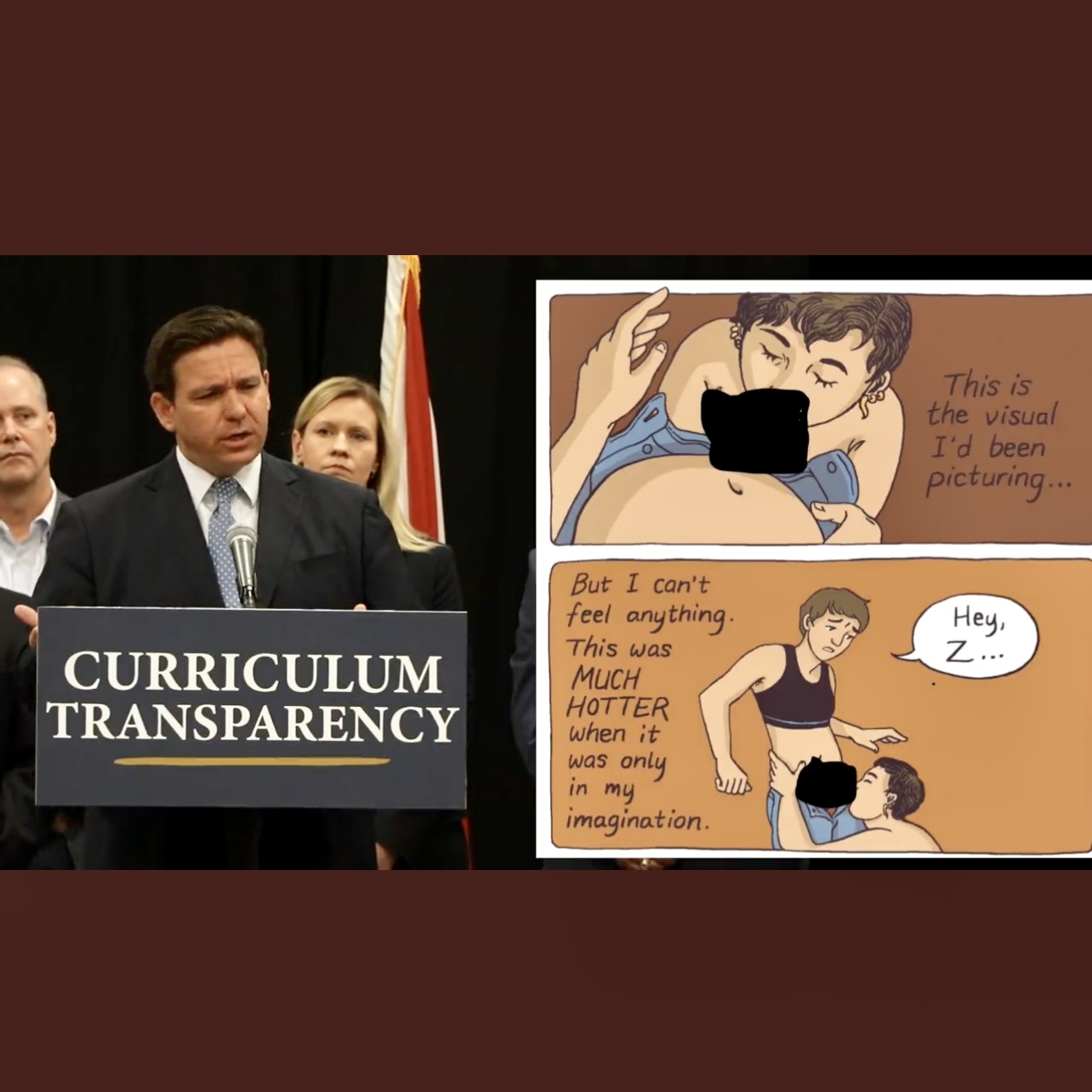
The grooming is so bad that even state governors are acting to stem the harm to children that school librarians trained by American Library Association (ALA) are doing, as illustrated top right.

Lesson learned: research and think carefully about the excuses librarians are using to perpetuate their ability to harm children, then use their words against them to deny them funding for continued grooming.

A report from Idaho provides an illustration of the above: “On Thursday, Rep. Julianne Young (R-Blackfoot) shared an email from the Idaho Libraries Association from March 2.  Young said it contained ‘a number of false and misleading claims about the content and potential effects’ of House Bill 666 – a proposal that would’ve made it a misdemeanor for librarians to lend any material deemed ‘harmful’ to children.” 

Source: “5th Time's a Charm: Idaho Legislature Passes Library Commission Budget,” by James Dawson, Boise State Public Radio News, 26 March 2022.

So, the Idaho Library Association lied and the Idaho legislator called out its “false and misleading claims about the content and potential effects” of an Idaho House bill (Idaho HB 666).  People are waking up, but not the kind of woke ALA wants.  “‘This is conduct that is unprofessional, it is disingenuous, and in my mind, it is unacceptable,’ Young said of the email Thursday.”

And she’s absolutely right.  Other legislators should similarly look at the “conduct that is unprofessional, … disingenuous, and … unacceptable” by their own state library associations and librarians, let alone ALA.

The content for which librarians are acting so unprofessionally?  It’s grooming content so bad Florida Governor DeSantis spoke out specifically against it, displaying images from a book called “Gender Queer: A Memoir” so pedophilic they had to be blacked out in areas and media will not even show them.  The problem is so bad that it’s festered to the point where state governors are now having to act since so many are frozen by the assumption librarians would never harm children.


These are books school librarians are giving to America’s children.  ALA gives them awards (Stonewall Book Award, 2020, Gender Queer) precisely to help librarians spread them further.  They are award winning!  They are protected by ALA’s so-called “Library Bill of Rights” that prevents librarians from making “age” distinctions!  It’s the First Amendment!  “FReadom”!  “We believe that school libraries do not have obscene or pornographic materials and using these terms to describe books, singular words, or small portions of a book is a tactic to undermine the value of books, public education and educators, particularly school libraries and school librarians.”  

Know that ALA trains librarians, “A librarian is not a legal process. There is not a librarian in the county—unless she or he is a lawyer—who is in the position to determine what he or she is looking at is indeed child pornography.”  It’s like they don’t know what a woman is because they are not biologists.  The people need legislators to act in the face of librarians who are the cause of the problem and who target children with “conduct that is unprofessional, … disingenuous, and … unacceptable.”

Just days ago ALA held a librarian conference where librarians were specifically trained to defy parents and legislators. Look how they lie:

“This is not an accident. What we’re seeing today reflects planning,” noted Caldwell-Stone. The “perfect storm” of the last few years (pandemic, political division, social media, and virtual meetings) has led to local and national attempts to exploit divisions and fears. These attempts also raise moral panic about false claims of pornography, critical race theory (CRT), marxism, and more. School and library board candidates are running on book banning platforms.  Politicians and organizers portray libraries as “dens of iniquity” and librarians as worse.

Source: “Censorship Preparedness at #PLA2022,” by Alec Chunn, ALSC Blog, 25 March 2022.

So while the ALA leader decries “attempts to exploit divisions and fears,” she exploits divisions and fears about “book banning” and “dens of iniquity,” all to make more graphic pedophilic literature available to more school children.

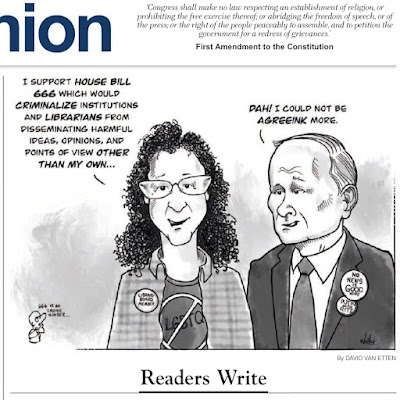
Even members of library boards of trustees who don’t toe the ALA’s groomer line are attacked as homophobes and war criminals, talk about “raising moral panic”:


Source: Coeur d’Alene Press, Friday, 18 March 2022

So, legislators, since librarians will not voluntarily stop giving children graphic pedophilic literature—quite the opposite, it’s getting worse—you can stop funding them and their groomer activities, as Rep. Julianne Young and fellow legislators have just successfully done.  Don’t give money to people grooming your children, even if they serve a once venerable public role.  Carefully research and examine the excuses librarians use to perpetuate their harm to children, then use their own words to deny them funding for continued grooming.

Sunday, March 13, 2022

School Librarians Admit Past Racism, Endorse State-Sponsored Reverse Racism

School librarians are all in on state-sponsored racism.  Read this posted a few days ago from the American Association of School Librarians (AASL), a division within American Library Association (ALA):

ALA Resolution 52 from AASL:

Because we so often run out of time to discuss the other resolutions, I wanted to share my 3 minute explanation of resolution 52 which we should be discussing and voting on today.

Why did AASL bring this resolution? This resolution is not solely an apology for inaction and for harm to others regarding past actions that were brought to our attention by author Wayne Wiegand. While looking at the actions, inactions and the silence of the past, we looked at ALA and AASL today to see how well we are working together on current EDI initiatives. We discovered that AASL has taken some beginning steps that others in ALA are unaware:

AASL has created documents and initiatives to support equity, diversity and inclusion and we listed these in the resolution in case you haven't seen them.

AASL has sponsored Spectrum Scholars program since its inception – our current president Kathy Carroll is a Spectrum Scholar.

Equity, diversity & inclusion are core values of our profession; EDI is at the forefront of AASL policies, our strategic, and our operational plans; and within every area of school librarian practice.

We acknowledge and we apologize for past actions and inactions that have harmed members of the profession and for the part AASL and ALA has played in historical racism and segregation in the library profession.

We commit to promoting diversity at the beginning of their careers, in leadership opportunities and in the greater work of AASL and ALA through an EDI lens in a sustainable manner.

We see the need for better communication throughout ALA so all are aware of EDI initiatives. One of the problems historically has not been that nothing was done, but that nothing was written or communicated to others within our profession about our work and opportunities.

AASL stands ready to lead loudly while creating opportunities and resources for collaboration with ALA divisions, ALA chapters, AASL chapters, ALA Roundtables and Ethnic Caucuses to create a stronger voice for our profession.

At a time when school and youth librarians are being targeted in our society for our intellectual freedom and social justice efforts; at a time when our BIPOC students are losing equitable access to school librarians and their libraries; at a time when we need to be standing together, taking action and communicating to others, this is when ALA needs to join with us to acknowledge the past, commit to doing better, and sharing our message of power and hope to promote Equity, Diversity, and Inclusion Efforts in ALA while addressing historical effects of racism.

------------------------------
Diane R. Chen
School Librarian @ Stratford STEM Magnet School
AASL Division Councilor
------------------------------


2021-2022 ALA CD#52 
2022 ALA Virtual January Council Meeting

Resolution to Promote Equity, Diversity, and Inclusion (EDI) Efforts in AASL
While Addressing Historical Effects of Racism

Whereas the American Library Association (ALA) Council adopted resolution CD#41-7618 “Resolution to Honor African Americans Who Fought Library Segregation” stating that the American Library Association participated both passively and actively, in the disenfranchisement of African American librarians, depriving them of the resources of a professional association;

Whereas between 1954 with the Brown v. Board of Education decision through 1968, the American Association of School Librarians (AASL) took no action to publicly support Brown or to oppose segregated public school libraries;

Whereas Koch wrote in 1975 “from their late-nineteenth and early twentieth-century origins, southern state library and education associations to which school librarians belonged had been segregated. AASL not only said nothing and took no public position against these racist practices, it continued to accept delegates from segregated school library associations as AASL representatives until the mid-1960s. In 1951, AASL quietly decided that in its state-member Assembly, segregated black and white state library associations could each appoint one representative, but those representatives would each get only half a vote” ;

Whereas AASL acknowledges the racist experiences suffered by Black school librarians including Ernestine Denham Talbert, Jurl Portee Watkins, Carrie Coleman Robinson, and many others who did not have the voice of the association advocating on their behalf;

Whereas the inactions of AASL also caused harm to Black and Indigenous People Of Color (BIPOC) members of the school library profession;

Whereas AASL acknowledges harm done to fellow BIPOC colleagues and offers a sincere apology as an important and necessary first step in the process of reconciliation;

Whereas AASL must communicate how the association has worked to create documents and
initiatives to support equity, diversity and inclusion such as “Developing Inclusive Learners and  Citizens Activity Guide”, “Defending Intellectual Freedom: LGBTQ+ Material in School Libraries" Toolkit, Mary Keeling’s 2019-2020 Presidential Initiative, Office Hours, and Increasing Representation Mentoring Program (IRMP), and the Knowledge Quest March/April 2021 issue Black School Librarianship: Navigating Race and Creating Change;

Whereas, AASL has and continues to be a sponsor of the Spectrum Scholars program since its inception;

Whereas AASL affirms the importance of equity, diversity & inclusion as core values of our profession;

Whereas equity, diversity and inclusion are at the forefront of AASL policies, our strategic, and our operational plans;

Whereas equity, diversity and inclusion are within every area of school librarian practice including collection development, professional development, recruiting, mentoring, and instruction through our National School Library Standards and opens opportunities for future members to see themselves as an integral part of AASL; and

Whereas the inclusion of all perspectives enriches and builds understanding which in turn impacts our school library profession, our learners, and our community; now, therefore, be it

Resolved, that the American Library Association (ALA), on behalf of its members
  1. Acknowledges the American Association of School Librarians’ past actions and inactions that have harmed members of the profession;
  2. Apologizes to Black school librarians for wrongs committed against them and for AASL’s inactions on behalf of segregated school libraries and school library state associations;
  3. Apologizes to all Black and Indigenous People of Color (BIPOC) school librarians for AASL’s part in historical racism and segregation in the school librarian profession;
  4. Commits to promoting diversity in school librarianship in undergraduate and graduate programs and at school recruitment fairs;
  5. Commits to ensuring a diverse and inclusive membership by recruiting, welcoming and encouraging BIPOC school librarians to consider leadership opportunities within ALA and AASL;
  6. Commits to applying and prioritizing an Equity, Diversity and Inclusion (EDI) lens in all aspects of the greater work of AASL and ALA;
  7. Commits to sustaining a more diverse and inclusive leadership within ALA and AASL in terms of ethnicity, gender, and ability representation;
  8. Communicates all EDI initiatives throughout AASL, ALA and the profession;
  9. Creates opportunities and resources for collaboration with ALA divisions, ALA chapters, AASL chapters, ALA Roundtables and Ethnic Caucuses to create a stronger voice for our profession.
Mover: Diane R. Chen, AASL Division Councilor 
Seconder: Erika Long, Chapter Councilor
Kathy Carroll, Councilor-at-Large
Kathy Lester, Councilor-at-Large
Brenda Pruitt-Annisette, MLS, Ed.D., Chair, Coretta Scott King Book Awards Committee 
Dorcas Hand, Councilor-at-Large
Joyce Kasman Valenza, PhD, Councilor-at-Large
Dr. Daniella Smith, Councilor-at-Large
Sara Dallas, Councilor at Large
Amy Lappin, Councilor-at-Large
Sara Kelly Johns, Councilor-at-Large

Version 11/07/2021

References:

American Association of School Librarians. 2019. “Developing Inclusive Learners and Citizens Activity Guide.”
 
American Association of School Librarians. 2021, March/April. ”Black School Librarianship: Navigating Race and Creating Change.” Knowledge Quest vol. 49, no. 4.

Koch, Charles William. 1975. “A History of the Association of American School Librarians, 1950- 1971.” PhD diss. Southern Illinois University.

Wiegand, Wayne A. 2021. “Race and School Librarianship in the Jim Crow South, 1954-1970: The Untold Story of Carrie Coleman Robinson as a Case Study.” Library Quarterly: Information, Community, Policy, vol. 91, no. 3, pp. 254-269. 2021 by the University of Chicago.

Wiegand, Wayne A., and Shirley A. Wiegand. 2018. The Desegregation of Public Libraries in the Jim Crow South: Civil Rights and Local Activism. Baton Rouge: Louisiana State University Press.

- - - END - - -
- - - SOURCE LINK - - -


To me, the above "Resolution" tells me the so-called "National School Library Standards" are racist and anything a school librarian says in furtherance of such "Standards" will be racist.  To me, the above shows me school librarians are all in on state-sponsored racism also known as Critical Race Theory.  What does it tell you?

As an aside, these same racist school librarians are calling it "freadom" for school kids to have school access to graphic child p r nso why should we believe these racist groomers?  At least some people are no longer blindly accepting school librarian grooming, like Larry Sanger of Wikipedia and Knowledge Standards Foundation fame:


URL of this page:  
@aasl @dianerchen @ks_found @lsanger @magnet_stem


Sunday, December 19, 2021

The Book Banning Trend; Transcript of PFLAG National Featuring Deborah Caldwell-Stone, Malinda Lo and Maia Kobabe

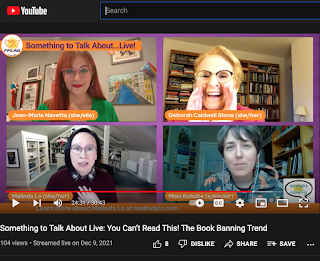
"Something to Talk About Live: You Can’t Read This! The Book Banning Trend," by PFLAG National, YouTube, 9 December 2021
Transcript of "Something to Talk About Live: You Can’t Read This! The Book Banning Trend," by PFLAG NationalYouTube, 9 December 2021, featuring Liz Owen and Jean-Marie Navetta of PFLAG, Deborah Caldwell-Stone, Esq., of American Library Association, and authors Malinda Lo and Maia Kobabe.  Graphic at right is from source and video itself is embedded below.  Hyperlinks added.


Liz Owen (00:00): Hello everyone, welcome to Something to Talk About Live. My name is Liz Owen. My pronouns are she and her, and I'm the director of communications for PFLAG National. It is really, really great to have you with us. Uh, I don't wanna waste any time because this is such an important and timely conversation. I'm gonna turn it right over to my friend and colleague, Jean-Marie Navetta

Jean-Marie Navetta (00:22): Hey Liz, how's it going? 

Liz Owen (00:23): I'm good. How are you? 

Jean-Marie Navetta (00:25): I'm so excited about this conversation, I can hardly sit still. 

Liz Owen (00:28): I'm gonna get the heck outta here. 

Jean-Marie Navetta (00:30): Yes, so I can dig it all jiggly around here and get very excited and talk about banned books. So thank you, Liz. We'll talk to you later. 

Liz Owen (00:36): You bet. 

Jean-Marie Navetta (00:38): Hey everybody. My name is Jean-Marie Navetta. I'm the director of learning and inclusion at PFLAG National. My pronouns are she and ella. Um, and every single week we get together to talk about something related to LGBTQ inclusion, and so this is a very interesting show. Um, you know, a few weeks ago, um, my colleague Greg Rokisky, who is our social media guru, um, came to me and said, "I have this idea. There's this whole thing with these books being banned and I think we should talk about it." And he started to construct the list and construct what this could look like. And I'm so excited that this is really happening. 

Jean-Marie Navetta (01:11): Um, so for those of you who like to read the article and the questions, um, and read along, you can go to straightforequality.org/discussionseries. And that is where you will find this week- weeks article which is entitled, "Librarians Are Resisting Censorship of Children's Books by LGBTQ+ and Black Authors." And that appeared in "The 19th" and it was written by Nadra Nittle. Um, so to have this conversation, we have three absolutely incredible guests. Um, we have first, um, Deborah Caldwell-Stone, who is the director of the American Library Association's Office for Intellectual Freedom. We have Maia Kobabe, who is the author of "Gender Queer: A Memoir," and we have Malinda Lo, the author of "Last Night at the Telegraph Club," which was just named one of the National Book Award winners for, uh, Young People's Literature. So welcome everybody. And thank you for being here. 

Maia Kobabe (02:04): Hello. 

Malinda Lo (02:04): Hello. 

Deborah Caldwell-Stone, Esq. (02:05): Hello everyone. Thanks for having me. 

Jean-Marie Navetta (02:07): Oh, thank you so much for being here and for joining us for this really, really important conversation. So I wanna get right into the content. Um, so for those of you who haven't read the article yet, it is a pretty shocking piece when you actually get into some of the numbers and the ways this effort is actually showing up. So, Deborah, I was wondering if we could start with you. So one of the interesting things, and by interesting, I mean kind of horrifying things, um, but I saw in the article was that the ALLA, ALA had reported that between, uh, if we looked at September 2020 and September 2021, um, the reports of attempts to ban books had gone up about 60%, which is kind of an outrageous number for one year. So what's happening out there, and what do you think is behind the sudden urgency for this effort? We know this isn't a new effort, but it does seem to be ramping up. 

Deborah Caldwell-Stone, Esq. (02:57): No, I think we're seeing, um, the results of a fairly loosely, uh, I'll be fair, it's loosely organized campaign among a number of advocacy groups, uh, to impose a kind of, uh, orthodoxy on what's available to young people in school libraries and public libraries. Um, we're seeing groups like MassResistance, the anti-LGBTQ group, get involved with challenges. Um, we're seeing, uh, Heritage Action, which is part of Heritage Foundation, Parents Defending Education, Moms for Liberty, and they're all targeting specific books. Um, they're target, you know, it seems like the main target for their ire are books that deal with the experiences of LGBTQIA persons, um, or that are meant for families led by same sex couples or things like that. 

Deborah Caldwell-Stone, Esq. (03:48): Um, what's really insidious about their, uh, efforts is that their effort to frame any materials dealing with gay, queer, transgender persons as inherently obscene for minors. And when I say minors, they're talking about anyone under the age of 18, so that there's no accommodation for adolescents, young adults preparing for adulthood at all. And some of their rhetoric makes it sound like books that are intended for high schoolers are in the hands of five year olds. Um, and the that's been remarkably effective as well. So we're seeing elected officials join the bandwagon. Uh, the governors of Texas and South Carolina have both promised to erase quote pornographic materials unquote from school libraries and public libraries. Um, we're seeing the pa, uh, proposal of legislation that would make it possible for, uh, librarians and educators to be criminally charged for providing materials to young people that parents don't approve of. 

Deborah Caldwell-Stone, Esq. (04:50): Um, and we're seeing, uh, really this rhetoric, this framing around these issues, that's being really destructive. We're seeing equal efforts as well, targeting, uh, materials, dealing with racism, the black American experience, black history, it seems to be a twin campaign that feeds off of each other, both, uh, LGBTQ materials and materials that they're targeting under that, you know, false rubric of Critical Race Theory. Um, and, and we, we sometimes see challenges, uh, brought by one group to both sets of materials at one time at school board meetings. 

Jean-Marie Navetta (05:27): Yeah, it is. It's been very intense. Um, and, and, and you just keep seeing more and more in the headlines. Um, you mentioned something about the age of, of readers and how this is being portrayed. Um, Malinda, your book is recommended for readers, um, grades nine and up, so it's hardly a children's book. Um, could the level of resistance to your book actually surprise you given who it was written for? 

Malinda Lo (05:53): Um, well, you know, I think the resistance has only really popped up this fall. So "Telegraph Club," um, came out in January and it's done really well over the past year. Like it's, it's sold really well, it's garnered a lot of, um, awards and I mean, and critical acclaim. It won the National Book Award. I mean, I think that the reason it got on these lists is because it's been doing pretty well. Um, I, I think that the, the thing to remember is that, um, you know, book challenges are kind of random in the past, like it's not clear why certain books are challenged. It's not clear that people actually have read the books that are being challenged. And oftentimes, yes, I can see you all nodding. (laughs) 

Malinda Lo (06:36): I can, you know, know, oftentimes the ones that are challenged are the best sellers, because those are the ones that people are aware of. Um, so, so far, uh, these challenges have not affected "Last Night at the Telegraph Club" at all, as far as I can tell, but there is the issue that, um, overt book banning is not the only way it can cause harm. I mean, the... This, they have this chilling effect on- 

Deborah Caldwell-Stone, Esq. (07:02): Absolutely. 

Malinda Lo (07:02): ... teachers and librarians that can lead them to self censor and not acquire books at all out of fear that they will be challenged. And, you know, people have their jobs on the line and I can understand why they would do this, but it's a very... It's just a hard problem, you know, because we can't fight... 

Deborah Caldwell-Stone, Esq. (07:20): Absolutely. 

Malinda Lo (07:20): ... We can't resist what we don't know about. 

Jean-Marie Navetta (07:22): Exactly. 

Malinda Lo (07:22): So if they're not even buying the books, what, what can we do? 

Deborah Caldwell-Stone, Esq. (07:25): Yeah. And, and that's really the intent behind some of these efforts is, you know, we actually saw library staff charged with pandering obscenity to minors, um, in Wyoming. And now the prosecutor, fortunately, dismissed those charges, didn't, uh, act on them. But, you know, if you're an educator, if you're a librarian and you know that this is going on, you know, and especially in rural communities, small towns, and things like that, it's really easy to decide that you want to avoid the controversy and not acquire the book at all. And that's a real shame because we know that in those communities, that there's always young people who want or need the information, want to know about these experiences, or exploring their own gender identity, sexual identity issues, and they really need to be able to reach out and see themselves reflected in library collections. And when that doesn't happen, it, it just, impoverishes their whole experience, educational experience, their whole, whole life, and really defeats the whole purpose of what libraries are all about. 

Jean-Marie Navetta (08:30): It, it's true. You know, it was interesting, um, getting ready for today's show, I read both of the books. Couldn't put either one of them down. (laughs) If you haven't read these books, you absolutely should make it a, your business to start reading them there, just so good. And interestingly enough, um, Maia, I read about your book before I actually read your book. And so I went into it sort of wondering what was I going to see compared to what article says, and when I got to some of those places, it... When you read the context, when you read the whole thing, I, I literally could not figure out what was going on. So, um, you wrote a great, uh, well wrote and drew, um, a great "Washington Post," um, editorial about, um, the response to "Gender Queer," which is just so amazing. What did it feel like to know that your personal story has suddenly made you this kind of lightning rod, um, for other people's resistance? 

Maia Kobabe (09:21): Yeah, it was very strange. Um, I, my book has been out for even longer than Malinda's. It actually came out in 2019. It's been out for two and a half years at this point. And when it first came out, I did brace myself for some resistance. I know that it's really common for queer stories to receive push back online. So I kind of like braced myself a little bit for that. But when it didn't come in the first two years, I thought this is probably fine, it's... I'm safe now. Um, and then I really feel like what's happened is that this book, my book, Malinda's book, and a lot of other books have just been caught up in what really feels like a viral social media moment. And I absolutely do think that the majority of the people challenging the books have not read them. 

Maia Kobabe (10:00): So for me, I'm really not taking it as a judgment on my work or on my book, I'm really taking it as like my book is, uh, particularly vulnerable because it is illustrated, so it's really easy to flip it open and grab the singular, um, visual images that people disagree with out of context and really easy to like, get them viral online, maybe easier than it would be like a, a paragraph of like written text. Um, so huh I mean, it's, I- I'm not happy about it obviously. It's been, it's been a very distracting and kind of upsetting time. Um, but on the other hand, like Malinda said, it's like, it hasn't hurt the book at all. The sales are up, it's doing great. Many people have reached out to me in the past couple of weeks to say, "I saw your book was banned and therefore I decided to read it and I really enjoyed it," which is like a weird little silver lining. 

Maia Kobabe (10:48): And really what I'm coming to see is these book bans don't really hurt the book or the author, what they hurt is the communities. It's, it's like, I'm when I'm seeing it as is a community attacking itself. And like Deborah said, impoverishing itself. 

Jean-Marie Navetta (11:01): Yeah. Yeah. I, you know, I couldn't help as I read both of your books, thinking about, uh, as I've joked a million years ago, being in high school, there were no books like yours (laughs) on the shelves. And I always go back, you know, I, I have these moments where I go back and I think 15, 16 year old me, how would it have been different now? And I think these would've... These kind of books would've been lifelines. Um, Deborah, you know, this whole idea of what appears in schools, what youth have access to, the role that their parents have in controlling this has certainly become very much of a political tool. In fact, a lot of people have put, have pointed to Glenn Youngkin's campaign in Virginia, which, one of his commercials actually featured, uh, a student reading, uh, Toni Morrison book, um, as one of the reasons that he was successful there that this, this whole theme, this drum that is being beat, um, is, succee-, you know, is why he won. Do you think we're gonna see more of that, um, in the future as we head towards another round of elections? 

Deborah Caldwell-Stone, Esq. (11:57): Absolutely. I think that, um, I, I, I would actually argue that it wasn't one of the, um, primary reasons why Youngkin won his election, but I think that what, the lesson they took from that it's a way of activating, um, suburban women, that trended toward voting for Biden in the presidential election, and to draw them in, and to create controversy around that, um, and, and activate the that particular set of voters. And so we're seeing these groups, Moms for Liberty, um, or Parents Defending Education, they're doing anything, but, but they're out there, they're recruiting, they're organizing, um, uh, campaigns. We're actually seeing efforts to target and recall school board members who vote to support intellectual freedom, to support access to these materials. Um, and so I think it's going to be a real factor in elections. 

Deborah Caldwell-Stone, Esq. (12:56): And you can look at the, um, actions of the one state rep in Texas [NOTE: Matt Krause] who created that list of 800 and fif- 849 bad books. Um, and it's drawing him attention and otherwise he would be a nobody in the race for Attorney General in Texas. It it's got that, did exactly what he wanted, which was to elevate his profile and get him attention. And he didn't really ask for anything to happen with these books, he just asked, "Do you have these books in your library?" And the sad thing is, is we're now hearing from school districts in, um, in Texas, that there are a number of 'em using that list to identify and pull books simply because they appeared on his list without anything more. 

Deborah Caldwell-Stone, Esq. (13:42): And it it's in of course the majority of the books were either LGBTQIA themed, or dealing with, uh, race or racism. Uh, so, you know, it's, uh, you know, I think that we'll certainly see it, and we're certainly already seeing discussions of state legislatures. We know that there will be a bill pending in Georgia, a bill's already been introduced in Florida, uh, all aimed at providing tools for censorship, uh, aimed at what are called diverse materials, diverse topics in schools and libraries. 

Jean-Marie Navetta (14:15): Yeah. It's, it's definitely on the move. Malinda, you da, your book wh, it, it, wasn't just about, um, uh, a, you know, LGBTQ characters or anything, it had a lot of themes. It was coming of age, it was about race, it was about sexual orientation, it was about expression, it, it all came into play. Um, do you think it was this combination that led to so much ire? Because I have to admit as I read it, I thought I really have a hard time putting my finger on any one thing that I would call problematic. (laughs) I mean, it was so many different themes that we need people to, to learn, uh, to learn about. So do you think it was the combination, or do you think there was one thing that really attracted attention? 

Malinda Lo (14:54): Uh, well, first of all, I wanna, I wanna note that I have not faced anywhere near the amount of, uh, book challenges and resistance as Maia has with "Gender Queer." Like my books have always kind of floated under the radar, I think maybe because they're novels about queer girls and that doesn't seem as, as threatening as novels about trans and gender queer people. Um, it's, it's an interesting situation, um, to find my books in now, because as Deborah mentioned, that list of 850 books includes, uh, my first novel "Ash," which was published in 2009. 

Maia Kobabe (15:30): Oh my gosh. 

Malinda Lo (15:30): I mean, that book has been out for so long. Uh, it's a lesbian retelling of "Cinderella" that has, I don't know. I mean, they could... That actually was attempted, somebody did try to challenge that when it first came out, but that it didn't work. Um, so I, I think that, again, the problem is they're not really reading these books- 

Maia Kobabe (15:50): No. 

Malinda Lo (15:50): ... in the ways that readers read them. You know what I mean? Like I follow this, um, researcher on Twitter, Richard Price, and he's been getting some of the complaints from the school districts where these books are being challenged, including one school district where "Last Night of the Telegraph Club" is on their list of pending books to discuss. They've already removed Maia's book from their school district there. Um, but so Richard Price received these complaints and they say nothing on them when they ask, why are you challenging this book? It just says parental complaint, that's it? 

Maia Kobabe (16:21): Yeah. 

Malinda Lo (16:21): There's no detail. So I'm really not convinced that, uh, they know why they're challenging these books. (laughs) 

Deborah Caldwell-Stone, Esq. (16:28): I can confirm that because we, uh, we solicit reports from educators and librarians across the country, which goes into our most challenged book lists. And we're getting reports particularly about "Gender Queer" that, um, repeat the very same language from a social media post. 

Maia Kobabe (16:49): Yeah. 

Deborah Caldwell-Stone, Esq. (16:50): So we know that they're challenging this based on social media reports that they're reading or outrage articles in, you know, right wing press, and they're not actually reading the book. Uh and and you know, it's not uncommon for that to happen, but this really is... This is, part of this is fueled by social media and outrage and and deliberate... 

Jean-Marie Navetta (17:11): It is. It definitely is. And it ah, in some ways I'm surprised by what you just said, and in other ways, I'm, I'm not [inaudible 00:17:16] zero ways. So Maia, you know, we've been talking about sort of the front side of this, you know, what the bans look like and what making us inaccessible can look like. But, um, your book, as you said, it's been out a little while. Um, we are not talking about the impact that it's had on the readers. Um, and it's really significant. Could you talk a little bit about some of the feedback that you've received from readers, especially the younger ones, um, and, and what that's been like. 

Maia Kobabe (17:43): I've been getting so many messages from readers. I mean, ever since the beginning, I, when the book first came out, I was getting, uh, multiple specifically Instagram DMs. Yes, so from likely from young people, like a week, and a lot of people saying things like, "This is the first time I've ever seen myself represented in a book," or like, "I had... I've never heard this described this way," or, "I didn't even have the language to describe this." And then my favorite type of messages are when people say, I, like, "I shared this with my parents, and then now they like understand me better." Or like, "It's opened up conversations we hadn't been able to have before," or sometimes the reverse and sometimes like people say, "I'm a non-binary parent and I share this with my child." And that's like, really, just like so heartwarming and so lovely. 

Maia Kobabe (18:23): And there has been an uptick of messages again, since like the recent banning and some of them yes, are people saying, I, I heard about this because of the ban. And then I think other peoples maybe are seeing it, yeah, maybe slightly more prominently displayed in a bookstore or something and, um, and reaching out. Or, or librarians and teachers saying like, "I have this book in my classroom and I'm gonna make sure it stays in the classroom and on the shelf." So that's really heartwarming and heartening. 

Jean-Marie Navetta (18:48): What, what, I I I, you know, opposition is typically not listening to us and they don't particularly care about what's going on, but what is the thing that you wish that they could see or hear about books like yours? 'Cause I think they're so riled up in maybe not even reading the book and just getting to the ban, what are they missing that they're not listening to? 

Maia Kobabe (19:08): I think that they're missing how like smart young people are, and how most, especially like teen and middle grade readers, if they come across this type of material, it's often 'cause they're seeking it out because they're already questioning these topics because they want to know things about this. And that includes topics of Critical Race Theory or civil rights, students rights, and you know, sexual health and abortion, which are all topics that also showed up on that 850 book list. Like teens are so smart and they're so curious and they really want knowledge about the world, but sometimes they feel too like shy or hesitant to like ask like a parent or a teacher directly. 

Maia Kobabe (19:44): And so, um, and I also know like as a teen, a couple of times I did come across a book that felt like it wasn't quite right for me, but I was very good at being like, I'm not ready for this book and setting it aside. And I think that they're not counting on, yeah, just how smart and thoughtful young readers are and that they are ready... If they're ready for this material, like they will know. Yeah. And then, and just the fact that you can learn so much from books that are both also about people that are completely different from you and it can really like open up windows of empathy. 

Jean-Marie Navetta (20:12): Yes. I have to know while I was reading yours, I was actually saying this to one of my colleagues earlier as somebody who's who identifies incredibly as incredibly binary, cisgender and gay, (laughs) there were so many parts of it where I found myself saying, I, I know what that feels. Oh my goodness. I, I have that too. And I, and it, it was such an eyeopener to me, even as an adult, or at least that's what I'm told, to have these moments. And again, it left me with that wonder 15, 16 year old me wishing that she had that book. So, uh, we have about 10 minutes left and I wanna spend time talking about what we should be doing, um because PFLAGers are, um, nothing, if not acts, uh, action oriented. 

Jean-Marie Navetta (20:49): So Deborah, I wanna start with you. So how can everyday advocates be of service here? Um, how can they help defend librarians, defend the selections that are coming in in libraries? 'Cause I, I was listening to the point that you started with, that this isn't just about banning, but this is sometimes about intimidating librarians from bringing certain content in. So what should people be doing, um, with libraries and librarians? 

Deborah Caldwell-Stone, Esq. (21:12): In the present moment, start showing up at board meetings, I'm dead serious. We've, you know, we've... I think we've gotten into the habit of kind of ignoring small, local elected boards, school boards, library boards, and they're taking advantage of that. They're targeting those groups. And so we need people to show up and speak up at board meetings. More importantly, we need people to show up and vote in these elections. We do know that they're organizing deliberately to take over seats with an anti, um uh, excuse me, a pro censorship agenda. And we've already had it happen in three library boards out west where individuals who vowed to scrub the library of LGBTQ materials were elected to the library board. And because boards are the decision makers, they set the policy, they make the decisions, they may well have the power to do that if someone doesn't go to court and challenge it. 

Deborah Caldwell-Stone, Esq. (22:07): So get involved with local elections and pay attention to your local press. If you don't have any, pay attention to your local media. Join local, uh, if you've got a friends group for your local libraries, if you've got a PTO, that's another place where you can make a real impact in, uh, changing the rhetoric around the schools. Because these people get attention because they're the loudest voices. 

Maia Kobabe (22:29): Yes. 

Deborah Caldwell-Stone, Esq. (22:29): They need counter voices. 

Jean-Marie Navetta (22:31): Yeah. 

Deborah Caldwell-Stone, Esq. (22:31): So I guess what we're saying right now is, you know, engage, you know, engage in your, your local community and be involved with your schools and your libraries. Um, if there's a support group, join it, um, and pay attention to what's going on, participate in elections. Better yet, stand for election. Stand for those seats, compete for them, offer an alternative vision so that people know that censorship isn't the lesson we wanna be teaching our young people today. It's really, uh, it it's really as fundamental as that, but also, um, and, and, and pulling out a little bit further, state legislatures. You know, and I know that it seems like we're powerless that we've been gerrymandered to death, but even a few voices at a hearing can help turn away censorship legislation at this point. 

Jean-Marie Navetta (23:19): I know it would be unprofessional for me to cheer, but just know in my head I'm cheering right now at every word that you just said. (laughs) Get involved in your school board, this has been a strategy at my position for years, we need to play the same game, but even better. Um, so, um, both Mel, um, Malinda and Maia, I would love to hear from you, um, from the perspective of content creators. So what can advocates do to protect books like yours, um, what can parents and students do? And maybe Malinda, we can start with you and then Maia. 

Malinda Lo (23:46): Sure. You know, I, I think that something that I am still very concerned about is this self censorship, this quiet censorship, where the books are just not acquired. And I really want to encourage parents to talk to your kids, you know, ask them what they're reading at school, ask them if they, you know, it depends on your relationship with your kid, but ask them, you know, if they hear about anything like this going on at their school. You know, because the biggest problem is that we don't know what's happening. 

Maia Kobabe (24:14): Yeah. 

Malinda Lo (24:14): So if you find out about a book challenge at your school or an instance when a book has been silently removed, you know, get on your social media networks and tell people about it, to tell your local community, tell people on your Facebook groups. You know, I tell me. 

Deborah Caldwell-Stone, Esq. (24:30): Tell the ALA. (shouting) 

Malinda Lo (24:31): I wanna know. Tell... 

Jean-Marie Navetta (24:32): Tell the ALA. 

Malinda Lo (24:36): ... Tell the ALA. 

Maia Kobabe (24:36): Yeah, there's a form on the ALA website, like right in. 

Malinda Lo (24:37): Yeah. Tell people because that's the only way we'll know. Like a lot of times people ask me if my books have been banned and I'm just like, "Well, I only know if it's in the news." (laughs ) 

Maia Kobabe (24:46): Yeah. 

Malinda Lo (24:47): You know, because people don't necessarily come and tell the author. And I can't speak for other authors, but if you find about me, tell me (laughs), I wanna know. I'm, I'm, I'm, I'm on Twitter, just, just tell me. And so, you know, spread the news. I think we all have to share this information. 

Maia Kobabe (25:03): Right. 

Jean-Marie Navetta (25:04): I think so much of this happens in darkness. I mean, people just are not... It it's, it's not seen, and so it slides by. Maia, what about you? What do you think? 

Maia Kobabe (25:11): Yeah, I was just gonna say about my... The first time I heard about "Gender Queer" being banned was through the ALA's Banned Book field report from 2020. And there must have been a couple instances in 2020 that I literally never heard about until the book report, field report came out in September of this year. Um, I would say, yeah, um, checking the book out from the library and so that the librarian's like, "No, all this is in circulation and people are interested in this, and then if there's not a copy available of either of our books or any book that you see, that's banned that you wanna try reading." Um, every library has a some- something on the website where you can request a purchase and you can like request that they buy it. And I think librarians seeing those purchase requests, like it's sort of like, uh, that is also almost like an email or like a direct voice of them knowing like, oh, people in the community are interested in this and they want this available and they want to read this. 

Jean-Marie Navetta (25:58): Excellent. Excellent. Um, I, I really appreciate that, 'cause I think so many people, um, often feel powerless. I mean, sometimes this feels like the train is left the station and I think they're is always an opportunity to get it back. And I think these are really tangible suggestions. Things like requesting the book, letting people know that there in, in fact is demand for this content... 

Maia Kobabe (26:16): Yeah. 

Jean-Marie Navetta (26:17): ... Um, is, is so absolutely critical. So, um, I'm going to take my book nerd privilege, um, moment here, um, which is asking all of you, um, to tell us something fantastic that you have been reading lately. Um, because I think one of the best things that we can do with our platforms, isn't just talk about the problems, but talk about what is going right and what we are really enjoying. Um, and so, um, I'm gonna start again with Deborah so we can go around. 

Deborah Caldwell-Stone, Esq. (26:40): Oh, huh, I have to say I've been so busy, I haven't had a lot of time for recreational reading for the last few months. Um, but actual highlight a book I still cherish, and that's "The Absolutely True Diary of a Part-Time Indian." And it was just, uh, a glimpse into a world I didn't know anything about and, and the experiences of, uh, the protagonist and, and, you know, navigating the two worlds, his life on the res and, and the life in the white high school and things like that. Um, and I just enjoyed it. I remember vividly, uh, working on a challenge in a small community where all the young men in the community, all the 14 year olds were carrying the book because it was the first time they'd ever read a book that accurately reflected their lives living in rural poverty. And they, they were just so devoted and it was a heartbreaking when the board voted to remove the book from the, the library collection. Um, but that- that's one book I really cherish. 

Jean-Marie Navetta (27:41): Thank you. Um, Malinda. 

Malinda Lo (27:45): Well, I, I wanna talk about this wonderful book, "The Legend of Auntie Po" by Shing Yin Khor... 

Maia Kobabe (27:49): Yes. 

Malinda Lo (27:50): ... which is a graphic memoir. It's absolutely beautiful, the art is wonderful. And, um, the thing about this book is, so my novel "Last Night of the Telegraph Club" is about a queer Chinese American girl in the 1950s. There are very few books about queer Chinese American girls in history. This is another one (laughs) and it just came out this year. It's set in the 1800s, and the main character is in a logging camp. It's wonderful. And it's about, um, self-made myth, and coming of age, and exploring her identity as a queer person as well. It's a wonderful book, highly recommend it. 

Maia Kobabe (28:25): Second that, I love that book. 

Jean-Marie Navetta (28:26): I love the fact that, that we're like this, but we didn't think these books existed and yet here they all are. So that's right. It's so exciting. Maia, go ahead. I'm sorry I interrupted. 

Maia Kobabe (28:34): No, that's okay. I love that book. I'm friends with the author. We did a book event together earlier this year. 

Malinda Lo (28:38): Oh, great. (laughs) 

Maia Kobabe (28:39): Um, I wanted to shout out a book that I think has been a little under the radar, just "Out of Salem" by Hal Schrieve, which is, um, a book that's set in a high school in which there's like magic and sort of supernatural elements. And there is a werewolf character and zombie character, and they're both like queer and they become friends. And like, there's also a lot of really rich metaphor of like of monstrosity and queerness and the way people, you know, view other sexualities and other bodies as monstrous, but that can be like reclaimed and people like finding each other who have been sort of like pushed to the margins of their societies. And I just thought it was really, really well written. And, um, I believe it came out in early, early this year. 

Jean-Marie Navetta (29:16): Thank you. Um, thank you all. Uh, this was such an absolute treat. It was an absolute gift that when we came up with the idea, I wasn't sure if we'd be able to make it happen in here, all of you are having this conversation. Um, I'm so grateful to you for your time. I'm even more grateful for you to, for your advocacy and your creativity, and what you are putting out into the universe and giving people who sometimes feel like they are never gonna be seen a way to see themselves, um, and then defending the ability that for those books to remain on shelves. So, um, Deborah, Malinda, Maia, thank you so, so very much, and please keep up the incredible work that you are doing. 

Maia Kobabe (29:52): Thank you for having us. 

Deborah Caldwell-Stone, Esq. (29:53): Thank you for hosting this. 

Malinda Lo (29:54): Yeah. 

Jean-Marie Navetta (29:55): Thank you. Well, everybody, this gets us to the end of yet another show. Um, it's always hard to end these, um, when the conversation is that good. We will be back next week with actually our last show of 2021. I almost said 20, I'm so confused. Um, we will wrap up the same way we do every single week, which is reminding you to run fast, laugh hard, and most of all be kind, but please, please, please, if you haven't done it yet get vaccinated, and if you have been vaccinated, go get your boosters, um, so we can all be together again sometime soon. If you need any help before next week's show, um, make sure you visit pflag.org/find to locate your lo-, uh, closest chapter. My name is Jean-Marie Navetta, and I will see you next week on Something to Talk About Live. Bye everybody. 


Source:

"Something to Talk About Live: You Can’t Read This! The Book Banning Trend," by PFLAG NationalYouTube, 9 December 2021.


Join PFLAG National live this Thursday, December 9th at 4:30 PM ET/1:30 PM PT for Something to Talk About Live! This week we'll be discussing Nadra Nittle’s article in the 19th, “Librarians are resisting censorship of children’s books by LGBTQ+ and Black authors.”

We are excited to welcome Maia Kobabe, author of Gender Queer: A Memoir, Malinda Lo, author of Last Night at the Telegraph Club, and Deborah Caldwell-Stone, Director of the American Library Association’s Office for Intellectual Freedom to the conversation this week.

For more information--and to check out our discussion questions in advance--visit https://pflagnation.al/STTALive-120921.

License

@AdvInCensorship, @ALALibrary, @DefendingEd, @GlennYoungkin, @GovAbbott, @GregRokisky, @hal_schrieve, @henrymcmaster, @Heritage, @Heritage_Action, @JoeBiden, @malindalo, @MassResistance, @Moms4Liberty, @NadraKareem, @OIF, @PFLAG, @RepMattKrause, @sawdustbear, @washingtonpost, @19thnews 


Wednesday, September 1, 2021

FOIA on School Librarians Regarding Antifa Indoctrination

1 September 2021


Natomas Unified School District

Inderkum High School

2500 New Market Dr. 

Sacramento, CA 95835


Dear Principals and Library Technician:


This is a public records request.


Under the California Public Records Act § 6250 et seq., I am requesting an opportunity to obtain copies of public records that pertain to the school’s library, the school’s librarians and media specialists and library volunteers, their connections with the state’s library association and the American Library Association, and anything related to the indoctrination of school children as specified below.


If there are any fees for searching or copying these records, please inform me if the cost will exceed $150.  However, I would also like to request a waiver of all fees in that the disclosure of the requested information is in the public interest and will contribute significantly to the public’s understanding of how public school librarians and media specialists, influenced by library associations that bring in trainers to train school librarians and media specialists on how to indoctrinate children nationwide, then carry out that indoctrination.  


I am Dan Kleinman of SafeLibraries® Brand Library Educational Services who has for over two decades exposed how policies promulgated by the American Library Association harm children, local communities, and even librarians themselves.  My cybersafety work has been cited in over a dozen United States utility patents.  I publish my findings and make them available at no cost, and my findings are discussed in library schools worldwide.  More information about me here: https://tinyurl.com/AboutDan  


I am a representative of the news media and my request is related to news gathering purposes.  This information is not being sought for commercial purposes.  I again request a waiver of all fees in that the disclosure of the requested information is in the public interest and more, as stated above.


Requests from others might pertain to school teachers like Gabriel Gipe and school administration, whereas mine pertain to school libraries and school librarians.  Gabriel Gipe was filmed by reporters for Project Veritas, via James O’Keefe, III, bragging about turning school children into revolutionaries in 180 days.  See https://www.projectveritas.com/news/breaking-pro-antifa-high-school-teacher-in-california-admits-communist/  It is this video that prompted me to determine what kind of involvement he had with school librarians and whether that involvement may have furthered his child abuse.


Gipe was filmed having in his classroom a flag of domestic terrorists called “Antifa,” a portrait of the Communist mass murderer Mao Zedong, and antisemitic support for foreign terrorists called “Palestinians.”  He has an INGSOC tattoo of significance from George Orwell’s book, “1984.”  He along with his wife has been charged for riot and more by the California Highway Patrol due to their participation in domestic terror.  This open records request is to determine if and to what extent school librarians have adopted or contributed to what he is reported to have presented to students to indoctrinate them or if they have done their own indoctrination sua sponte or as prompted by various library associations.


Here are the generalities of this request:


  1. This request is limited to documents created during 2019, 2020, and 2021.
  2. This request is limited to the Inderkum High School librarians, media specialists, and library volunteers such as those from the school’s joint partnership with Sacramento Public Library/North Natomas Branch, both those employed or volunteering in the past (2019-2021) and those currently employed or volunteering.
  3. Librarians comprise accredited librarians, library employees, media specialists, and library volunteers associated with school district libraries and the provision of library-related services. One does not need to have attended nor been graduated from an American Library Association accredited library school to be considered a librarian for the purposes of this public records request.  Library volunteers comprise those who work in public libraries and not in school libraries and who also volunteer for school libraries.  Hereafter, for brevity, all will be termed “librarians.”
  4. This request is not limited to the school’s assigned email addresses. “Librarians” have been trained to use personal email accounts and media sites to effect communications intended to be hidden from the public and from public disclosure laws.  As such, documents requested herein should also come from personal emails and accounts when they pertain to the documents being sought.  Of course redact any personal email addresses and telephones.
  5. This request is not limited to email addresses in the To and Cc addresses.  It also includes the Bcc addresses.  Bcc addresses are for the convenience of the sender and are not a means to evade open government laws.
  6. This request is limited to documents, but it is not limited to only electronic documents.  It includes written documents.  For example, it includes handwritten notes taken by “librarians” while in attendance at any trainings.  The American Library Association has advised its trainees not to respond to FOIA requests for notes on the claim that they contain material that is proprietary to the American Library Association and taken during trainings closed to the public.  But such declarations are not of concern to open government laws, so such documentation must still be produced, particularly in light of CPRA § 6253.3.
  7. Please do not redact any non-exempt information on the documents.  
  8. Please do not destroy the documents requested then claim they do not exist, no matter who advises “librarians” to destroy public records, particularly in light of CPRA § 6253.3.  The American Library Association has done this in the past to prevent disclosure of the crime of child pornography viewing in public libraries and of its own homophobia when an ALA trainer asked why any woman would let her small children around a gay man (the gay man and the woman were the whistleblowers, so homophobic ad hominem argument was part of the training).  California librarian Sarah Houghton, known as the Librarian in Black, provided training at a California Library Association conference in which she hinted that librarians should destroy public records to thwart police investigations.
  9. All documents should be clear of imperfections that result from poor copy quality.  For example, hand written notes should be completely readable and not appear too light or too dark to read.  Unreadable documents are non responsive documents.
  10. All documents should be produced as PDFs, except for photographs (that should be JPEG), audio files (that should be MP3), and video (that should be MP4 or MOV).  Handwritten documents can be scanned into PDFs.  If the document files are too large to transmit in one single email, I authorize you to transmit them to me either using a free file sharing service such as DropBox or to send multiple emails (as many as required to send all documents being provided).
  11. All documents are to be provided electronically.  Documents made available for personal inspection are intentionally not responsive to this public records request as I will not make a personal appearance to inspect such records, nor is that required by the law.


Here are the specifics of the request, given the generalities to be applied from above:


  1. Provide documents showing the attendance of all “librarians” at online and in person meetings of any kind, including trainings and conferences, sponsored by the California Library Association or any of its subdivisions.  Documents are to include financial receipts for payment of related expenses, attendance sheets from such events, lists of events attended, notes by hand or electronically recording during such events, recording of such events, links to recordings of such events, handouts from such events, links to handouts from such events, listings of books and other reading materials including online sources such as EBSCO received from such events, awards or certifications obtained at such events, and emails pertaining to such events.
  2. Provide documents as described in #1 above, only with respect to the American Library Association or any of its subdivisions, such of the Office for Intellectual Freedom (OIF), the Young Adult Library Services Association (YALSA), the American Association of School Librarians (AASL), the Association for Library Service to Children (ALSC), the Freedom to Read Foundation (FTRF), Banned Books Week (BBW), etc.
  3. Provide documents as described in #1 above, only with respect to the school district itself or school superintendents or principals themselves.
  4. Provide transcripts of all “librarians” who spoke at any local public meetings including school board meetings and provide the full transcripts and meeting notes of such meetings.  Such documentation should include the identity and date of the meeting.
  5. Provide documents created by all “librarians” containing the following words and phrases: critical race theory, crt, social emotional learning, social and emotional learning, social learning, emotional learning, social and emotional competencies, sel, tsel, 1619 project, howard zinn, zinn education project, equity, gender, gender unicorn, masturbation, anal, top surgery, front hole, chestfeeding, chest feeding, gender pronouns, breast binder, breast binding, PrEP, pre-exposure prophylaxis, implicit bias, drag queen, drag queens, drag queen story hour, drag queen story time, dqsh, dqst, diversity, inclusion, social justice, white fragility, black lives matter, latinx, acting white, white supremacy, white supremacist, white privilege, kendi, ibram kendi, ibram x kendi, n hannah jones, hannah jones, nikole jones, nikole hannah-jones, ida bae wells, whiteness, bipoc, deangelo, diangelo, robin diangelo, antiracist, antiracists, antifa, antifascist, fascist, fascists, critlib, #critlib.  For example, referring again to Sarah Houghton, she tweeted on Twitter, “If you are a fascist and work in a library, find another job. If you are white supremacist and work in a library, find another job.”  Documents such as that with respect to your own “librarians” should be included in the response.
  6. Please provide documents regarding “librarians” meeting online or in person with Gabriel Gipe, including those describing what was discussed and what services were provided to him by the “librarians.”  Such meetings may have occurred in the library, in Gipe’s classroom, or elsewhere.  
  7. Please provide documents created by “librarians” that name Gabriel, Gipe, Gabriel Gipe, or any other name that refers to him.


CPRA requires a response time within ten business days.  If access to the records I am requesting will take longer than this amount of time, please contact me with information about when I might expect copies of the requested records.


If you deny any or all of this request, please assist me per CPRA § 6253.1(a)(1) and cite each specific exemption you feel justifies the refusal to release the information and notify me of the appeal procedures available to me under the law.


Thank you for considering my request.


Sincerely,


Dan Kleinman

SafeLibraries® Brand Library Educational Services

973-610-8296

SafeLibraries@pm.me

641 Shunpike Rd #123

Chatham, NJ 07928


PS: This FOIA request is published here: 


https://safelibraries.blogspot.com/2021/09/foia-on-school-librarians-antifa.html


URL of this page:  

Sunday, August 29, 2021

FOIA on School Librarians Regarding Critical Race Theory

29 August 2021


Custodian of Records

South Kingstown Public Schools

307 Curtis Corner Rd

Wakefield, RI 02879


Dear Custodian of Records:


This is a public records request.


Under the Rhode Island Access to Public Records Act, §38-2-1 et seq., I am requesting an opportunity to obtain copies of public records that pertain to the school’s library, the school’s librarians and media specialists and library volunteers, their connections with the state’s library association and the American Library Association, and anything related to a particularly heinous form of state-sponsored racism commonly called critical race theory, among other things.  Specifics on what I seek follow below.


If there are any fees for searching or copying these records, please inform me if the cost will exceed $150.  However, I would also like to request a waiver of all fees in that the disclosure of the requested information is in the public interest and will contribute significantly to the public’s understanding of how public school librarians and media specialists, influenced by library associations that bring in trainers to train school librarians and media specialists on how to teach critical race theory to children, contribute to the indoctrination of racism into the minds of school children nationwide.  


I am Dan Kleinman of SafeLibraries® Brand Library Education Services who has for over two decades exposed how policies promulgated by the American Library Association harm children, local communities, and even librarians themselves.  My cybersafety work has been cited in over a dozen United States utility patents.  I publish my findings and make them available at no cost, and my findings are discussed in library schools worldwide.  More information about me here: https://tinyurl.com/AboutDan  


I am a representative of the news media and my request is related to news gathering purposes.  This information is not being sought for commercial purposes.  I again request a waiver of all fees in that the disclosure of the requested information is in the public interest and more, as stated above and in §38-2-4.


I am not related to nor am I working for Nicole Solas, though I support her open government efforts to obtain documentation from public schools as she sees fit.  Her requests pertain to school teachers and school administration whereas mine pertain to school libraries and school librarians.


Here are the generalities of this request:

  1. This request is limited to documents created during 2019, 2020, and 2021.
  2. This request is limited to the South Kingstown School District’s librarians, media specialists, and library volunteers, both those employed or volunteering in the past (2019-2021) and those currently employed or volunteering.
  3. Librarians comprise accredited librarians, library employees, media specialists, and library volunteers associated with school district libraries and the provision of library-related services. One does not need to have attended nor been graduated from an American Library Association accredited library school to be considered a librarian for the purposes of this public records request.  Library volunteers comprise those who work in public libraries and not in school libraries and who also volunteer for school libraries.  Hereafter, for brevity, all will be termed “librarians.”
  4. This request is not limited to the school’s assigned email addresses. “Librarians” have been trained to use personal email accounts and media sites to effect communications intended to be hidden from the public and from public disclosure laws.  As such, documents requested herein should also come from the personal emails and accounts when they pertain to the documents being sought.  Of course redact any personal email addresses and telephones.
  5. This request is not limited to email addresses in the To and Cc addresses.  It also includes the Bcc addresses.  Bcc addresses are for the convenience of the Sender and are not a means to evade open government laws.
  6. This request is limited to documents, but it is not limited to only electronic documents.  It includes written documents.  For example, it includes handwritten notes taken by “librarians” while in attendance at any trainings.  The American Library Association has advised its trainees not to respond to FOIA requests for notes on the claim that they contain material that is proprietary to the American Library Association and taken during trainings closed to the public.  But such declarations are not of concern to open government laws, so such documentation must still be produced.
  7. Please do not redact any non-exempt information on the documents.  
  8. Please do not destroy the documents requested then claim they do not exist, no matter who advises “librarians” to destroy public records.  The American Library Association has done this in the past to prevent disclosure of the crime of child pornography viewing in public libraries.
  9. All documents should be clear of imperfections that result from poor copy quality.  For example, hand written notes should be completely readable and not appear too light or too dark to read.  Unreadable documents are non responsive documents.
  10. All documents should be produced as PDFs, except for photographs (that should be JPEG), audio files (that should be MP3), and video (that should be MP4 or MOV).  Handwritten documents can be scanned into PDFs.  If the document files are too large to transmit in one single email, I authorize you to transmit them to me either using a free file sharing service such as DropBox or to send multiple emails (as many as required to send all documents being provided).
  11. All documents are to be provided electronically.  Documents made available for personal inspection are intentionally not responsive to this public records request as I will not make a personal appearance to inspect such records, nor is that required by the law.

Here are the specifics of the request, given the generalities to be applied from above:

  1. Provide documents showing the attendance of all “librarians” at online and in person meetings of any kind, including trainings and conferences, sponsored by the Rhode Island Library Association or any of its subdivisions.  Documents are to include financial receipts for payment of related expenses, attendance sheets from such events, lists of events attended, notes by hand or electronically recording during such events, recording of such events, links to recordings of such events, handouts from such events, links to handouts from such events, listings of books and other reading materials including online sources such as EBSCO received from such events, awards or certifications obtained at such events, and emails pertaining to such events.
  2. Provide documents as described in #1 above, only with respect to the American Library Association or any of its subdivisions, such of the Office for Intellectual Freedom (OIF), the Young Adult Library Services Association (YALSA), the American Association of School Librarians (AASL), the Association for Library Service to Children (ALSC), the Freedom to Read Foundation (FTRF), Banned Books Week (BBW), etc.
  3. Provide documents as described in #1 above, only with respect to the school district itself or school superintendents or principals themselves.
  4. Provide transcripts of all “librarians” who spoke at any local public meetings including school board meetings and provide the full transcripts and meeting notes of such meetings.  Such documentation should include the identity and date of the meeting.
  5. Provide documents created by all “librarians” containing the following words and phrases: critical race theory, crt, social emotional learning, social and emotional learning, social learning, emotional learning, social and emotional competencies, sel, tsel, 1619 project, howard zinn, zinn education project, equity, gender, gender unicorn, masturbation, anal, top surgery, front hole, chestfeeding, chest feeding, gender pronouns, breast binder, breast binding, PrEP, pre-exposure prophylaxis, implicit bias, drag queen, drag queens, drag queen story hour, drag queen story time, dqsh, dqst, diversity, inclusion, social justice, white fragility, black lives matter, latinx, acting white, white supremacy, white privilege, kendi, ibram kendi, ibram x kendi, n hannah jones, hannah jones, nikole jones, nikole hannah-jones, ida bae wells, whiteness, bipoc, deangelo, diangelo, robin diangelo, antiracist, antiracists, critlib, #critlib, T.A.S.K. or TASK (Towards an Antiracist South Kingstown).
  6. Provide documents showing that the people who responded to this public records request have within the past twelve months been provided orientation and training regarding Access to Public Records Act, §38-2, as required in §38-2-3.16.

The Rhode Island Access to Public Records Act requires a response time within ten business days.  If access to the records I am requesting will take longer than this amount of time, please contact me with information about when I might expect copies of the requested records.


If you deny any or all of this request, please cite each specific exemption you feel justifies the refusal to release the information and notify me of the appeal procedures available to me under the law.


Thank you for considering my request.


Sincerely,


Dan Kleinman of SafeLibraries® Brand Library Education Services


URL of this page:  
@ALALibrary @Nicoletta0602 @rilibraries @skingstownrigov