Showing posts with label MaterialsSelectionPolicy. Show all posts

Sunday, May 5, 2024

NH HB1311 Students' Freedom to Read Act

Regarding HB1311 on 5/7/2024, I have an illuminating document from a University of Houston professor who explains how for almost 60 years American Library Association has been working to take power away from parents and school boards precisely to expose school children to inappropriate material.  It's linked below and you'll hear it from no one else.

You see, you have a piece of legislation that came up this year, and you have to decide it this year, all based on some guidance from David Paige who remains part of the American Library Association from Chicago, Illinois.  That guidance, like that 1311 "safeguards the rights of parents" when the exact opposite is true, is crafted to be misleading about the legislation and is based on 60 years of people trying to accomplish what 1311 would accomplish.  They don't have the power to force this law themselves so they work to mislead state and federal legislators into voting for it.  People with 60 years of experience are misleading people with six months of experience into passing a law that meets the aspirational creed of a private Chicago organization that works for the exact opposite of what's best for the education of school children, those in New Hampshire included.

This article linked below provides the balance you need to see clearly what is really going on.  It catches you up on 60 years of political activism from activists in Chicago seeking to obtain control of school libraries nationwide.  Indeed, ALA is working to get these same laws passed in states nationwide and has already fooled Illinois and Maryland into passing such laws.  Will New Hampshire be next?  Only you can stop it.  I strongly urge you all to read this before​ voting on whether to set The Chicago Way into the law of New Hampshire, because then you'll vote against HB 1311, your eyes having been opened:


Thank you.  Feel free to contact me (phone, text, Signal, Telegram, same number, 973-610-8296).  And I may be sending a second email regarding HB 1311.

Above was sent via email to: Ruth.Ward@leg.state.nh.us; Carrie.Gendreau@leg.state.nh.us; Timothy.Lang@leg.state.nh.us; Donovan.Fenton@leg.state.nh.us; Suzanne.Prentiss@leg.state.nh.us; peter.mulvey@leg.state.nh.us.

Saturday, March 23, 2024

Freedom to Read Act Sets NJASL as Overseer of NJ School Boards, NJASL Lies on One On One With Steve Adubato, and ALA Astroturfs for NJASL

The Freedom to Read Act by the American Library Association [ALA] in Chicago, Illinois, is sweeping America.  In New Jersey, S2421 (and A3446) will codify the Chicago organization's aspirational creed as NJ law.  Section 4(a) requires "model [school library curation] policy established by the Commissioner of Education" and section 4(b) requires "the commissioner shall consult with the State Librarian and the New Jersey Association of School Librarians" [NJASL].  So the required model policy for schools requires the model policy be written by NJASL.  Problem?  The president of NJASL was interviewed 4/11/2023 by the well-respected One On One With Steve Adubato and lied her way though.  As a result, the S2421 model policy will be based on the lies of a partisan organization parroting the words of a Chicago organization, and NJ school children will be directly harmed.  The Freedom to Read Act (aka Right to Read Act, Libraries For All Act) is fatally flawed and should never become New Jersey law.  Further, NJASL is directly supported by ALA which is astroturfing in New Jersey to pass this law that this group in Chicago wants, and NJASL with its lying president is essentially made the overseer of school boards by the Freedom to Read Act.  One hand washes the other—to take away parental rights and harm school children.


Below is a transcript of the lies made by NJASL President Ewa Dziedzic-Elliot.  She has several main points.  Each one sounds legitimate but each is intentionally misleading, sometimes to the point of simply being false.  
  1. As trained professionals, librarians are in the best position to help everyone, Ewa says.  They have teaching certificates and librarian certificates so they are "dually certified."  Sounds good, but she leaves out A.) ALA requires MLIS degrees to "infuse concepts of Equity, Diversity, and Inclusion throughout the standards."  See: https://safelibraries.blogspot.com/2024/03/mlis-degrees-are-woke.html.  B.) She also leaves out that ALA bragged to the Biden administration how librarians are better than teachers at indoctrinating school students because they have the children for years whereas the teachers have them for only a class.  See: (citation will be added when I recall where I put it).  C.) She also leaves out "the library and information services profession's commitment to racial and social justice ... diversity and inclusion as one of the profession's core values."  See: https://www.ala.org/news/member-news/2021/07/ala-adopts-new-code-ethics-principle-racial-and-social-justice  So yes, they are trained, but librarianship is a job, not a profession, and the training requires diversity, equity, and inclusion in all topics, and we all know what DEI really means.  D.) She also leaves out that ALA policy is all material for all ages: "Library policies and procedures that effectively deny minors equal and equitable access to all library resources available to other users violate the Library Bill of Rights. The American Library Association opposes all attempts to restrict access to library services, materials, and facilities based on the age of library users."  See: https://www.ala.org/advocacy/intfreedom/minors.  So the NJASL leader tells you librarians are trained but leaves out they are trained to provide any material at any age.  Does this match the community standards of New Jersey parents?  Is this common sense?  Is there a reason parental rights should be overturned in NJ to assuage the feelings of people from Chicago who think children should get anything at any age?  E.) And that "task force" NJASL created?  It's to "force" parents and legislators to cede control of NJ school and children to a politically-motivated outside organization from Chicago, IL.  That's the task force.  Any parents who step out of line are gang rushed, like the parents intimidated from even attending a public meeting about the issue they raised in Glen Ridge, NJ.  I was the only person who spoke in favor of those parents, and even afterwards the NJ ACLU decided to deride me for doing so.  That's the effect of the "task force" about which she brags that bully parents so much they fear even attending open public meetings.
  2. "We d- don't come up with these recommendations and with the- these books out of thin air."  False.  School policies substantially match the model policies made up in Chicago, IL.  This whole Freedom to Read Act S2421 is essentially a giant recommendation from Chicago, IL.  It even replaced a previous attempt called the Right to Read Act that specifically named ALA's "Library Bill of Rights" and required that it become NJ law.  That got shot down and reformed as the Freedom to Read Act, only the explicit inclusion of the "Library Bill of Rights" was excluded.  But the ideas are all the same in the new act, just without the explicit reference, and with more teeth.  And books out of thin air?  Gender Queer was a book written for adults and sales lagged for two years until ALA found it and gave it two awards, including one specifically for kids.  Now it's in nearly every school, as if summoned out of thin air.  No, actually, ALA creates lists of books like this or gives them awards and all those books go right into the schools because everyone trusts librarians, and all from ALA in Chicago, IL, about which the NJASL leader acts innocent and claims librarians are only responding to NJ educational requirements.  Super deceptive.
  3. "[O]ur biggest problem here right now is that a lot of school districts are not following their school policies and are not following the state standards and laws."  Okay, perhaps.  So if that's the problem, why is there a need for a law to force a school board to accept a policy it's not going to follow anyway?  Because S2421 A3446 is a giant power grab, that's why.  They are grabbing the power from New Jersey parents, giving it to Illinois librarians who "oppose[] all attempts to restrict access to library services, materials, and facilities based on the age of library users," then getting NJ legislators to pass it into NJ law.  And into law in state after state as ALA tries to push this nationwide.
  4. Ewa then digs into her biggest lie of all: that no parents should have the right to control what the children of other parents are reading.  And we hear books are "lifesaving" for that one special kid so all the kids have to read the "lifesaving" books.  "Lifesaving," you know, like Gender Queer and its guidance to see kink dot com, you know, that kind of "lifesaving," and all kids have to read that.  Can you see why this is so deceptive?  Can you see the huge lie?  It sounds so good.  It sounds correct.  Of course no parent should tell another parent what his child should or should not read.  Of course.  Only that's not the issue.  The issue is not parents dictating what books other families should allow their kids.  Not once has a parent ever removed a single book from a school library, short of theft.  The reality is parents have the right under the First Amendment to bring concerns to the government, in this case the school board, then it's the school board that makes the decisions, not the parents.  So arguing, "I would say to those parents, if you are not comfortable for your child to read that, you have the right to do it, but you cannot make this decision for all of the children," sounds great but it is intentionally false.  It is a well-honed lie to mislead people.  And the "lifesaving" lie is the icing on the cake.  We are supposed to think all children should be exposed to inappropriate material that could be removed under the law just so one super troubled youth might read something that maybe makes him feel a little better about himself.  Fine.  That's what public libraries are for.  School libraries are not public libraries.  School libraries are not for anything-goes, especially simply because the anything-goes people from Chicago, IL, organize "task forces" to intimidate people into allowing their children to be exposed to harm and to intimidate legislators into making it law.
  5. Another lie the NJASL leader pushes is how data shows school librarians "increase all kinds of state sc- uh s- scores in, in all state standards."  Scores are dropping everywhere as DEI gets pressed into every subject.  Math proficiency in Chicago, for example, is 0% in all classes.  The kids are experts on pronouns, microaggressions, and white supremacy, but reading, science, and mathematics scores are falling off a cliff nationwide—at the same time ALA is making DEI one of its "core values."  So librarians are not "increas[ing] all kinds of state sc- uh s- scores in, in all state standards."  Just the opposite.  And there's the Freedom to Read Act praising librarians: "school library media specialists and librarians are trained to curate and develop collections."  No, they are not.  They are trained to follow Chicago ALA's orders: "The American Library Association opposes all attempts to restrict access to library services, materials, and facilities based on the age of library users."  This is precisely why schools are awash with inappropriate material, why parents oppose this, why Chicago's ALA wants New Jersey legislators to pass into law Chicago's rules, and why the NJASL leader is flat out lying in a deceptive way that sounds good but it really hiding the real goal.
Now, given the above, go read and/or listen to this interview of the NJASL President.  At least the public is starting to wake up to the lies, as shown with this tweet by @WakeUpNJ below.  The question is, will NJ legislators wake up in time?


By the way, ALA itself has started to directly apply pressure by tweeting out, via its @EveryLibrary de facto subgroup, a call to "support the Freedom to Read Act, which protects children's access to books and defends educators from harassment."  It really protects Chicago ALA's "oppos[ition to] all attempts to restrict access to library services, materials, and facilities based on the age of library users," and "defends educators" from parents who oppose the elimination of age from school book selection policy.  In other words, the Freedom to Read Act opposes common sense, community standards, and the law.
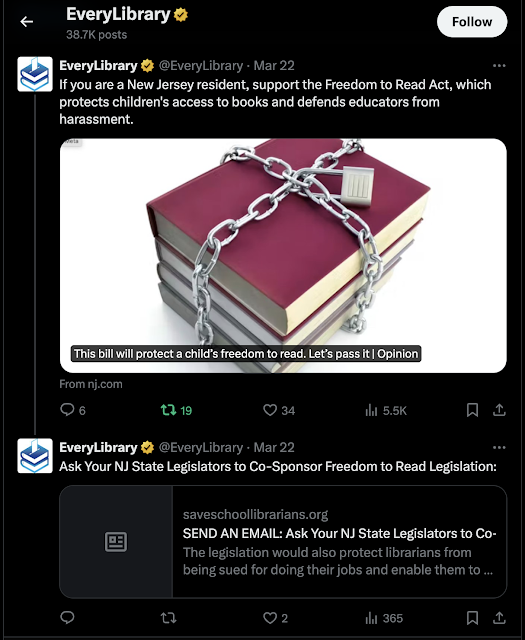

Notice too an astroturfing website created and maintained by ALA to "SEND AN EMAIL: Ask Your NJ State Legislators to Co-Sponsor Freedom to Read Legislation."  See: https://www.saveschoollibrarians.org/njaslbookbans:

Help the New Jersey Association of School Librarians (NJASL) to put an end to book bans in schools and public libraries by contacting your New Jersey Assembly Member and state Senator and asking them to co-sponsor Sen. Zwicker's Freedom to Read bill.  ....  Please join the New Jersey Association of School Librarians (NJASL) and SWEEP NJ to send a message to the Assembly and Senate Leadership that New Jersey should protect the Freedom to Read. 

Do you see what just happened here?  Do you see it?  Think before reading on.

Look at that website again:

https://www.saveschoollibrarians.org/njaslbookbans

Look at that quote again:

Help the New Jersey Association of School Librarians (NJASL) to put an end to book bans in schools and public libraries by contacting your New Jersey Assembly Member and state Senator and asking them to co-sponsor Sen. Zwicker's Freedom to Read bill.  ....  Please join the New Jersey Association of School Librarians (NJASL) and SWEEP NJ to send a message to the Assembly and Senate Leadership that New Jersey should protect the Freedom to Read. 

Look at NJ S2421 2024 again:

4(b): “the commissioner shall consult with the State Librarian and the New Jersey Association of School Librarians….”
The NJASL is to be made by law the drafter of the model policy for school boards.  Yet NJASL is supported directly by Chicago's ALA (therefore by its de facto subgroup EveryLibrary also based in Chicago), the drafter of the legislation.  The legislation was written by ALA, for ALA, and power comes from within the ALA, only delegated to NJASL.  New Jersey families are cut out.  Is there any chance at all that the New Jersey law will not be what the Chicago librarian group wants and New Jersey citizens don't want?  Zero.


ALA even does direct manipulation of the New Jersey legislators themselves!!  At that website it urges people to write directly to their legislators to say the following, even provides a web form to make this easy:

I am writing to ask you to co-sponsor the New Jersey "Freedom to Read" bill, S2421 and A3446, sponsored by Senator Andrew Zwicker, Senator Teresa Ruiz, and Assemblywoman Mitchelle Drulis. It is a comprehensive, affirmative bill that would protect the right to read in public libraries and school libraries across New Jersey. Censorship is on the rise in our state, and the freedom to read is under threat across the country. The time to act is now. Please co-sponsor this important legislation and preserve the right to read for every resident of our state.

At the hearings for this legislation, listen if any of the legislators mention all the emails they got in support of the legislation.  Now you know they are astroturfed by ALA with full knowledge and support of NJASL.  The fix is in.

What we have here is a law Chicago's ALA wants nationwide, here in NJ as S2421, and Chicago's ALA showing NJASL will do exactly what ALA wants, openly supporting NJASL, even putting NJASL directly into the astroturf letter writing website URL www.SaveSchoolLibrarians.org/njaslbookbans, and ALA getting directly involved in astroturfing the public to pressure the legislators (and paying for all the support and infrastructure that goes into designing, building, and maintaining that site), AND ALL TO ENSURE SCHOOL CHILDREN REMAIN EXPOSED TO THE VERY HARM ABOUT WHICH NEW JERSEY PARENTS ARE COMPLAINING AND THAT'S LEGAL TO REMOVE FROM SCHOOL LIBRARIES.

I have warned about this before:


And here is EveryLibrary acting for ALA, and using its power to astroturf as detailed above to push for bad legislation in New Jersey that will harm children and deny parents rights:


The Freedom to Read Act requires NJASL to set model policy for New Jersey school boards.  After watching the NJASL president lie and lie throughout an entire interview, and after seeing ALA directly promoting NJASL in an astroturfed letter writing campaign, it is apparent that the model policy written by NJASL will exactly match the policies of Chicago's ALA, namely, "The American Library Association opposes all attempts to restrict access to library services, materials, and facilities based on the age of library users."  

If New Jersey legislators do not stop this Freedom to Read Act from Chicago becoming law in New Jersey, our children will directly suffer, and there will be nothing any parent can do about it because it will be the law.  There will need to be a massive effort and lawsuit to strike down the law under the First Amendment, the New Jersey Constitution, and other laws.  Let's hope the legislature has the sense to stop it now.  Detailed information about the laws overstepped by the Freedom to Read Act are here: https://worldlibraryassociation.org/right-to-read-act/.

Finally, here is the transcript, now better understood in light of the above:


Steve Adubato:
All right, folks. My colleague, Jacqui Tricarico, joined me down in Atlantic City for the New Jersey Education Association convention, and Jacqui sat down with Ewa Elliot, who is the president of the New Jersey Association of School Librarians, to talk about a whole range of important issues affecting school librarians and students in our public schools who rely on those libraries. Here's Jacqui.

Jacqui Tricarico:
Joining me now is Ewa Dziedzic-Elliot, who is the president of the u- New Jersey Association of School Librarians, has over 10 years experience as a school librarian, um, and is here today at the NJEA Convention. Thank you so much for taking the time to speak with us.

Ewa Dziedzic-Elliot:
Thank you for having me here today.

Jacqui Tricarico:
So, let's describe the Association of School Librarians. What is that in, here in New Jersey?

Ewa Dziedzic-Elliot:
Um, we are NJEA members, um, and, um, what we do is we provide professional development and support for school librarians across the state of New Jersey. Uh, what that means is that, um, if the school district, let's say, is writing new curriculum, or if they are hiring a new librarian and that li- librarian needs additional training, we're able to provide that training, we're, uh, able to provide that professional development, we're able to provide mentorship. Um, but also, in the light of the latest book challenges, we are cr- we have created a task force, and that task force is able to provide resources, uh, to support school districts, school administrators, school board members, and the school librarians across the state of New Jersey.

Jacqui Tricarico:
Well, let's talk a little bit about that. We're hearing that word "book banning," that term a lot now in the media. What does that mean for a school librarian, the role that they play, in terms of book banning, or, or specific issues that community members, parents, caregivers, um, bring up about the books that are being presented on the shelves in the libraries of our st- of our schools?

Ewa Dziedzic-Elliot:
This is actually very complex problem, and I think that at the core of it is something that, um, shows a very negative impact on our librarianship as a profession, um, because we... As school librarians, we have teaching certifications, and on top of that, we have library certifications, so we are dually certified. And here, we have, um, community members coming to our libraries and saying that we don't know what we're doing, and we are specialists in the field. We are trained to provide expertise and proper materials for our school libraries, and this is something that we have to remember.

School librarians' materials are supplementary materials, and they support state standards, so anything and everything that we provide in our libraries is to support already existing policies and curricula and state standards. We d- don't come up with these recommendations and with the- these books out of thin air. If there is a certain book in a library, that, um, book was purchased keeping in mind that we have to provide some level of support for classroom, or for some kind of lesson plan. So it's, it's a well-thought-out process.

Um, when it comes to book banning, it's, again, very, very complex issues, but, um, it's greatly under-reported, and our biggest problem here right now is that a lot of school districts are not following their school policies and are not following the state standards and laws. So the issue is very under-reported. We, as association, receive information from our members, um, that school administrators or school board members come into the library space and make requests to remove something out of fear of potential book challenge. Um, that's sweeping the problem under the rug, so-

Jacqui Tricarico:
Well, yeah, and playing devil's advocate a little bit, what do you say in terms of parents who say let's leave it up to the parents to decide if these books that, you know, are causing these issues, um, or that are coming up in a lot of these school board meetings as books that should be taken off the shelves, leave it up to the parents to make that decision if the kids can have access to them?

Ewa Dziedzic-Elliot:
I would say to those parents, if you are not comfortable for your child to read that, you have the right to do it, but you cannot make this decision for all of the children, because there are children out there who look forward to have these resources in their hands. They really need it. In some cases, um, seeing a protagonist struggling with the same problem that the chil- child or the student is struggling, it might be lifesaving, so I would say to those parents, if you are not comfortable having these conversations with your child, if you are not comfortable with your child to be exposed to certain subjects, you have right to do it, but, um, take care of it with your child. Don't put this on everybody else, because remember, if you are putting that pressure on yours or my child, another parent may do the same to your child. They may put something, um, that is not compliant with your belief system, so it, it's, it works both ways.

Jacqui Tricarico:
It's a, it's a challenging conversation, and, and things, that, so something that we're consistently hearing. Lastly, how important is the role of the school librarian? How important is it for us as a community, for parents, to support the librarians that are in our children's lives as part of their education?

Ewa Dziedzic-Elliot:
So, um, there is a lot of studies. Librarians love data (laughs). We love studies and data. Uh, there is a lot of studies that are showing that having a school librarian actually increases all kinds of state sc- uh s- scores in, in all state standards, um, if they are properly aligned. And what happens is, um, having a school librarian actually helps with literacy more than having early interventions, which basically means that, um, if you're talking about money, if you're talking about hiring someone, um, as a school administrator, you are better off hiring a skilled librarian with proper certifications, who can provide support for your child, for your student, uh, rather than even having, um, certain programs. Um, then on, on top of that, we are providing, um, all kinds of research, um, assistance. Our job changes from grade level to the grade level. Um, elementary school librarian has completely different job description than middle or high school. Elementary school librarian is more like a intervention teacher, um, for library literacy, skill liter- a l- skill reading literacies, and then middle and high school is more college prep oriented.

Um, we are the only people in school buildings who actually work with everyone who knows the curricula and lesson plans across the board. We are prepared, and ready, and trained to work with absolutely any department in the building. I can provide assistance to art teacher. I can provide assistance to science teachers, to math, uh, English, social studies, because I'm trained to do it. We are the only people in the building who can also provide IT s- uh, IT help. So, we are very diverse in that.

Jacqui Tricarico:
Yeah. Ewa, thank you so much for giving us some more insight into the challenges right now facing school librarians and just how important that role is in our children's lives. Thank you so much.

Ewa Dziedzic-Elliot:
Thank you.

Announcer:
One on One with Steve Adubato has been a production of the Caucus Educational Corporation. Funding has been provided by Holy Name, New Jersey Sharing Network, the Russell Berrie Foundation, Valley Bank, PSE&G, The Fidelco Group, the Port Authority of New York and New Jersey, The Healthcare Foundation of New Jersey, and by the New Jersey Education Association. Promotional support provided by the New Jersey Business and Industry Association and by AM970 The Answer.


Source of transcript: 

Wednesday, September 26, 2018

Who Are the Book Banners: Librarians


Who Are the Book Banners?: 

September 23-29 is the ominously and inaccurately named Banned Books Week established by the book-banning American Library Association (ALA) to suggest that book banning is prevalent in America and very scary.

Although the ALA named it Banned Books Week, it acknowledged in the “about” section of the Banned Books Week website that it’s not really about books that have been banned à la Fahrenheit 451 or even asked to be banned. It’s centrally about books that have been challenged, which is a horse of an entirely different and far less dark color. A book is challenged when the appropriateness of it in some context is questioned.

Of course, the book banners at the ALA hope that no one notices the book banning they do through de facto book-banning protocols called Collection Development Policies (CDPs) that coincidentally align with the “progressive” biases of many librarians. (FYI, the field of library science is decidedly not ideologically diverse; it’s dominated by “progressives.”)

....

Parents who object to the inclusion of texts in libraries, sections of libraries, or classrooms due to obscene language, sexuality, or highly controversial messages are not engaging in inappropriate censorship. All educators evaluate curricular materials for objectionable content, including language, sexuality, and controversial themes. The irony is that when librarians and teachers decide not to select a text due to these elements, the choice constitutes an exercise in legitimate text-selection, but when conservative parents engage in it, they are tarred with the label of censor and book banner.

Continue reading "Who Are the Book Banners?" by Laurie Higgins at Illinois Family Institute here.


And let me add that ALA actively censors and blacklists the one means parents and educators have to evaluate school and home reading material for the potential for inappropriate material, namely, Common Sense Media Book Reviews: YALSA Board of Directors Meeting, Intellectual Freedom Committee Report, 29 August 2013.

"Who Are the Book Banners?"

—

URL of this page: 
safelibraries.blogspot.com/2018/09/who-are-book-banners.html


On Twitter:
@ALALibrary @BannedBooksWeek @CommonSense @OIF @ProFamilyIFI


Friday, September 30, 2016

Freedom to Read/Intellectual Freedom Violated at Orland Park Public Library

Dear Orland Park Public Library Board of Trustees,

I have read several letters to the editor in the Orland Park Prairie recently and I have been contacted by members of the Orland Park community and library patrons who accuse the OPPL of censorship and book-banning that seems inconsistent with the OPPL being awarded the 2014 Downs Award by the "iSchool" at the University of Illinois at Champagne-Urbana (an award that the OPPL made a lot of fanfare about in 2015 when Bridget Bittman was still the OPPL's spokesman). 

Today, 8/30/16, the OPPL produced responsive to FOIA requests documentation (see attached) that the book SHUT UP!: The Bizarre War that One Public Library Waged Against the First Amendment has been requested by OPPL patrons to be added to the Library's collection. As you well know, Megan Fox and I co-authored this book, which is a detailed account of years' worth of wrongdoing that was allowed to continue at the OPPL with Mary Weimar as its Director. 

SHUT UP! is currently on the shelves at the Chicago Public Library, the State Library in Springfield, the Tinley Park and Mokena public libraries, and other public libraries in Illinois. It meets all requirements for purchase by public libraries and inclusion in collections and has been reviewed favorably on WorldCat, GoodReads, and Amazon. Additionally, a free copy of SHUT UP! has been offered to the OPPL for donation by more than one individual. Mrs. Fox and myself would, of course, also be happy to gift the OPPL with an autographed copy of our book if the OPPL would accept it for its collection and place it on its shelves as the Chicago Public Library and other libraries have done. This way, members of the Orland Park community would be able to read our book as a first person account of everything that Mary Weimar, Bridget Bittman, and OPPL Trustees such as Diane Jennings chose to do beginning in 2013 to trample the First Amendment rights of the public and discourage public participation in government affairs in Orland Park. 

Andrew Masura -- one of the OPPL staffers whose wrongdoing was highlighted in the book alongside that of Weimar, Bittman, and Jennings -- apparently is one of the OPPL staffers banning/censoring the book from the OPPL's collection (see attached documentation). Should he be allowed to do that? Since Mr. Masura is himself one of the subjects of our book, should Mr. Masura be personally involved in banning/censoring our book from the collection and keeping it off the OPPL's shelves? In my eyes, that's a clear conflict of interests on Mr. Masura's part, as he is the subject of at least one whole chapter in the book that he is now banning. 

Should any of the individuals whose documented wrongdoing is exposed in our book be allowed to ban the book from a library's shelves and prevent the public from reading it, just because they disagree with the book's authors or they are embarrassed that their wrongdoing was the subject of our investigative work? The OPPL is violating its own "Freedom to Read" policies, as said policies prohibit OPPL staff from banning/censoring a book just because staff members at the OPPL do not like a book's authors or agree politically with a book's content. 

Here, we have the Orland Park Public Library, which for several years has claimed that it must allow men to view pornography and masturbate on public computers "because of the First Amendment." The OPPL bragged about winning the 2014 Downs Award for "intellectual freedom," sending Mary Weimar, Nancy Wendt Healy, and Bridget Bittman to the ALA's Midwinter Conference at taxpayer expense in Chicago in January 2015 to pose for a photograph and accept the Downs Award. The University of Illinois faculty and staff made a big production of awarding the OPPL for its "intellection freedom"...but shouldn't that award be revoked for the OPPL's documented act of book-banning and censorship when it comes to the matter at hand? 

"patron accused of viewing child
pornography at public internet station"
Here in 2016, the OPPL is documented to be refusing to carry on its shelves a book about the OPPL itself and about the poor decisions and reprehensible behavior of Orland Park officials such as Police Chief Timothy J. McCarthy and now-Assistant Village Manager Joe LaMargo. The very same people who claim they have to continue allowing lewd behavior in a public building "because of the First Amendment" and who annually participate in the American Library Association's farcical "Banned Books Week" have been caught banning a book that is highly critical of the Orland Park Public Library Board of Trustees, its Director Mary Weimar, the odious law firm Klein Thorpe Jenkins, and corrupt public officials in the Village of Orland Park. 

When public employees ban a book from a library's shelves because the public employees in question do not want people in the community to read that book, that is book-banning and censorship.  The attached documents have Mary Weimar and Andrew Masura busted on book-banning, which in my opinion makes the University of Illinois look incredibly foolish for awarding the OPPL that Downs Award. 

Do any of you involved in this travesty have anything to say for yourselves or wish to comment on this obvious hypocrisy? With Banned Books Week fast approaching, I hope you can appreciate the irony that the 2014 Downs Award-winning library has been caught so clearly engaging in book-banning and abridging the very same intellectual freedom and "Freedom to Read" that the Downs Award is supposed to celebrate. How shameful!

I petition the Orland Park Public Library Board of Trustees to reconsider its stance on this book-banning and rectify this matter. Keeping a book you don't like off your shelves when library cardholders have asked you to carry the book is grotesquely hypocritical for a public library that markets itself as "award-winning" in the realm of "intellectual freedom."  

Kevin DuJan


******************************************************************
MEDIA CREDENTIAL
******************************************************************
Story Time Digital Media is a digital news service in electronic format presenting video content and in-depth articles to the public (free of charge) as well as newsletters distributed to the public on a regular rolling basis. Our focus is on topics pertaining to the welfare and safety of children and being a watchdog exposing government abuse, graft, and corruption in the state of Illinois and nationally. We are experts on government transparency laws, the Freedom of Information Act, the Open Meetings Act, the Illinois Local Library Act, and the First Amendment Right to Petition our government for change and redress of grievances. Read our new book SHUT UP! The Bizarre War that One Public Library Waged Against the First Amendment, about the pattern of abuse and intimidation that the Orland Park Public Library engaged in to silence and censor its critics and attempt to chill the Free Speech and other protected activity of investigative reporters who uncovered unreported crimes happening in what had become a dangerous place for children. SHUT UP! is available now on Amazon.com and has been targeted for suppression, censoring, and banning by members of the American Library Association who do not want people to know the truth about the ALA or its Office for Intellectual Freedom. 

Subscribe to our video channel to view news reels, cartoons, and other motion picture news clips that we produce to educate the public on the affairs of local government and elected officials' mistreatment of the public. "Like" us on Facebook or more information on who we are and the stories we cover and click below for our social media presence:


https://www.facebook.com/StoryTimeDigitalMedia

NOTE: Story Time Digital Media is recognized in Illinois as both media and non-profit under the definitions in Section 2 (c-10) ("Commercial purpose"), Section 2 (f) ("News media"), Section 2 (g) ("Recurrent requester"), and Section 2 (h) ("Voluminous request") of the Freedom of Information Act, for the purposes of being exempt to the provisions of Section 3.1 (Requests for commercial purposes), Section 3.2 (Recurrent requesters), Section 3.6 (Voluminous requests), and Section 6 (Authority to charge fees). All documents received by Story Time Digital Media are intended for research involved in articles, newsletters, news reels, essays, and books written for public awareness, education, and instruction.


Elected Library Trustee Diane Jennings admits to making gay slurs.


VIOLATION of Freedom to Read/Intellectual Freedom Policy at Orland Park Public Library

Story Time Tue, Aug 30, 2016 at 6:00 PM


To: Joanna Leafblad , "nhealy@orlandparklibrary.org" , "Diane I. Jennings" , Christian Barcelona , Elan Kleis , "Catherine M. Lebert" , "Denis P. Ryan" , Mary Adamowski , "Mary K. Weimar"


Cc: Bill Jones , Heather Warthen , Joe Coughlin , "Zumbach, Lauren" , cashwill@illinois.edu, ischool-dean@illinois.edu, weech@illinois.edu, Joseph La Margo , dmclaughlin@orland-park.il.us, LMcQueary@orland-park.il.us


NOTES ADDED BY DAN:

University of Illinois gave that "Intellectual Freedom" award to OPPL, on the urging of ALA's Office for Intellectual Freedom.  Remember, the award was granted for passing a policy allowing child pornography viewing.  The policy was passed during a holiday in violation of the law as determined by the Illinois Attorney General.  Adequate notice was not given to the public, as required by law.  When the public did attend—in part because of me noticing the announcement in the Chicago Tribune the day before—the child porn whistleblower tried to speak up about meeting during a legal holiday but was waved away and silenced.

What a laughingstock, another Banned Book Week hoax/hypocrisy.  Hoax that Banned Books Week is, the University of Illinois is a clear patsy for ALA and is all the more laughable therefor.  Library schools teach ALA propaganda.  No wonder they get ALA accredited.

Note that Kevin DuJan attended the ALA Midwinter meeting where the award was presented precisely to see OPPL bragging about the "Intellectual Freedom" award at a ceremony open to the Midwinter meeting's attendees, of which Mr. DuJan was one, but ALA found one reason after the next to block Mr. DuJan from attending the meeting that was literally about him.  Censorship runs deep at ALA, even to the point of denying entrance to a man who paid precisely to attend this meeting that was about him.  I know he paid for it because I was one who paid his entrance fee.

Here is a picture of ALA bragging about the library winning this award, that ALA recommended, as if violating the law (sunshine law and state library and criminal laws) and allowing/covering up child pornography is "intellectual freedom" or "simply trying to do their job" or "remain[ing] steadfast in its support for the freedom to read":


Source: "Freedom to Read Foundation News," by Freedom to Read Foundation, American Library Association, Vol. 40, No. 1, March 2015, pp. 6-7.

So ALA arranged for the award, touted the award, blocked the child porn whistleblower from attending the public meeting, ignored the Illinois Attorney General finding the meeting to be illegal, and all to equate child pornography viewing with the "freedom to read" and "intellectual freedom," all to protect ALA's policy as applied in public libraries, this time in the ALA suburb of Orland Park.

The award was literally for an illegal act that in Illinois is a crime and it was officially declared a crime.  This is the award-winning library that is blocking access to the book about the library's support for child pornography viewing with the guidance of ALA, the creator of the Banned Books Week hoax.  This is the kind of banned book ALA will never track and never announce.

By the way, all this is going in a case where the library still makes child pornography available to the public and still follows ALA directives to destroy the evidence.  Further, ALA is involved in allowing, covering up, and supporting the use of homophobia, including ordering librarians to defy records retention laws and destroy the evidence of homophobia.

Librarians are so keen to keep people from reading the book that they will even go on Amazon and leave fake negative reviews to tank sales, even if that violates the code of conduct at the library schools they attend.

Yet the book has already had the salutary effect of forcing the American Library Association to stop facilitating child pornography in public libraries are decades of doing so.

A simple look at the library's own policy shows it is knowingly committing censorship and book banning under the circumstances:
Collection Development Policy 
Introduction 
The Orland Park Public Library Board of Trustees supports the Library Bill of Rights and the American Library Association’s Freedom to Read and Freedom to View Statements. (See Section A of Policy Manual) 
It is the goal of the Orland Park Public Library to meet the informational, educational, cultural, inspirational, and recreational needs of the residents of Orland Park. The library recognizes the needs of the community are of primary importance in selection. This is a diverse community and each individual’s needs will be considered in conjunction with the needs of the community as a whole. An effort is made to include information representing all sides of controversial issues as such material becomes available. The criteria for the selection of controversial materials are the same as for any other materials.
.... 
Objectives in Materials Selections 
The general objectives in materials selection are to carry out the library’s goals of providing the community with a variety of formats to meet their informational, educational, cultural, inspirational and recreational needs. 
Here two published letters to the editor of the Orland Park Prairie, as discussed above, reprinted as fair use, and as referenced in the 8/30/2016 FOIA response from OPPL cited by Mr. DuJan:


OPPL Hypocritical to Ban New Book

Orland Park Prairie
August 27, 2016

I was troubled to read an article recently that alleged that the Orland Park Public Library was banning a new book that is critical of the library. To me, this sounds like censorship and also a violation of the library’s own intellectual freedom policy. I think it also goes against the spirit of Banned Books Week, which is an event that the OPPL participates in annually.

The book in question is called “SHUT UP!: The Bizarre War that One Public Library Waged Against the First Amendment.” The article I read stated that several requests were made from Orland Park residents asking the library to carry this book, and I am personally aware of at least one library cardholder who has persistently asked the library to carry the book. The OPPL has refused to allow the book into its collection, despite offers to donate a copy of the book to the library and demonstrated community interest in the book.

Since the book is carried by the Chicago Public Library and other libraries in the area, such as Tinley Park and Bellwood, I am left to assume that the staff at the OPPL has decided to engage in what I feel is viewpoint discrimination. “SHUT UP!” is a primary source account what transpired in our library in recent years, including reprints of incident reports and legal documents involved in complaints made against the library and its staff. The authors of “SHUT UP!” won several high-profile determinations against the library by the Attorney General and received court settlements.

The residents of Orland Park deserve the opportunity to read this account of what went on in our library that led to the squandering of money on legal battles. In my opinion, library staff should not be able to ban a book from its shelves because they do not like the contents of the book or because it might embarrass them. In keeping “SHUT UP!” off its shelves, the OPPL feels like it is trying to keep the truth from taxpayers about what’s been going on in there.

Jean Morrow

Orland Park resident


OPPL Silencing Its Critics by Banning Book From Shelves

Orland Park Prairie
August 27, 2016

Although the Orland Park Public Library Director Mary Weimar accepted the 2014 Intellectual Freedom (of censorship) Award, she reserves the right to ban materials with a differing opinion.

I was informed by Andrew Masura, head of Adult Services, that “Shut Up! The Bizarre War that One Public Library Waged Against the First Amendment” “does not meet the standards for selection, as defined in the policy.” The brief “Standards for Selection” policy include this sentence, “No library material shall be excluded because of the race, nationality, political or social views of the creator.”

Despite requests from patrons that the book be carried and the Library being offered a free copy for the community to read, the OPPL has chosen again to silence critics and cover up [indecent behaviors].

I see “Shut Up!” as a how-to book in dealing with runaway government entities.  Megan Fox and Kevin DuJan thoroughly document two years of verbal and physical attacks by library staff, trustees, and their family members since an Oct. 8, 2013, library visit to print out homeschooling materials revealed shocking behaviors.

We have a runaway board. Another example is lavish spending for Robin Wagner and Jason Rock to attend a San Francisco conference amounting to $3,655.18, plus salaries for four days. Both left their positions, assistant director and virtual services manager, in 2-3 months. (Safe Libraries, May 9, 2016)

I have been attending Orland Library Board meetings 2 1/2 years but learned so much more from the pages of “Shut Up!” Fox and DuJan are dedicated and persistent in their fight for citizens’ rights in an era of Big Government.

I do expect adherence to Village ordinances and State statutes in public buildings, merely common decency. I bought three books, keeping one for myself to highlight and make notes. Residents, we need to step up and speak out. Let’s put the “public” back into Orland Park Public Library!

Nanc Junker

Orland Park


Lastly, see also:


—
URL of this page:
safelibraries.blogspot.com/2016/08/freedom-to-read-hoax.html

On Twitter:
@ALALibrary @HillBuzz @iSchoolUI @MeganFoxWriter @OPPrairie @OrlandPkLibrary @VillageOrlandPk

Tuesday, October 20, 2009

But... Monkey in Cheshire, CT; Selection Policy Needs Amendment; Library Director Ramona Harten Says Her Own Authority Trumps All

There's a "But... Monkey" in the Cheshire Public Library in Cheshire, CT, and she has declared that her own authority trumps residents, the library board, even the town government itself: "Library Director Ramona Harten said Monday she will listen to what the residents have to say. But, ultimately, neither the library board nor anyone else in town government has the authority to overturn the director’s decision, she said."

Source: "Residents to Have Say on Petit Book," by Luther Turmelle, New Haven Register, 20 October 20 2009, emphasis mine. It should have been called "Residents to Have NO Say on Petit Book."

Thank you, radio host Laura Ingraham, for the fair use of the But... Monkey concept and image. Ms. Ingraham's concept of a But... Monkey is someone who says something good initially, then there's a "but," then the person says and means nearly the exact opposite. In Cheshire, CT, the library director says she will listen to residents, and that is good, then there's a "but," then she says she will not listen to them, the library board, or even the town government. That is bad. The truth is the exact opposite.

Who is the real power in the town? The residents are the real power. At some time in the past, they organized a public library. That organization was likely recorded in some legal document such as a statute, an ordinance, a charter, what have you. That library was most likely established for a certain purpose, and the purpose was to be carried out by a certain means that likely has nothing to do with a single library director overruling an entire town and its government.

Look at the history of the library: "Community support for the Cheshire Public Library began in 1888 when a group of concerned citizens gathered together to form the Village Improvement Society." "The assets of the Library Association were turned over to the town and a citizens’ advisory Library Board was appointed by the Board of Selectmen." There's nothing there about the library director outranking those citizens or those boards.

"In 1978, the Library went 'on-line' with four other towns, forming the first automated Library consortium in the state of Connecticut." That implies Ramona Harten can control several communities all at once.

Consider this:

“This is not about my personal judgment about whether I like this book or not,” Harten said. “This is about me doing the job that I’m paid to do, and the final decision lies with the library director. There are probably a lot of books in our collection that some people may find offensive, but we leave it up to our patrons to decide whether they want to read them or not.”


If the statement in bold sounds like hubris, it is not. Factually, the library director is correct. The official book selection policies and practices say, "Although the staff participates in the selection process, the Library Director is ultimately responsible for the selection of materials." Despite the history of the library, despite founding documents, despite common sense, the current library director is, by policy, the sole arbiter of what goes. Does anybody see anything wrong here? Might there be a need to amend the policy?

One policy consideration is a selection criterion called, "evident popularity." The book is about the brutal murder of the entire family of a man who lives in the town. Hundreds of people are asking that the library in this particular town not stock this particular book while the victim is still living in the town. I would call that "evident UNpopularity."

"In the event of an objection to any material, ... [t]he Director will apply the selection criteria to the material in question," says the policy, but it appears that may not be happening. Noncompliance may be another reason to amend the library's policy.

What does the American Library Association [ALA] say about selection policy? Certainly ALA guidance is important because the library holds ALA policy to be paramount (Section III). In the ALA's "Workbook for Selection Policy Writing," apparently written for public school libraries, more than a single person is involved in selection policy decisions, and the final decision maker has authority delegated to her—she is not the ultimate authority:

In most states, the locally elected or appointed school board, by law, has broad powers and responsibilities in the selection of instructional materials. This authority should be delegated by policy to appropriate professionals for day-to-day exercise.

While selection of materials involves many people, including administrators, supervisors, teachers, library media specialists, students, and even community residents, the responsibility for coordinating and recommending the selection and purchase of library media materials should rest with the certificated library media personnel. Responsibility for coordinating the selection and purchase of textbooks and other classroom materials may rest with appropriate department chairpersons or with textbook or media evaluation committees.


Ramona Harten did say, "This is about me doing the job that I’m paid to do." That indicates she is answerable to someone or some entity. Perhaps that person or entity would like to consider what the ALA has said about selection policy decisions and rewrite the Cheshire Public Library policy to be in line with the ALA policy held so high in Section III. Compliance with reasonable ALA policy may be a third reason to change the library's existing policy.

In order to stock that first library, Mary Baldwin and her friend Mary Dickerman spent many hours collecting books. In 1892, a Library Association formed, with Mary Baldwin volunteering to serve as Librarian, a post she would hold for the next 29 years. .... Two years later the Library moved to a house owned by Mary Baldwin’s father, presently known as the Belknap House. .... In late summer 1996, the new Library opened. .... A larger programming room (named for Mary Baldwin) and sophisticated telecommunications links were among the improvements. Source: "A History of the Cheshire Public Library."


Compare Mary Baldwin to library director Ramona Harten: "This is about me doing the job that I’m paid to do, and the final decision lies with the library director."

First Library Director Mary Baldwin. Present Library Director Ramona Harten. What a difference.

The residents, library board, and town government of Cheshire, CT, ought to ensure the library policy is amended to be more compliant with existing ALA guidelines, local control, and common sense. Several justifications have been provided for amendment. Certainly there are more.

"Cheshire Public Library has not lost sight of its mission...." Time will tell if that is true.

.